With less than 48 hours until the FOMC decision: How long can the dollar's calm above 101 last?
2026-07-28 10:22:03
On Tuesday (July 28) during Asian trading hours, the US dollar index fluctuated narrowly, currently trading around 101.50. The market remains cautious ahead of the FOMC decision, with the question of whether the Fed's tradition of "no surprises" will continue to be answered this week. The Fed typically signals its interest rate actions in advance and then executes them as planned. This week will provide the clearest evidence yet whether Fed Chairman Warsh is ending the era of a "no surprises" Fed. The market has already priced in a significant probability of a Fed rate hike after this week's two-day meeting. If the Federal Open Market Committee does raise rates, it will herald a new era—reduced central bank predictability, acceptance of greater volatility and surprises in exchange for greater policy flexibility. 
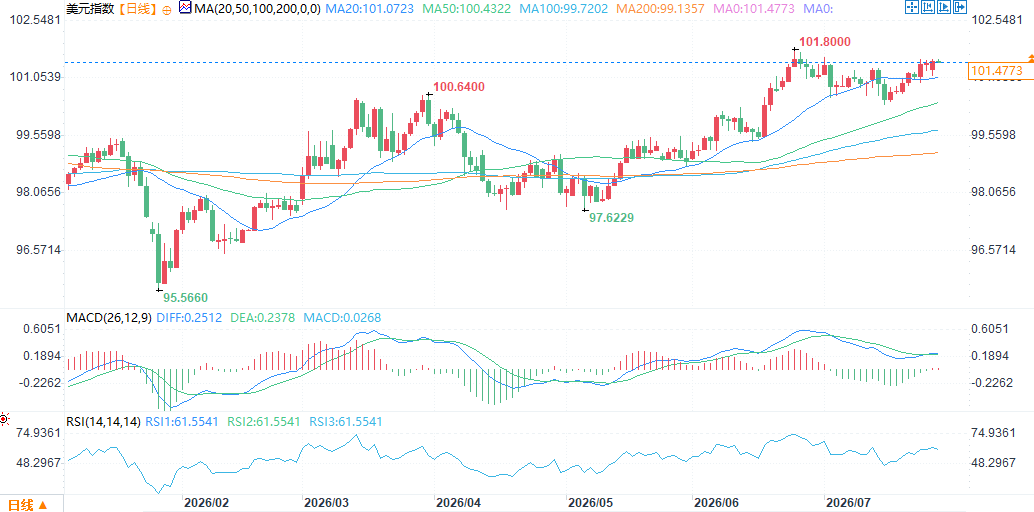 (US Dollar Index Daily Chart, Source: FX678) At 10:20 AM Beijing time on July 28, the US Dollar Index was at 101.49.
Escalating tensions in the Persian Gulf are reshaping market expectations.
In its final public communications before the Fed entered its pre-meeting blackout period, the signal was that the FOMC would keep interest rates unchanged at this meeting, but would leave open the possibility of a rate hike if inflation did not decline in the future. Subsequently, escalating hostilities in the Persian Gulf pushed up oil prices and long-term bond yields, causing traders to increase their bets on a rate hike—currently, the CME FedWatch tool shows a probability of about 34%, up from 16% a week ago. Warsh often talks about not predicting the outcome of policy meetings and that officials should remain open-minded, deciding on the best policy through “family debate.” This means the range of potential action (or inaction) is wider than was the norm during his predecessors’ tenures. However, the increased policy flexibility also carries the risk of appearing “wavering” and overreacting to the latest headlines. If Fed officials were more patient on a rate hike 10 days ago, should a $10 swing in oil prices (most of which has since reversed) really shake those plans? Warsh will face pressure at Wednesday’s post-meeting press conference to explain his rationale for action or inaction more clearly than he has so far in his public comments.A former Federal Reserve economist discusses the "surprise".
“Since the market has priced in about a one-in-three chance of this meeting, there will be some surprises whatever the FOMC does,” said Bill English, a former senior economist at the Federal Reserve and now a professor at Yale School of Management. “They should do the right thing based on the information they have. I don’t think there’s anything wrong with the committee surprising the market at a particular meeting—that should happen occasionally. But I do think the lack of explanation behind actions (or inactions) is a problem, because it can lead to unexpected market reactions.” Former Fed Chairman Ben Bernanke learned the hard way about surprising the market during the “taper tantrum” in May 2013—when he indicated that the Fed might soon begin to slow quantitative easing, catching the bond market off guard and triggering a sell-off that pushed up long-term interest rates at a time of fragile economic growth. This event influenced then-Governor Jerome Powell, who said at a policy meeting in September 2015 that he did not want to raise rates until market expectations were “well above 50%,” adding, “In my perfect world, it would be 100%.” “Raising rates when the market doesn’t expect it is very unwise,” Powell said.The lessons learned from the European Central Bank
It's worth noting that the European Central Bank kept interest rates unchanged last week, with Lagarde arguing that policymakers shouldn't overinterpret the rapid fluctuations in oil prices while the conflict remains unresolved. Lagarde stated, "We've seen such sudden changes—occurring within days—not only at the level of the conflict, but also in their impact on energy prices." This cautious stance provides an interesting contrast to the current predicament faced by the Federal Reserve.Unexpected interest rate hikes in history
In recent decades, the Federal Reserve has most frequently surprised markets when it aims to send deliberate shock signals through the system. During the 2008 global financial crisis and the early stages of the 2020 pandemic, multiple emergency meetings resulted in massive interest rate cuts, designed to instill confidence in the market that the Fed would not stand idly by and allow the economy to collapse. Conversely, the massive rate hikes that began in June 2022 aimed to convey the Fed's determination to curb inflation. But these actions were taken in extreme circumstances—not merely routine adjustments to recalibrate interest rates based on economic conditions, but moments where surprise itself was part of the objective. Even in these cases, the actions were not entirely unexpected on the day of the meeting—in June 2022, news reports foreshadowed the decision to raise rates by 75 basis points at the last minute. Two days after the collapse of Lehman Brothers in September 2008, the FOMC chose not to adjust interest rates. Many officials spoke of waiting to see how the event spread through the economy before taking action. Then-St. Louis Fed President James Bullard stated, "In this uncertain environment, I think it would be unwise to react too hastily to a rapidly changing situation."The US dollar index faces a directional choice.
The US dollar index is currently fluctuating around 101, with the market pricing in only 34% of a rate hike this week. This means that if the FOMC unexpectedly raises rates, the dollar index could quickly break through the resistance range of 101.50-101.80, heading towards 102.00 or even higher. The front end of the US Treasury yield curve will be the first reaction channel—if the market is forced to reprice the Fed's reaction function, the 2-year Treasury yield could jump, directly pushing up the dollar. Conversely, if the Fed holds rates steady but its statement leans hawkish (leaving the option of a September rate hike), the dollar index could also find support. However, if Warsh fails to clearly explain the logic behind the action or inaction, the market may experience a "disorderly reaction"—the dollar could fluctuate wildly in both directions due to uncertainty. For traders, this FOMC meeting is no longer a "known event," but rather a true "risk test" for the dollar index at the 101 level.This week will examine the extent of the "break" between the Walsh and Powell precedents.
This week will provide some evidence of the extent to which Warsh has broken with Powell's precedent. Powell made it clear in September 2015 that "raising rates when the market doesn't expect it is very unwise"—an idea that shaped the Fed's long-standing policy model of "advance communication and on-plan execution." However, Warsh's governance style appears to be challenging this tradition. He prefers to remain open-minded and allow "family debate" to determine policy direction—meaning the outcome of this FOMC meeting is more uncertain than ever. The market's expectation of a rate hike rising from 16% to 34% is itself a challenge to the "no surprises" tradition. Regardless of whether the final result is a rate hike or no change, Warsh will need to clearly explain the underlying logic after the meeting. If he fails to do so—or if the rate hike decision does surprise the market—it could mark a fundamental shift in the Fed's policy communication paradigm. For traders, this means future FOMC meetings may no longer be a "known event" but a genuine "risk event." (US Dollar Index Daily Chart, Source: FX678) At 10:20 AM Beijing time on July 28, the US Dollar Index was at 101.49.
- Risk Warning and Disclaimer
- The market involves risk, and trading may not be suitable for all investors. This article is for reference only and does not constitute personal investment advice, nor does it take into account certain users’ specific investment objectives, financial situation, or other needs. Any investment decisions made based on this information are at your own risk.