Markets remained cautious ahead of the Fed's decision, with the dollar index fluctuating at high levels.
2026-07-28 14:16:05
The US dollar index (DXY) retreated during Asian trading on Tuesday, currently trading around 101.50 after three consecutive days of gains. The dollar's upward momentum temporarily slowed as investors reduced risk ahead of the upcoming Federal Reserve policy decision. The Fed's policy meeting is the focus of global markets this week. The market widely expects the Fed to maintain current interest rates, but investors are clearly divided on the future policy direction. According to market interest rate tools, the probability of a rate hike in July is close to 38%, a level rarely seen so close to the policy meeting, reflecting significant uncertainty in the market's assessment of US inflationary pressures and the policy path.  Some institutions believe that the Federal Reserve may strengthen its anti-inflation stance by raising interest rates to boost market confidence in restoring its price stability goal. Meanwhile, market expectations for at least a 25 basis point rate hike in September remain high, at approximately 81%. The Fed's future interest rate path remains the core driver of the dollar's performance, and high interest rate expectations continue to limit the dollar's significant downside. The dollar's recent performance has also been influenced by changes in global risk factors. The US has stated that it is working to ease tensions in the Middle East through communication channels and that related discussions have made positive progress. The US previously suspended related actions for 13 consecutive nights, and there has been no further escalation for several days. However, uncertainty remains regarding these diplomatic developments. Iran has stated that there are currently no direct negotiations with the US, and communication is only maintained through Oman regarding future arrangements in the Strait of Hormuz. Therefore, the market believes that the current improvement in the situation is more of a temporary de-escalation than a complete removal of risk. Changes in the energy market have become one of the important factors affecting the dollar. As expectations of easing tensions rise, international oil prices have fallen significantly, reducing market concerns about energy costs driving a renewed rise in global inflation and reducing some investors' bets on the Fed continuing to tighten policy. The decline in oil prices eased inflationary pressures, putting short-term pressure on the US dollar, but the interest rate advantage still provides a bottom support for the dollar. From a macro perspective, the dollar is currently supported by the resilience of the US economy and relatively high interest rates. Although the market is beginning to focus on the risk of slowing economic growth, the relatively stable US economic performance still makes the dollar attractive. The market focus will be on the Federal Reserve's policy statement and post-meeting remarks. If the Fed releases a more hawkish signal, the market may further increase expectations for future interest rate hikes, pushing the dollar index higher; if the policy stance is more dovish, the recent gains in the dollar may face correction. In addition, investors will also pay attention to subsequent US economic data, including inflation indicators, employment market performance, and consumer spending. These data will determine the market's judgment on the timing of the Fed's policy shift and affect the medium-term trend of the dollar. From a daily chart perspective, the dollar index has entered a consolidation phase after a recent rebound, currently trading around 101.50. The overall structure remains bullish, with resistance at the 102.00 area; a break above this level could lead to a further test of the 102.50 area. Support is initially seen at the 101.00 area; a break below this level could lead to a pullback to around 100.50. In terms of technical momentum, the US dollar had previously risen rapidly, and there is short-term profit-taking pressure, but the trend has not yet shown clear signs of reversal. Looking at the 4-hour chart, the US dollar index has entered a period of high-level consolidation after continuous gains, with short-term momentum cooling somewhat. If the price can hold the support zone of 101.00-101.20 and break through the resistance at 102.00, the rebound may continue; if it breaks below key support, it may enter a deeper correction phase. Technical indicators show that short-term buying power has weakened, and the market is awaiting new directional guidance from the Federal Reserve's decision.
 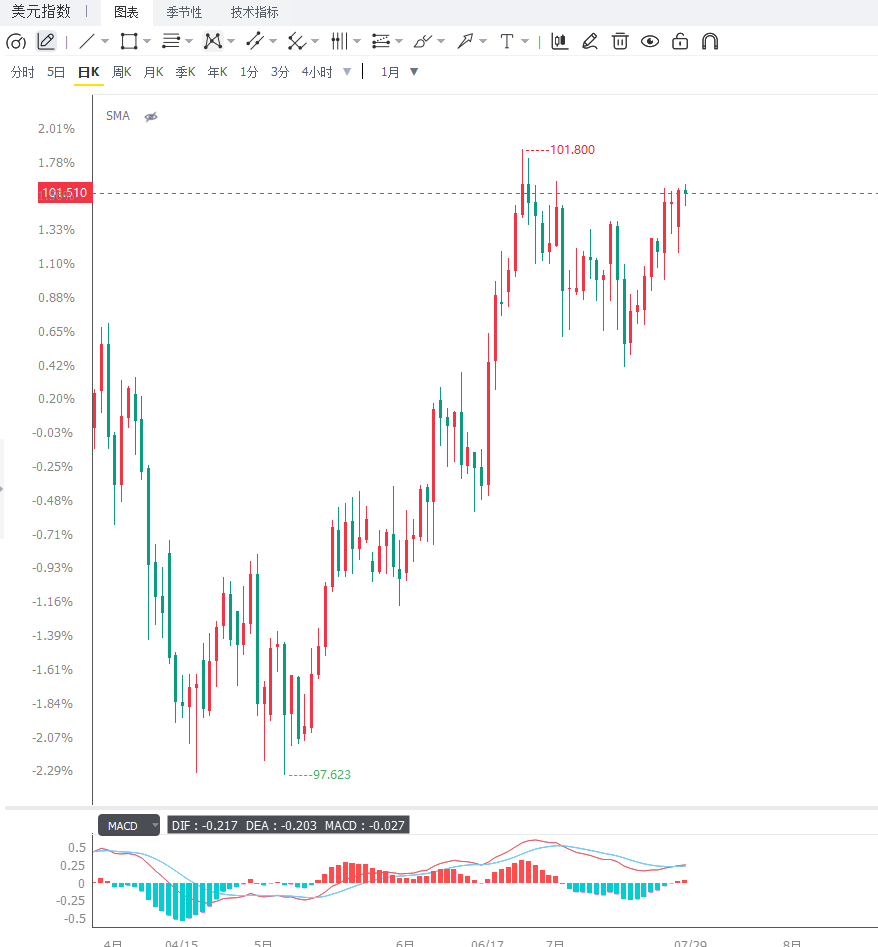 Editor's Summary: The US dollar index is currently in a phase dominated by policy expectations, and the outcome of the Federal Reserve meeting will determine its short-term direction. Although the easing of tensions in the Middle East has driven down oil prices, reducing inflationary pressures and weakening some of the safe-haven demand for the dollar, the US interest rate advantage remains a key factor supporting the dollar. In the short term, the dollar's movement will revolve around the interplay between "high interest rate expectations" and "expectations of easing inflation." If the Fed releases hawkish signals, the dollar may retest its highs; if its policy stance is cautious, the dollar may experience a period of pullback. The 101.00-102.00 area will be a key trading range for the market in the near term.
Some institutions believe that the Federal Reserve may strengthen its anti-inflation stance by raising interest rates to boost market confidence in restoring its price stability goal. Meanwhile, market expectations for at least a 25 basis point rate hike in September remain high, at approximately 81%. The Fed's future interest rate path remains the core driver of the dollar's performance, and high interest rate expectations continue to limit the dollar's significant downside. The dollar's recent performance has also been influenced by changes in global risk factors. The US has stated that it is working to ease tensions in the Middle East through communication channels and that related discussions have made positive progress. The US previously suspended related actions for 13 consecutive nights, and there has been no further escalation for several days. However, uncertainty remains regarding these diplomatic developments. Iran has stated that there are currently no direct negotiations with the US, and communication is only maintained through Oman regarding future arrangements in the Strait of Hormuz. Therefore, the market believes that the current improvement in the situation is more of a temporary de-escalation than a complete removal of risk. Changes in the energy market have become one of the important factors affecting the dollar. As expectations of easing tensions rise, international oil prices have fallen significantly, reducing market concerns about energy costs driving a renewed rise in global inflation and reducing some investors' bets on the Fed continuing to tighten policy. The decline in oil prices eased inflationary pressures, putting short-term pressure on the US dollar, but the interest rate advantage still provides a bottom support for the dollar. From a macro perspective, the dollar is currently supported by the resilience of the US economy and relatively high interest rates. Although the market is beginning to focus on the risk of slowing economic growth, the relatively stable US economic performance still makes the dollar attractive. The market focus will be on the Federal Reserve's policy statement and post-meeting remarks. If the Fed releases a more hawkish signal, the market may further increase expectations for future interest rate hikes, pushing the dollar index higher; if the policy stance is more dovish, the recent gains in the dollar may face correction. In addition, investors will also pay attention to subsequent US economic data, including inflation indicators, employment market performance, and consumer spending. These data will determine the market's judgment on the timing of the Fed's policy shift and affect the medium-term trend of the dollar. From a daily chart perspective, the dollar index has entered a consolidation phase after a recent rebound, currently trading around 101.50. The overall structure remains bullish, with resistance at the 102.00 area; a break above this level could lead to a further test of the 102.50 area. Support is initially seen at the 101.00 area; a break below this level could lead to a pullback to around 100.50. In terms of technical momentum, the US dollar had previously risen rapidly, and there is short-term profit-taking pressure, but the trend has not yet shown clear signs of reversal. Looking at the 4-hour chart, the US dollar index has entered a period of high-level consolidation after continuous gains, with short-term momentum cooling somewhat. If the price can hold the support zone of 101.00-101.20 and break through the resistance at 102.00, the rebound may continue; if it breaks below key support, it may enter a deeper correction phase. Technical indicators show that short-term buying power has weakened, and the market is awaiting new directional guidance from the Federal Reserve's decision. Editor's Summary: The US dollar index is currently in a phase dominated by policy expectations, and the outcome of the Federal Reserve meeting will determine its short-term direction. Although the easing of tensions in the Middle East has driven down oil prices, reducing inflationary pressures and weakening some of the safe-haven demand for the dollar, the US interest rate advantage remains a key factor supporting the dollar. In the short term, the dollar's movement will revolve around the interplay between "high interest rate expectations" and "expectations of easing inflation." If the Fed releases hawkish signals, the dollar may retest its highs; if its policy stance is cautious, the dollar may experience a period of pullback. The 101.00-102.00 area will be a key trading range for the market in the near term.
- Risk Warning and Disclaimer
- The market involves risk, and trading may not be suitable for all investors. This article is for reference only and does not constitute personal investment advice, nor does it take into account certain users’ specific investment objectives, financial situation, or other needs. Any investment decisions made based on this information are at your own risk.