Oil prices fell while gold prices didn't rise; US Treasury bonds and AI stocks suffered double blows, and gold's resilience stemmed from its safe-haven properties.
2026-07-28 16:24:03
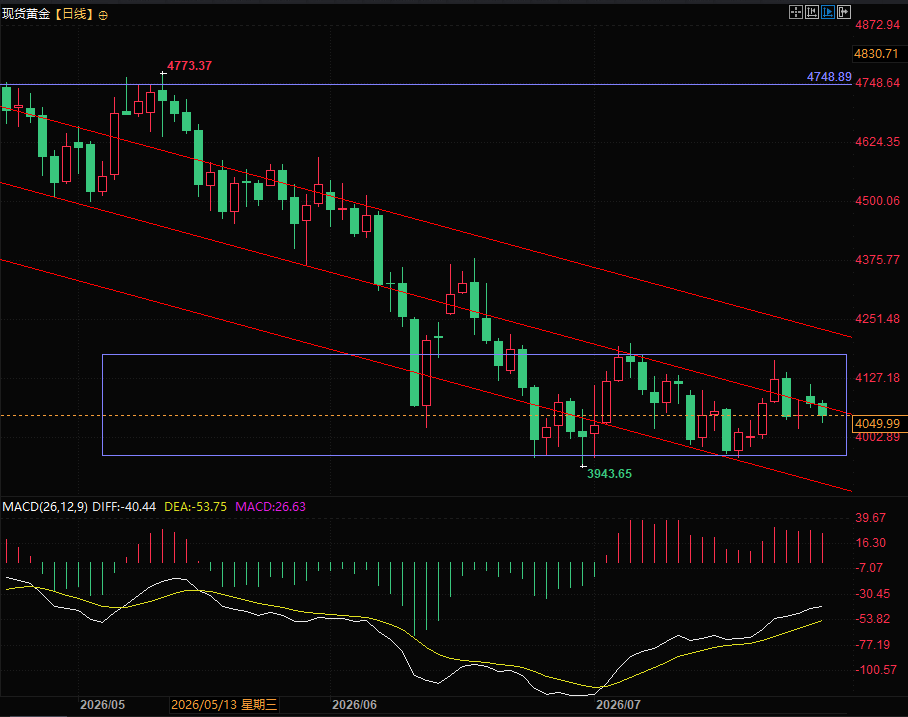
On Tuesday (July 28), during the Asian and European sessions, the ceasefire between the US and Iran was extended again, causing a sharp drop in oil prices. However, gold prices did not see a significant increase, currently trading around 4050, down 0.65%. Although there is a temporary ceasefire, neither side has made any significant concessions, and the navigation conditions of the two energy straits have not improved significantly. Meanwhile, the US's accelerated issuance of bonds and continued investment in AI are pushing up US Treasury yields, suppressing long-term assets. Gold and technology stocks have generally retreated, but this time the gold pullback is not as severe as that of technology stocks, mainly because technology stocks have other factors contributing to their decline. 
 (Spot gold daily chart, source: FX678)
The situation in the Strait of Hormuz and the Red Sea is impacting gold prices from two directions.
The Strait of Hormuz carries nearly one-third of the world's seaborne crude oil, while the Red Sea is a crucial energy trade route between Eurasia. The safety of these two waterways directly determines crude oil supply expectations, establishing a core transmission link between "geopolitical conflict—oil prices—inflation expectations—Federal Reserve monetary policy—gold prices." Recently, regional tensions have remained high: Iranian authorities have repeatedly intercepted ships deviating from official routes and shut down their positioning systems while transiting the Strait of Hormuz, leading to frequent navigational frictions; the US-Iran standoff continues to escalate, with both sides implementing maritime blockades. Trump has signaled, on the one hand, that he has initiated diplomatic negotiations with Iran through mediation by Oman and Qatar, suspending military strikes to allow a window of opportunity for negotiations; on the other hand, he has clearly warned that strong military action will be taken if negotiations break down. Iran's attitude has been inconsistent, stating that negotiations have not yet begun and that the Strait remains under control. Simultaneously, risks are spreading in the Red Sea, with Houthi attacks on shipping and Saudi oil facilities increasing navigational risks. Many very large crude carriers (VLCCs) are detouring, diverting to Egypt's Siddiqr port to pick up Saudi crude oil, resulting in a significant decline in tanker traffic at Saudi Red Sea ports. In short, Middle East conflicts do not directly equate to rising gold prices. Monetary policy expectations driven by oil prices are the most crucial intermediary variable affecting gold prices through geopolitical events, while safe-haven sentiment is only a secondary disturbance.US fiscal debt pressure: Expansion in US Treasury supply distorts the yield curve, constituting a long-term underlying variable for gold prices.
Goldman Sachs predicts that the US Treasury will increase its third-quarter marketable debt issuance to $827 billion, significantly higher than the previous estimate of $671 billion. In the short term, the Treasury will maintain the current size of its coupon bond auctions, resulting in a substantial increase in net short-term Treasury supply to $534 billion, and plans to increase the issuance of 2-7 year bonds starting in May 2027. Coupled with the current administration's continued expansion of defense spending, US fiscal spending remains rigid, and debt rollover pressure continues to rise. The debt issue has a dual impact on gold prices: in the short term, the large-scale issuance of Treasury bonds exacerbates the oversupply of US Treasury bonds, pushing up US Treasury yields and real interest rates, suppressing gold valuations; if market demand is insufficient, bond volatility will rise, amplifying the risk on the denominator side of global assets. In the long term, the continuously expanding federal debt is eroding the credibility of the US dollar. Continued market skepticism about the sustainability of US fiscal policy is driving global central banks to continuously increase their gold holdings to diversify reserve risks, providing medium- to long-term support for gold prices. Key areas to watch include: adjustments to the Treasury's bond issuance structure, changes in the term premium of long-term US Treasury bonds, and market panic triggered by debt interest payments in a high-interest-rate environment.AI's massive capital expenditures: reshaping the logic of gold pricing from two dimensions: real interest rates and risk appetite.
Previously, the Nasdaq index, representing AI, and gold prices exhibited nearly identical intraday trends. This was due to two main reasons: firstly, both had experienced significant short-term gains, leading the market to perceive them as high-beta assets of risk assets; secondly, both are long-term assets, influenced by market interest rates. However, AI tech stocks are not solely defined by these two attributes; they are also affected by industry fundamentals. While tech companies like Google maintained revenue and cloud business expansion in the second quarter, market focus has shifted from whoever has higher capital expenditures and thus greater future profitability to whoever has stronger cash flow and a higher safety margin and longer sustainability. Continued investment in the AI industry has brought two key changes: tech giants are continuously increasing their computing power, leading to a significant rise in capital expenditures and a decline in the sustainability of corporate development. Google even experienced its first negative free cash flow since its IPO. In the past, internet companies relied on stable cash flow to continuously reward shareholders, but in the AI era, companies need to continuously invest huge sums of money to establish long-term strategies, reducing share buybacks and dividends. The current market style has shifted, with funds beginning to favor value assets with stable cash flow and controllable capital expenditures, resulting in significant differentiation within the tech sector. Meanwhile, after the sharp correction in gold prices, the label of risky assets has been diluted, and the labels of old-growth assets, safe-haven assets, and halo (heavy assets, low obsolescence) assets have been reappeared . They have begun to show their inverse beta properties with technology stocks and can even be used to hedge against technology stocks.Viewpoints and Technical Analysis:
Gold prices are currently in a tug-of-war around $4050, influenced by multiple forces: while the large-scale supply of US Treasury bonds has pushed up real yields, and geopolitical conflicts have led to rising oil prices, reinforcing expectations of interest rate hikes/high interest rates and putting short-term valuation pressure on gold prices, the structural buying by global central banks "ignoring prices" and the long-term weakening of the US dollar's credibility have built solid bottom support. As cash flow pressures on tech giants cause gold to regain its safe-haven and hedging attributes, short-term trading should focus on two major triggers: US-Iran negotiations and the opening of shipping routes (oil prices/inflation), and US Treasury bond auctions (real yields). In the medium term, the focus should be on the structural themes of debt expansion and central bank gold purchases. Technically, spot gold is still under pressure from the middle line of the descending channel and the 0.618 Fibonacci retracement level, but the trend remains relatively strong. Attention should be paid to a breakout of this key price level. (Spot gold daily chart, source: FX678)Institutional Viewpoint:
Goldman Sachs points out that the gold market is composed of "steadfast buyers" (central banks, ETFs, and long-term institutions) and "opportunity buyers" (retail investors). Emerging market central banks' structural allocation to hedge against dollar credit risk provides a strong bottom, but futures long positions are high, and tactical profit-taking could be triggered when oil price volatility leads to a rebound in real interest rates. UBS believes the Middle East situation has a stronger impact on oil prices. When oil prices fall or strong inflation pushes up US Treasury real yields, the increased gold opportunity cost will suppress its safe-haven attributes. Gold's core value remains hedging against macro credit risk rather than a single geopolitical event. JPMorgan Chase indicates that the short-term Fed interest rate path and high-yield environment pose resistance, but the global central bank's annual structural gold purchase demand of approximately 1,000 tons, coupled with the expansion of the US fiscal deficit, constitutes an impenetrable defense. Citigroup and Commerzbank also maintain their medium-term bullish outlook to around $5,000, believing that de-dollarization buying will quickly intervene during pullbacks, and as long as US debt expansion continues, gold price lows will continue to rise. At 16:20 Beijing time, spot gold was trading at $4048.21 per ounce.- Risk Warning and Disclaimer
- The market involves risk, and trading may not be suitable for all investors. This article is for reference only and does not constitute personal investment advice, nor does it take into account certain users’ specific investment objectives, financial situation, or other needs. Any investment decisions made based on this information are at your own risk.