Gold and silver prices fell as the risk of interest rate hikes suppressed safe-haven buying.
2026-07-28 21:48:05
On Tuesday (July 28), spot gold and silver prices declined during the US trading session. A stronger dollar, high US Treasury yields, and cautious sentiment awaiting this week's Federal Reserve interest rate decision all weighed on precious metals. Spot gold traded around $4023.35 per ounce, down 1.3% on the day; spot silver was priced at approximately $56.859, down 2.60% on the day.  Gold traded in a range between $4016.20 and $4082.90 in early trading. Gold held above the $4000 support level but failed to break through the short-term technical breakout range of $4150–$4200. Silver traded in a range between $56.60 and $58.70 in early trading. Silver held above the $55.00 support level but was unable to regain the key trading range of $58.53–$59.44. Following the release of the latest major US economic data, market sentiment cooled somewhat compared to the easing expectations following the release of CPI and PPI data. Weakening inflation and declining durable goods orders initially pushed US Treasury yields down; however, strong retail sales, low initial jobless claims, recovering business activity, and improved consumer confidence made it difficult for traders to bet on a complete shift to easing policies by the Federal Reserve. The market generally expects the Fed to keep interest rates unchanged this week, but energy inflation pressures have not completely subsided, and a rate hike remains a potential risk that cannot be ignored. The 10-year US Treasury yield is around 4.62%, and the 2-year yield is around 4.31%; the US dollar index hit a one-month high. Gold found support at the $4,000 level but continued to be pressured by both rising interest rates and a stronger dollar. The situation in the Strait of Hormuz can be summarized as follows: a temporary ceasefire between the US and Iran, but shipping is restricted and far from returning to normal. The suspension of direct attacks by both sides has pushed international crude oil prices down sharply from last week's highs, but actual shipping traffic in the Strait of Hormuz remains sluggish; the Bab el-Mandeb Strait has become the area with higher shipping risk. Brent crude oil fell sharply on Monday, after briefly breaking through $100 last week; West Texas Intermediate (WTI) crude oil also retreated, with the market betting on an increased possibility of renewed negotiations. The decline in oil prices has a two-way impact on gold: lower crude oil prices alleviate the pressure of rising inflation and yields, which is bearish for gold; however, the continued geopolitical obstruction risk in key shipping lanes retains potential safe-haven buying for gold. Looking at the overall asset class landscape: Crude oil prices have fallen, yields have declined from recent highs, the US dollar remains strong, and precious metals continue to be highly correlated with Federal Reserve interest rate signals. Traders are focusing on: the start of the Fed's two-day policy meeting, policy guidance from Fed Chairman Kevin Warsh, Thursday's US GDP and PCE inflation data, and whether shipping in the Strait of Hormuz and the Red Sea will be disrupted again. If gold prices continue to hold above $4016.20, the $4000 support level will remain effective; once this level is broken, the downside target of $3950 will reappear. Major international market conditions: New York WTI crude oil fell, trading around $82.00; Brent crude oil, after a sharp correction on Monday, is priced around $86.00. The US dollar index strengthened; the benchmark 10-year US Treasury yield remained around 4.62%. Technical Analysis
 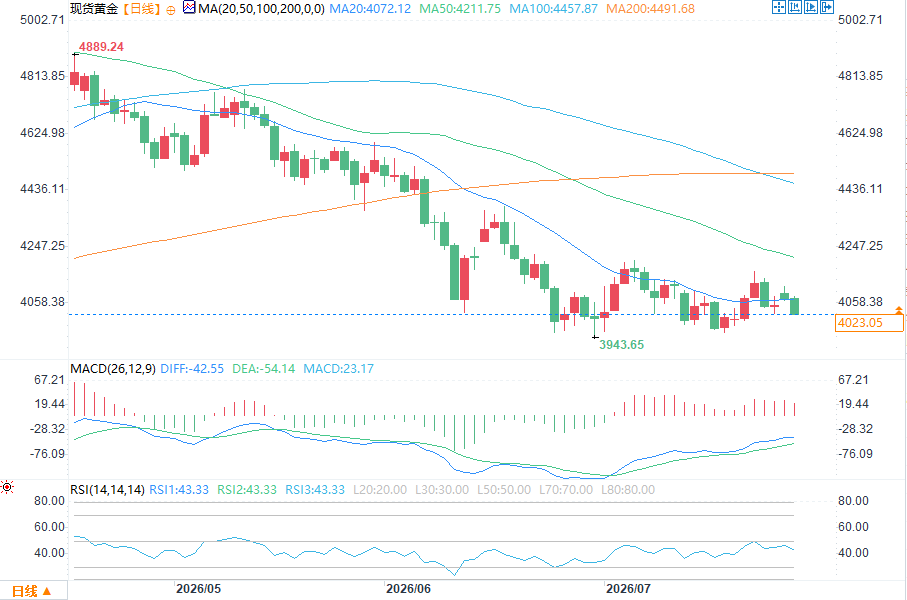 (Spot Gold Daily Chart Source: FX678) Short-term bears hold the technical advantage. Gold prices have remained below the upper edge of the $4150 trading range, failing to break through the $4200 mark. The primary upside target for bulls is a return above $4082.90; a hold above this level would target $4150, followed by a challenge of $4200. The short-term downside target for bears is a break below $4016.20; subsequent downside targets are $3950 and $3900. First resistance level: $4082.90; second resistance level: $4150. First support level: $4016.20; second support level: $3950. Short-term bears also hold the technical advantage. Silver prices have remained under pressure below the key trading range of $58.53–$59.44, failing to break through the $60 mark. Silver bulls' primary upside target: A firm hold above $58.53; a break above this level would target $59.44, with a further target of $63.28. Bears' downside target: A break below $56.60; subsequent support levels are $55.00 and $54.69. First resistance level: $58.53; second resistance level: $59.44. First support level: $56.60; second support level: $55.00.
Gold traded in a range between $4016.20 and $4082.90 in early trading. Gold held above the $4000 support level but failed to break through the short-term technical breakout range of $4150–$4200. Silver traded in a range between $56.60 and $58.70 in early trading. Silver held above the $55.00 support level but was unable to regain the key trading range of $58.53–$59.44. Following the release of the latest major US economic data, market sentiment cooled somewhat compared to the easing expectations following the release of CPI and PPI data. Weakening inflation and declining durable goods orders initially pushed US Treasury yields down; however, strong retail sales, low initial jobless claims, recovering business activity, and improved consumer confidence made it difficult for traders to bet on a complete shift to easing policies by the Federal Reserve. The market generally expects the Fed to keep interest rates unchanged this week, but energy inflation pressures have not completely subsided, and a rate hike remains a potential risk that cannot be ignored. The 10-year US Treasury yield is around 4.62%, and the 2-year yield is around 4.31%; the US dollar index hit a one-month high. Gold found support at the $4,000 level but continued to be pressured by both rising interest rates and a stronger dollar. The situation in the Strait of Hormuz can be summarized as follows: a temporary ceasefire between the US and Iran, but shipping is restricted and far from returning to normal. The suspension of direct attacks by both sides has pushed international crude oil prices down sharply from last week's highs, but actual shipping traffic in the Strait of Hormuz remains sluggish; the Bab el-Mandeb Strait has become the area with higher shipping risk. Brent crude oil fell sharply on Monday, after briefly breaking through $100 last week; West Texas Intermediate (WTI) crude oil also retreated, with the market betting on an increased possibility of renewed negotiations. The decline in oil prices has a two-way impact on gold: lower crude oil prices alleviate the pressure of rising inflation and yields, which is bearish for gold; however, the continued geopolitical obstruction risk in key shipping lanes retains potential safe-haven buying for gold. Looking at the overall asset class landscape: Crude oil prices have fallen, yields have declined from recent highs, the US dollar remains strong, and precious metals continue to be highly correlated with Federal Reserve interest rate signals. Traders are focusing on: the start of the Fed's two-day policy meeting, policy guidance from Fed Chairman Kevin Warsh, Thursday's US GDP and PCE inflation data, and whether shipping in the Strait of Hormuz and the Red Sea will be disrupted again. If gold prices continue to hold above $4016.20, the $4000 support level will remain effective; once this level is broken, the downside target of $3950 will reappear. Major international market conditions: New York WTI crude oil fell, trading around $82.00; Brent crude oil, after a sharp correction on Monday, is priced around $86.00. The US dollar index strengthened; the benchmark 10-year US Treasury yield remained around 4.62%. Technical Analysis (Spot Gold Daily Chart Source: FX678) Short-term bears hold the technical advantage. Gold prices have remained below the upper edge of the $4150 trading range, failing to break through the $4200 mark. The primary upside target for bulls is a return above $4082.90; a hold above this level would target $4150, followed by a challenge of $4200. The short-term downside target for bears is a break below $4016.20; subsequent downside targets are $3950 and $3900. First resistance level: $4082.90; second resistance level: $4150. First support level: $4016.20; second support level: $3950. Short-term bears also hold the technical advantage. Silver prices have remained under pressure below the key trading range of $58.53–$59.44, failing to break through the $60 mark. Silver bulls' primary upside target: A firm hold above $58.53; a break above this level would target $59.44, with a further target of $63.28. Bears' downside target: A break below $56.60; subsequent support levels are $55.00 and $54.69. First resistance level: $58.53; second resistance level: $59.44. First support level: $56.60; second support level: $55.00.
- Risk Warning and Disclaimer
- The market involves risk, and trading may not be suitable for all investors. This article is for reference only and does not constitute personal investment advice, nor does it take into account certain users’ specific investment objectives, financial situation, or other needs. Any investment decisions made based on this information are at your own risk.