The US-Israel meeting plan for Oman has flaws; the geopolitical risk premium for crude oil has not been cleared.
2026-07-28 21:39:03
On Tuesday (July 28), during the European and American trading sessions, international oil prices experienced a significant rebound after hitting a low. WTI crude oil prices narrowed their losses considerably, trading at $81.51, down 1.33%, after falling more than 4% at one point during the session . The core logic, aside from the release of technical oversold rebound risks, was the continued ceasefire and the emergence of a new peace negotiation plan, which had been suppressing oil prices. However, given the unclear situation and uncertain peace negotiations, oil prices were able to rebound. Trump stated that he believed Iran was willing to reach an agreement but would not give them much time. His meeting with Netanyahu exacerbated market concerns about geopolitical risks. Later, sources indicated that Oman had submitted a Strait of Hormuz governance plan to Iran, endorsed by the Gulf states, which included an arrangement to levy voluntary service fees on passing vessels. 
Oil prices plunge: Temporary ceasefire between the US and Iran triggers selling pressure from bulls.
The immediate trigger for this round of oil price plunge was the temporary de-escalation of the US-Iran conflict. Previously, Brent crude oil prices had surged due to shipping disruptions in the Red Sea and the Strait of Hormuz, briefly breaking the $100 /barrel mark, with geopolitical risk premiums remaining high. However, the US announcement of a suspension of military strikes against Iran and the opening of a diplomatic mediation window completely reversed market risk aversion. Following this positive development, Brent crude oil prices plummeted by 9% on Monday, quickly falling below the $88/barrel mark, and the previously accumulated bullish premiums due to the geopolitical conflict were rapidly wiped out. Even though oil prices briefly rebounded technically during the day, Trump's statement that the US and Iran were engaged in constructive consultations suppressed bullish sentiment again, causing oil prices to fall a second time, ultimately maintaining a decline of around 8%. Looking at the details of the situation, this US-Iran ceasefire is highly temporary and not a substantial reconciliation. After a 13-day military standoff, Iran voluntarily suspended retaliatory attacks after the US military refrained from launching missile strikes for two consecutive nights. The core reason for the US suspension of strikes was not a complete easing of the situation, but rather that the marginal benefits of US bombing had reached their limit and that its ammunition reserves were insufficient. At the same time, the Trump administration intended to ease the conflict through diplomatic negotiations.Cross-market linkage: Falling oil prices drive recovery in bond market and policy expectations
The short-term easing of geopolitical tensions has triggered a chain reaction in global capital markets. Previously, persistently high oil prices had fueled rising global inflation expectations, forcing central banks worldwide to tighten monetary policy and continuously pushing up sovereign bond yields. This recent sharp correction in oil prices has directly led to a decline in UK government bond yields, with the 10-year yield falling below 5%, and yields on two-year short-term interest rate-sensitive bonds also falling, indicating a cooling of pessimistic expectations regarding short-term inflation and interest rate hikes. Meanwhile, high oil prices continue to exert significant political pressure on the Trump administration, with the negative impact of inflation affecting the Republican Party's chances in the November midterm elections. The Federal Reserve's interest rate hikes to curb prices contradict Trump's low-interest-rate stance, further intensifying the policy game in the market.Market volatility: Key US-Israel meeting triggers oil price rebound after hitting bottom
Just as oil prices were experiencing a deep correction and market sentiment was leaning towards easing, new geopolitical risks quickly reversed the bottoming pattern, pushing oil prices to rebound. Israeli Prime Minister Benjamin Netanyahu's visit to the White House on Tuesday for a crucial meeting with President Trump was the key driver behind the stabilization of oil prices. This meeting was the first high-level meeting between the US and Israel since their joint strike on Iran in February. Core topics included Iranian military policy, the situation in Lebanon, and the expansion of the Abraham Accords. The market widely anticipates that this meeting carries a significant risk of escalating conflict. Historically, Netanyahu successfully lobbied Trump to launch military action against Iran. Currently, the Republican "America First" faction is highly vigilant, fearing that Netanyahu will again lobby for escalated military action against Iran, pushing the conflict further. The current US-Iran ceasefire is already fragile, and Trump has publicly stated that if this round of diplomatic mediation fails, the US will restart large-scale military strikes. Netanyahu's own politics heavily rely on a hardline stance against Iran. Coupled with the upcoming Israeli general election in October, he urgently needs a tough foreign policy to solidify his ruling base. He will likely push for deeper US sanctions and military action against Iran during the meeting, potentially shattering the current fragile ceasefire. Significant divisions exist within the US regarding the Israeli-Iranian situation. The Trump administration has repeatedly criticized Netanyahu's aggressive strategy on Lebanon, and Vice President Vance has stated that Israel is deliberately interfering with US-Iran negotiations and prolonging the conflict, widening the rift between the US and Israel. However, both sides share a core demand: resolutely preventing Iran from acquiring nuclear weapons. This suggests the meeting will likely reach a consensus on a hardline policy towards Iran, laying the groundwork for a renewed conflict.The core logic behind the Oman-Hormuz Strait solution
The voluntary fee scheme for the Strait of Hormuz, spearheaded by Oman and supported by Gulf states, is a geoeconomic compromise in the US-Iran rivalry. Its core logic is ingenious: by emulating the voluntary donation model of the Strait of Malacca, it replaces Iran's previous unilateral coercive control scheme. Without crossing US red lines or escalating the situation further, it opens a loophole for Iran's foreign trade, becoming a crucial backdoor to circumvent a comprehensive economic blockade. This allows Iran to generate revenue through strait services and alleviate sanctions pressure. However, this scheme faces significant risks and has extremely low feasibility. If the overall fee collection and management are highly flexible, Iran could indirectly gain control, or at least obtain access to funds and goods, thus offsetting US blockades. Conversely, if the management is not flexible enough, the Omani scheme, with its co-management model weakening Iran's sovereign authority and voluntary payment mechanism, significantly dilutes Iran's core interests, making the returns highly uncertain. For Iran, the meager benefits from the scheme cannot offset strategic concessions and sanctions losses. Without additional compensation, Iran will not compromise, making the scheme highly unlikely to be implemented.Viewpoints and Technical Analysis:
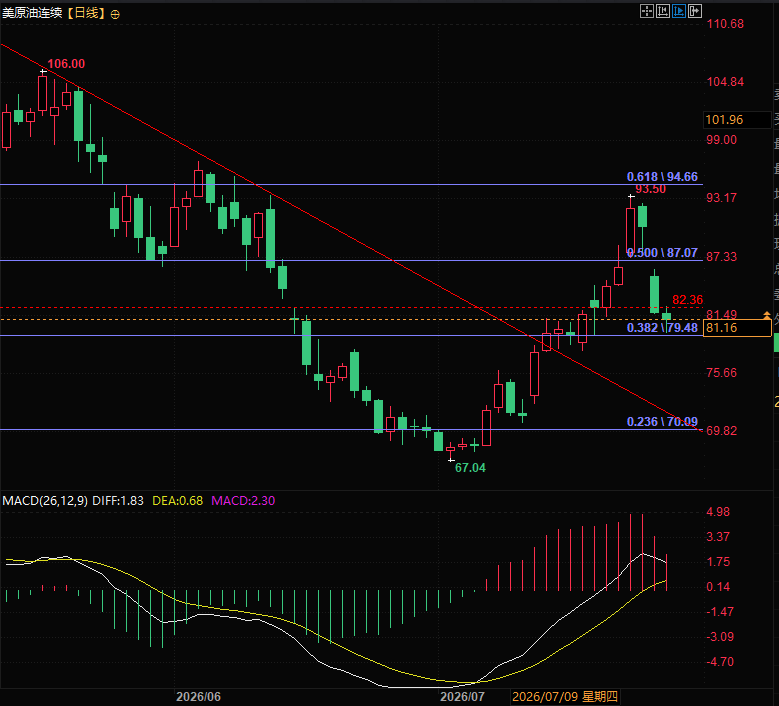
The recent rapid rebound in oil prices has significantly factored in the potential blockade of two energy shipping lanes. However, the market does not expect the Houthi rebels to maintain control of the Bab el-Mandeb Strait for long. Furthermore, insufficient oil demand due to the global economic recession is also a major constraint on further price increases. As mentioned in previous articles, the US-Iran conflict may be more serious after the US receives budget approval from Congress, as the conflict is severely hampered by the midterm elections. Technically, oil prices have broken below the previous upward gap and are currently finding support at the key 0.382 Fibonacci retracement level, with resistance at the 82.36 gap.Market analysts predict that geopolitical premiums will persist, and oil prices will remain volatile.
Major market institutions generally hold a skeptical view of the current ceasefire. Energy analysts such as SEB and PVM agree that this temporary ceasefire, lacking substantial agreement support, is unsustainable and cannot completely eliminate the risk of supply disruptions to Middle Eastern crude oil. The fundamental support for a deep decline in oil prices is severely insufficient. PVM Oil Associates analyst John Evans stated that the market always tries to find positives in highly unstable situations, but a short-term ceasefire does not equate to long-term guarantees for physical crude oil supply and shipping lane safety. As long as the Strait of Hormuz and the Red Sea shipping lanes lack a clear and lasting protection mechanism, geopolitical risk premiums could be reintroduced into prices at any time due to unforeseen events. SEB Research believes that the current oil price trend is a typical "headline-driven" phenomenon. Although the forward curve structure reflects the market's expectation of a medium- to long-term global crude oil supply and demand surplus, the high volatility of near-month contracts indicates that geopolitical premiums are extremely difficult to completely eliminate in one go. Before a breakthrough in diplomatic negotiations, any sign of escalating local conflicts will instantly trigger long covering. Citigroup and Goldman Sachs, among other international banks, point out that geopolitics is currently the most significant tail risk variable in the crude oil market. While the escalating US-Iran tensions will frequently push up the tail risk premium for oil prices, on the other hand, OPEC+'s massive spare capacity, increased supply from non-OPEC countries in the Americas (US, Canada, Brazil, etc.), and demand constraints due to the global economic slowdown collectively limit the potential for a sustained, unilateral surge in oil prices. At 21:33 Beijing time, WTI crude oil futures were trading at $80.79 per barrel.- Risk Warning and Disclaimer
- The market involves risk, and trading may not be suitable for all investors. This article is for reference only and does not constitute personal investment advice, nor does it take into account certain users’ specific investment objectives, financial situation, or other needs. Any investment decisions made based on this information are at your own risk.