The USD/JPY pair remains range-bound around 163.70, awaiting signals from the Federal Reserve.
2026-07-29 10:04:03
The US dollar weakened slightly against the Japanese yen (USD/JPY) in Asian trading on Wednesday, hovering around 163.70, after the pair recorded modest gains in the previous session. Current market trading is primarily driven by two factors: firstly, renewed tensions in the Middle East are pushing up oil prices, increasing Japan's energy import costs and weakening the yen's appeal; secondly, the US dollar is supported by safe-haven inflows and expectations of Federal Reserve policy, limiting the downside potential for USD/JPY.  Recent escalation of tensions in the Middle East has triggered a shift in risk aversion in global markets. Latest reports indicate that Iran launched multiple ballistic missiles at US targets in the region, including attacks on US bases in Jordan. Information released by the US military shows that all missile attacks were successfully intercepted. The market widely believes this action is related to previous US actions against Iranian naval forces, bringing regional risks back into investors' focus. Escalating geopolitical risks have a direct impact on the energy market, with crude oil prices rebounding significantly recently. For Japan, the impact of rising energy prices is even more pronounced, as it is a highly energy-dependent economy. Rising oil prices may increase energy costs for Japanese businesses and residents, weakening the yen's performance as a safe-haven currency . Therefore, while heightened global risk sentiment typically favors the yen's safe-haven demand, energy price factors may offset some of this support. The market is currently awaiting Japan's upcoming inflation and employment data to determine the Bank of Japan's future policy direction. Data shows that Tokyo's consumer price index, excluding fresh food, is expected to rise by about 1.7% year-on-year in July, higher than the previous level of 1.6%. Previously, Tokyo's overall inflation rate was 1.7%, and the core index, excluding food and energy, was 1.9%. Regarding employment, Japan's unemployment rate is expected to remain around 2.5%. If Japanese inflation continues to stabilize, the market may continue to assess the possibility of further adjustments to the Bank of Japan's monetary policy. However, given the current challenges facing the Japanese economy, including rising energy costs and uncertainties in external demand, the Bank of Japan's policy path still requires further confirmation from economic data. Meanwhile, the US dollar has received some support. With increasing geopolitical risks, investors tend to increase their allocation to safe-haven assets such as the US dollar. Furthermore, the Federal Reserve is about to announce its monetary policy decision. The market generally expects interest rates to remain unchanged, but investors are still paying close attention to any hints in the policy statement regarding future rate cuts or hikes. Although US President Trump has repeatedly called for lower interest rates, market trading data shows that investors remain highly focused on short-term policy changes. Market surveys indicate that traders currently believe there is a 30.5% probability of a near-term interest rate adjustment, while the expected probability of a policy change in September is about 76.6%, indicating that the market still believes US interest rates may remain at a high level for an extended period. The future movement of USD/JPY will be influenced by Japanese inflation data, Federal Reserve policy signals, changes in the US dollar index, and risks in the energy market. If oil prices continue to rise, increasing import cost pressures on Japan, the yen may continue to face downward pressure; however, if safe-haven demand intensifies further, the yen's traditional safe-haven attributes may still limit the upside potential of USD/JPY. Looking at the daily chart, the USD/JPY pair has maintained a high-level consolidation pattern recently, currently trading around 163.70, remaining in a strong zone overall. The daily chart structure shows that the bullish trend has not been significantly broken, but the market has entered a consolidation phase after continuous gains. Resistance is seen in the 164.50-165.00 area; a break above this area could lead to a further challenge of the 166.00 level. Support is seen at 162.50 and 161.80; a break below 161.80 could trigger a deeper correction. Current market momentum remains bullish, but the upside potential is affected by expectations of Japanese policy and the risk of currency intervention. The USD/JPY 4-hour chart shows a short-term pullback after reaching high levels, with short-term moving averages flattening out, indicating a rebalancing phase between bulls and bears. The MACD indicator shows weakening upward momentum, and the RSI has fallen to neutral territory, suggesting that short-term buying pressure is cooling. If the exchange rate breaks above 164.00 again, it may resume its short-term upward trend and test the 164.50 resistance level; if it falls below 163.00, it may further retrace to around 162.50 to find support. Short-term price action will still depend on the Federal Reserve's policy statement and potential adjustments in capital flows due to changes in Middle East risks.
 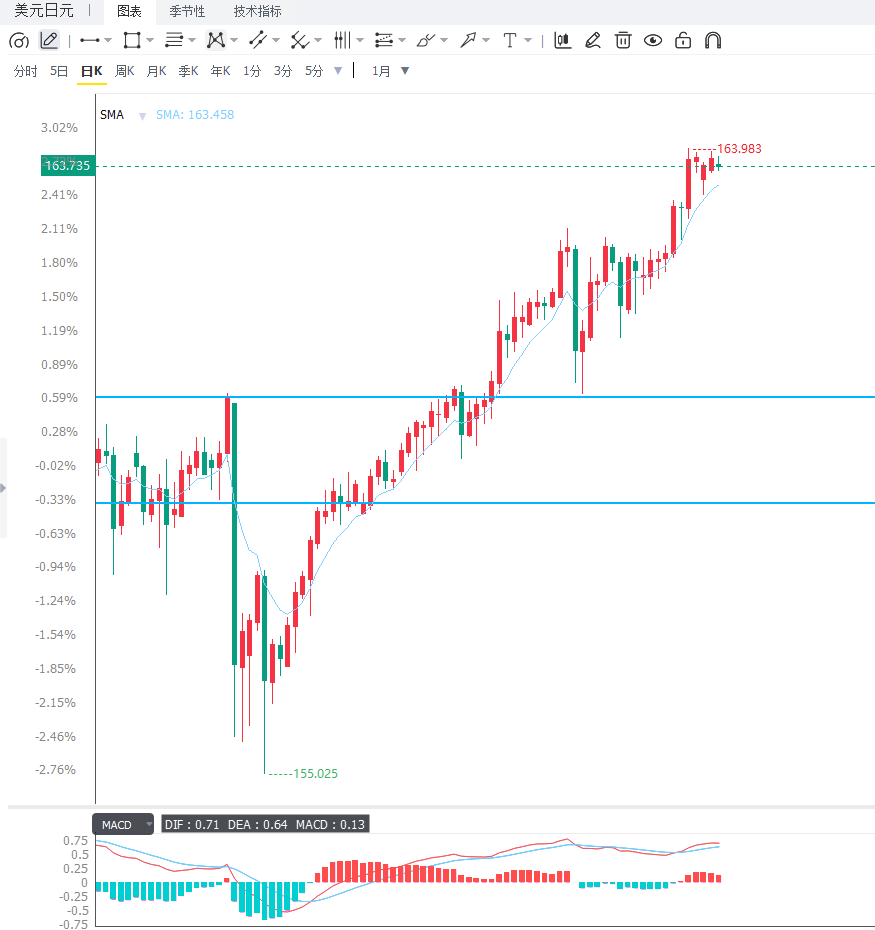 Editor's Summary: The USD/JPY pair is currently in a phase of intertwined factors. Escalating risks in the Middle East are driving up oil prices, putting pressure on Japan's energy import costs, while safe-haven inflows are supporting the dollar, keeping the exchange rate volatile at high levels. Going forward, the market will focus on whether Japanese inflation data strengthens expectations of a policy adjustment by the Bank of Japan, and whether the Federal Reserve signals a new interest rate path. If US interest rates remain high for an extended period, the USD/JPY pair may continue to find support; however, if Japanese inflation continues to improve and drives further policy normalization, the yen may gradually regain its rebound momentum. Overall, the USD/JPY pair is likely to remain volatile at high levels in the short term, with energy prices, central bank policies, and geopolitical risks being key factors determining its next direction.
Recent escalation of tensions in the Middle East has triggered a shift in risk aversion in global markets. Latest reports indicate that Iran launched multiple ballistic missiles at US targets in the region, including attacks on US bases in Jordan. Information released by the US military shows that all missile attacks were successfully intercepted. The market widely believes this action is related to previous US actions against Iranian naval forces, bringing regional risks back into investors' focus. Escalating geopolitical risks have a direct impact on the energy market, with crude oil prices rebounding significantly recently. For Japan, the impact of rising energy prices is even more pronounced, as it is a highly energy-dependent economy. Rising oil prices may increase energy costs for Japanese businesses and residents, weakening the yen's performance as a safe-haven currency . Therefore, while heightened global risk sentiment typically favors the yen's safe-haven demand, energy price factors may offset some of this support. The market is currently awaiting Japan's upcoming inflation and employment data to determine the Bank of Japan's future policy direction. Data shows that Tokyo's consumer price index, excluding fresh food, is expected to rise by about 1.7% year-on-year in July, higher than the previous level of 1.6%. Previously, Tokyo's overall inflation rate was 1.7%, and the core index, excluding food and energy, was 1.9%. Regarding employment, Japan's unemployment rate is expected to remain around 2.5%. If Japanese inflation continues to stabilize, the market may continue to assess the possibility of further adjustments to the Bank of Japan's monetary policy. However, given the current challenges facing the Japanese economy, including rising energy costs and uncertainties in external demand, the Bank of Japan's policy path still requires further confirmation from economic data. Meanwhile, the US dollar has received some support. With increasing geopolitical risks, investors tend to increase their allocation to safe-haven assets such as the US dollar. Furthermore, the Federal Reserve is about to announce its monetary policy decision. The market generally expects interest rates to remain unchanged, but investors are still paying close attention to any hints in the policy statement regarding future rate cuts or hikes. Although US President Trump has repeatedly called for lower interest rates, market trading data shows that investors remain highly focused on short-term policy changes. Market surveys indicate that traders currently believe there is a 30.5% probability of a near-term interest rate adjustment, while the expected probability of a policy change in September is about 76.6%, indicating that the market still believes US interest rates may remain at a high level for an extended period. The future movement of USD/JPY will be influenced by Japanese inflation data, Federal Reserve policy signals, changes in the US dollar index, and risks in the energy market. If oil prices continue to rise, increasing import cost pressures on Japan, the yen may continue to face downward pressure; however, if safe-haven demand intensifies further, the yen's traditional safe-haven attributes may still limit the upside potential of USD/JPY. Looking at the daily chart, the USD/JPY pair has maintained a high-level consolidation pattern recently, currently trading around 163.70, remaining in a strong zone overall. The daily chart structure shows that the bullish trend has not been significantly broken, but the market has entered a consolidation phase after continuous gains. Resistance is seen in the 164.50-165.00 area; a break above this area could lead to a further challenge of the 166.00 level. Support is seen at 162.50 and 161.80; a break below 161.80 could trigger a deeper correction. Current market momentum remains bullish, but the upside potential is affected by expectations of Japanese policy and the risk of currency intervention. The USD/JPY 4-hour chart shows a short-term pullback after reaching high levels, with short-term moving averages flattening out, indicating a rebalancing phase between bulls and bears. The MACD indicator shows weakening upward momentum, and the RSI has fallen to neutral territory, suggesting that short-term buying pressure is cooling. If the exchange rate breaks above 164.00 again, it may resume its short-term upward trend and test the 164.50 resistance level; if it falls below 163.00, it may further retrace to around 162.50 to find support. Short-term price action will still depend on the Federal Reserve's policy statement and potential adjustments in capital flows due to changes in Middle East risks. Editor's Summary: The USD/JPY pair is currently in a phase of intertwined factors. Escalating risks in the Middle East are driving up oil prices, putting pressure on Japan's energy import costs, while safe-haven inflows are supporting the dollar, keeping the exchange rate volatile at high levels. Going forward, the market will focus on whether Japanese inflation data strengthens expectations of a policy adjustment by the Bank of Japan, and whether the Federal Reserve signals a new interest rate path. If US interest rates remain high for an extended period, the USD/JPY pair may continue to find support; however, if Japanese inflation continues to improve and drives further policy normalization, the yen may gradually regain its rebound momentum. Overall, the USD/JPY pair is likely to remain volatile at high levels in the short term, with energy prices, central bank policies, and geopolitical risks being key factors determining its next direction.
- Risk Warning and Disclaimer
- The market involves risk, and trading may not be suitable for all investors. This article is for reference only and does not constitute personal investment advice, nor does it take into account certain users’ specific investment objectives, financial situation, or other needs. Any investment decisions made based on this information are at your own risk.