A new script of silent intervention has been played out. Will the Bank of Japan "certify" the yen's rise today?
2026-07-31 08:20:53
On Friday (July 31) in early Asian trading, the USD/JPY pair fluctuated higher, currently trading around 160. The USD/JPY pair plunged 2.4% on Thursday, closing near 159.50, marking its largest single-day drop since 2022, falling more than 5 yen from a high of nearly 164.00. The Japanese Ministry of Finance made no comment, and the government remained silent, which was precisely the intention – no verbal warnings, no interest rate checks, only large-scale intervention arriving without warning. After Thursday's plunge caught the market off guard, traders are trying to determine whether the Japanese authorities will intervene again, and the upcoming Bank of Japan policy decision and governor's press conference will be key variables determining the yen's short-term direction. 
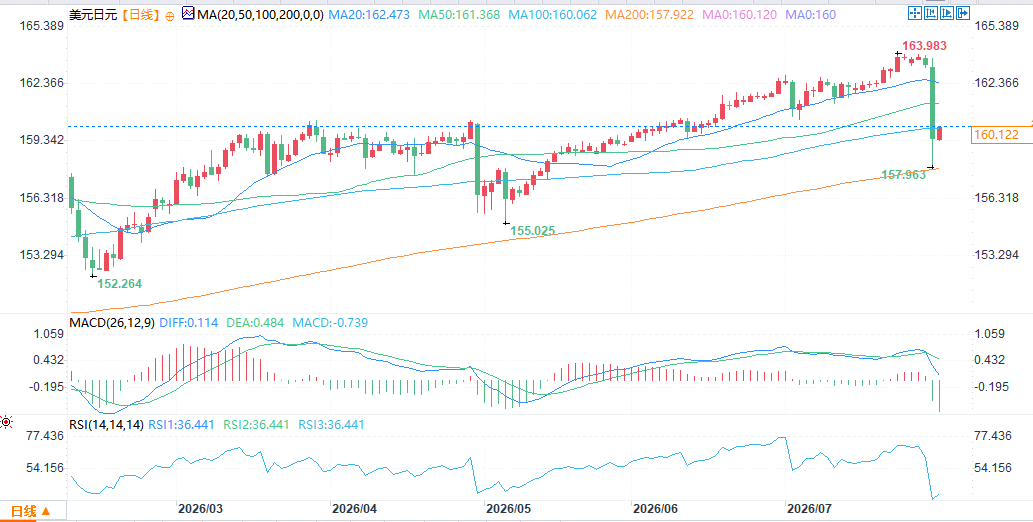 (USD/JPY daily chart, source: FX678) At 8:06 AM Beijing time on July 31, the USD/JPY exchange rate was 160.39.
A "new script" for intervention
The decline began at 9:30 PM Beijing time on Thursday and was largely completed before most trading desks had even finished reading the market data. One trading desk's records show that in the following ten minutes, approximately $8.1 billion was sold off against the yen in core trading venues, with overall market volume far exceeding normal levels. Previous Japanese interventions were preceded by weeks of escalating verbal warnings, interest rate checks, and calibration prompts, all of which allowed speculative positions time to be reduced. This time, however, there were no warnings; the new strategy was to remain silent and then intervene on a massive scale—the clear objective being to "empty" short speculative yen positions, rather than offering polite dissuasion. The timing was also carefully calculated: the day after the Fed's split decision, weak US economic growth data, month-end fund flows already underway, and the yen at a 40-year low—Tokyo bought dollars at the cheapest prices.The Bank of Japan must "verify" its intervention.
The Bank of Japan will announce its interest rate decision on Friday, and is expected to keep the rate unchanged at 1.00% after the June rate hike. The quarterly outlook report is the real focus – the fiscal year 2026 growth forecast is expected to be revised upward from 0.5% to 0.8%, and most economists still expect a rate hike to 1.25% by the end of the year, with October being the most favored time. July's Tokyo inflation data, released hours after the intervention, exceeded expectations across all central bank-tracked indicators – the reading excluding fresh food rose to 1.9% (expected 1.7%, previous 1.6%), and the overall figure rose to 2.0% (previous 1.7%). The indicator excluding food and energy also recorded 2.0%. This makes it more difficult to describe the yen's weakness as a "temporary energy effect," giving the Bank of Japan more reason to raise rates earlier on Friday morning than on Thursday afternoon.Without policy follow-up, the effects will be absorbed.
Tokyo spent approximately $70 billion intervening to support the yen between April and May, but the yen still fell to a 40-year low two months later—a measure of the effectiveness of intervention without accompanying interest rate hikes. Intervention without policy follow-up will eventually be absorbed by the market, and arithmetic explains why: the difference between the target interest rate ranges for the US and Japan is about 260 basis points, which is the yield that carry trades rebuild within days after each intervention. If the governor's press conference takes a hawkish stance on the yen's weakness, Thursday's intervention will be reinforced; if the energy shock is characterized as temporary and there is no intention to raise interest rates sooner, the recently liquidated positions will be handed back to the market.The game of data and central bank "verification"
The coming week will see the release of labor cash income data (previous value 3.2%), the minutes of the June meeting, the US manufacturing survey, private sector employment and non-farm payroll data (previous value 57,000), and the pricing of a 63% probability of a Fed rate hike in September. Each of these data points presents an opportunity to widen the interest rate spread that Tokyo has just narrowed due to its depleted reserves.Friday's press conference sets the tone
The dollar plunged to 159.50 against the yen in Thursday's "silent intervention," marking a fundamental shift in Japan's monetary policy—no more advance warnings, but sudden, large-scale intervention to completely wipe out speculative short positions. However, Friday's Bank of Japan press conference will be the real test: if the governor issues a clear warning about the yen's weakness and hints at an earlier rate hike, Thursday's intervention will be seen by the market as a signal of "policy coordination"; if the energy shock is characterized as temporary and there is no intention to raise rates earlier, the recently liquidated positions will be rebuilt, and the yen could return to 163. The market has already priced in a rate hike to 1.25% by the end of the year, with October considered the most likely timeframe—the next step is to wait for Friday's confirmation. (USD/JPY daily chart, source: FX678) At 8:06 AM Beijing time on July 31, the USD/JPY exchange rate was 160.39.
- Risk Warning and Disclaimer
- The market involves risk, and trading may not be suitable for all investors. This article is for reference only and does not constitute personal investment advice, nor does it take into account certain users’ specific investment objectives, financial situation, or other needs. Any investment decisions made based on this information are at your own risk.