After a 2% surge, the yen awaits confirmation from the Bank of Japan; the extent of Ueda's hawkish stance will determine whether the rebound can be sustained.
2026-07-31 08:34:51
The USD/JPY pair edged higher in early Asian trading on Friday (July 31), currently trading around 160. Thursday saw a dramatic rebound in the yen – the USD/JPY pair plunged from above 163 to below 158 within minutes, a drop of over 2%, fueling widespread speculation that Japanese authorities had intervened. The market is holding its breath awaiting the Bank of Japan's decision – Governor Kazuo Ueda's press conference will determine whether this rebound is a trend reversal or a short-lived impulse. Investors will focus on updated economic forecasts and Governor Ueda's press conference to assess whether the central bank's policy outlook can solidify the yen's rebound. 
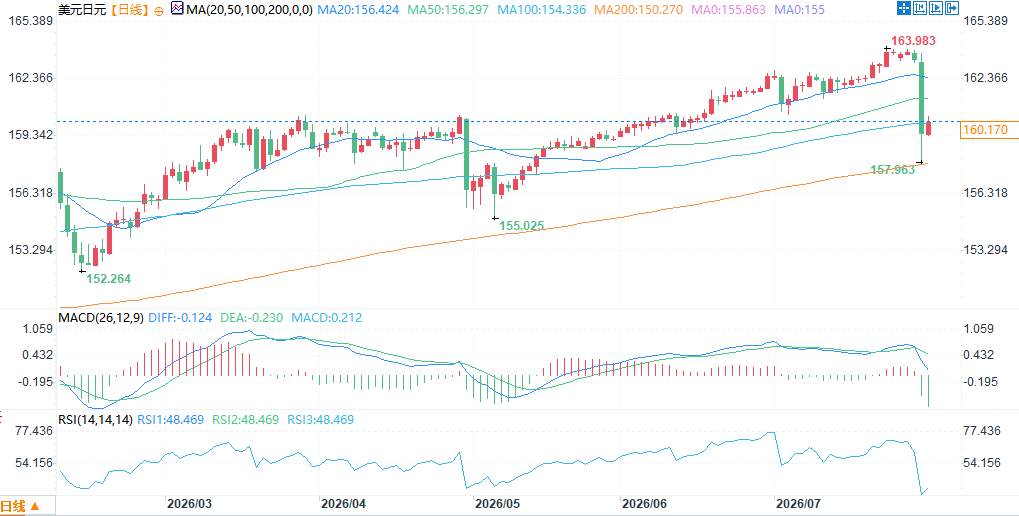 (USD/JPY daily chart, source: FX678) At 8:27 AM Beijing time on July 31, the USD/JPY exchange rate was 160.21.
Policy Decision Expectations
The Bank of Japan is expected to keep its policy rate unchanged at 1%, a decision likely to receive broad majority support from the Policy Board. The central bank will also release its quarterly outlook report, including updated economic growth and inflation forecasts. Policymakers may revise upward their growth forecasts—supported by resilient domestic activity and strong demand from AI-related investments. Meanwhile, overall inflation forecasts may be slightly revised downwards due to government subsidies and softer energy prices. However, a downward revision in inflation forecasts does not necessarily imply a more dovish policy stance—the central bank may still warn that potential price pressures could be stronger than expected as import and production costs gradually pass to consumers. The latest Tanshi Economic Survey shows that businesses expect inflation to remain above the 2% target for the next few years, and combined with rising wages and continued inflation in the services sector, this reinforces policymakers' confidence that a virtuous cycle of wages and prices is forming.The weakness of the yen remains an important consideration.
The weakness of the yen remains a key consideration. A weaker currency increases the cost of imported goods and energy, potentially exacerbating inflationary pressures. While Thursday's apparent intervention temporarily eased yen pressures after months of persistent weakness, the trend could resume—as seen after the intervention in April. Although the Bank of Japan does not directly set a currency target, Ueda is likely to emphasize that the impact of exchange rate fluctuations on the inflation outlook is being closely monitored. The central bank is expected to maintain a gradual tightening bias without explicitly committing to the timing of the next action—market pricing suggests investors expect at least one more 25-basis-point rate hike before the end of the year, but expectations are divided between the October and December meetings.Hawkish signals vs. neutral statements
Ueda's communication will be crucial. A stronger emphasis on upside risks to inflation, wage growth, or the economic consequences of a weaker yen could reinforce market expectations of an October rate hike—escalating Thursday's intervention and pushing the dollar lower against the yen. A cautious assessment of consumption and global demand could encourage investors to postpone expectations until December, putting the yen at risk of further decline. The Federal Reserve is also a factor—it kept interest rates unchanged for the fifth consecutive day on Wednesday, and the dollar weakened as investors unwound bets on a surprise rate hike. If the dollar remains under pressure, any hawkish signals from the Bank of Japan could have a greater impact on the dollar/yen exchange rate.The yen is at a crossroads; Ueda's "hawkishness" will determine everything.
Today's Bank of Japan meeting is crucial in determining the short-term direction of the yen. With no rate hike expected, the focus is entirely on President Ueda's press conference—hawkish signals (emphasizing inflation risks and hinting at an earlier rate hike) will solidify the effects of Thursday's intervention, pushing the yen further higher; a neutral or cautious stance could allow short sellers to return, pushing the USD/JPY pair back above 160. The market has already priced in at least one more rate hike before the end of the year, and Ueda's wording today will determine whether the market anchors its expectations to October or December. For traders, today's Bank of Japan meeting is not a "known event," but a true "policy catalyst"—the yen's next direction will be determined the moment Ueda speaks. (USD/JPY daily chart, source: FX678) At 8:27 AM Beijing time on July 31, the USD/JPY exchange rate was 160.21.- Risk Warning and Disclaimer
- The market involves risk, and trading may not be suitable for all investors. This article is for reference only and does not constitute personal investment advice, nor does it take into account certain users’ specific investment objectives, financial situation, or other needs. Any investment decisions made based on this information are at your own risk.