Long-term bonds are being sold off, and the dollar is weakening in tandem, indicating that traditional interest rate logic is failing.
2026-07-31 17:58:49
On Friday, July 31, the US dollar index was trading around 100.10, showing signs of stabilization after a sharp drop the previous day. The market is reassessing the relationship between the Federal Reserve's policy communication, interest rate path, and term premium. At its July meeting, the Fed maintained its target range for the federal funds rate at 3.50% to 3.75%, but three votes within the committee opposed a 0.25 percentage point rate hike. While policy rates remained unchanged, the bond market actively tightened financial conditions, with the 10-year Treasury yield rising to approximately 4.71% and the 30-year yield to approximately 5.24%, a near 19-year high. This combination of stable short-term policy, rising long-term financing costs, and a weakening dollar index suggests that the market is trading not just in the next interest rate adjustment, but also in the credibility of the Fed's communication mechanism itself. 
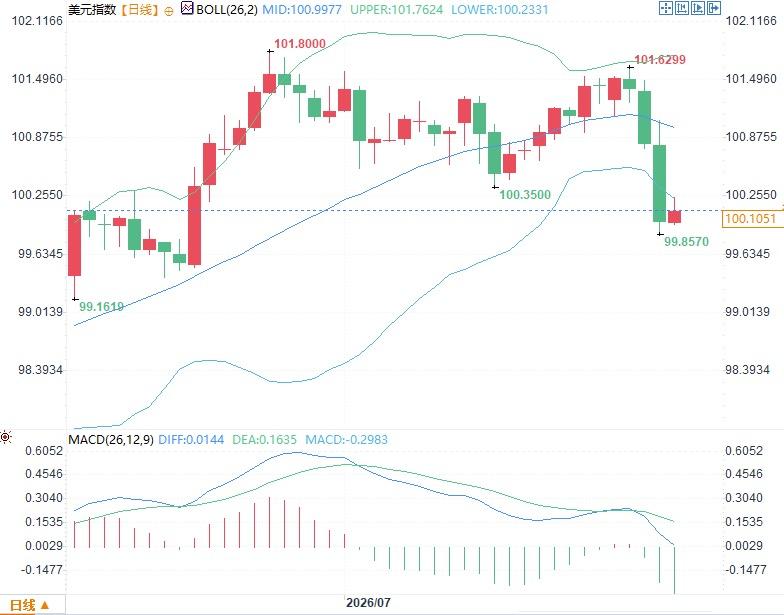 Momentum indicators are also weak. The MACD DIFF is 0.0144, DEA is 0.1635, and the histogram value has dropped to -0.2983, with the fast line significantly lower than the slow line and the negative bars expanding rapidly. This structure indicates that the decline is not simply due to intraday liquidity shocks, but rather a concentrated release of waning upward momentum.
Abandoning clear guidance forces markets to price up uncertainty.
The most noticeable change in policy communication since Kevin Warsh took office as Chairman of the Federal Reserve is the weakening of pre-commitments to the future path of interest rates. His recent statements emphasize that the Fed should focus more on its statutory goals rather than continuously providing directional protection to the market. Following the July policy meeting, Warsh expressed some acceptance of the market pushing interest rates up on its own, leading traders to speculate that reducing forward guidance was not a communication misstep, but rather part of the policy framework. The core of this approach is to allow interest rates, credit spreads, and asset volatility to again include an uncertainty premium. In the past, a clearer policy path could lower the discount rate for risky assets and compress interest rate volatility, but its side effect was that financial institutions and businesses could more easily increase leverage. When the market long believes that the Fed will explain and smooth policy changes in advance, risk pricing may gradually deviate from fundamentals. In early July, Warsh stated that the Fed would re-examine its policy tools, analytical methods, and implementation mechanisms to adapt to changes in the economic structure. This means that communication methods may be adjusted along with the balance sheet, liquidity management, and policy transmission mechanisms, rather than simply changing the wording of press conferences.A weaker dollar does not necessarily mean a shift in market expectations towards easing.
Normally, rising US Treasury yields would widen the dollar's interest rate advantage. However, the current divergence between the dollar index and long-term yields indicates a change in the nature of the yield increase. If the rise in yields is primarily driven by economic growth and improved real returns, the dollar often benefits; if it's mainly driven by inflation compensation, fiscal supply pressure, and term premiums, the dollar's attractiveness may not increase proportionally. Currently, the 2-year US Treasury yield is approximately 4.23%, the 10-year yield is approximately 4.67%, and the 30-year yield is approximately 5.21%. The significantly higher long-term yields reflect market demands for greater term compensation. Meanwhile, the Federal Reserve's decision to maintain interest rates indicates that immediate policy constraints have not been further strengthened. Rising long-term financing costs coupled with a lack of new support for short-term rates put the dollar under pressure from two fronts: first, the policy interest rate advantage has not widened; and second, the rising term premium may be seen as compensation for bond risk rather than an improvement in currency returns. Therefore, the recent drop in the dollar index below 100 cannot be directly interpreted as the market betting on rapid interest rate cuts. A more accurate description is that traders are lowering their valuation of the predictability of the Fed's communication while reassessing the impact of higher long-term interest rates on economic activity, debt costs, and financial stability.Technical analysis shows that the 100 level has shifted from support to a battleground.
The daily chart shows that after the US dollar index formed a high of 101.8000, the rebound high dropped to 101.6299, forming a weakened double-top pattern. Subsequently, the price broke below the Bollinger Middle Band at 100.9977 and then broke through 100.3500 with a large bearish candlestick, reaching a low of 99.8570. The latest price remains below the Bollinger Lower Band at 100.2331, indicating that short-term volatility has deviated from its recent normal range. Momentum indicators are also weak. The MACD DIFF is 0.0144, DEA is 0.1635, and the histogram value has dropped to -0.2983, with the fast line significantly lower than the slow line and the negative bars expanding rapidly. This structure indicates that the decline is not simply due to intraday liquidity shocks, but rather a concentrated release of waning upward momentum.The real risk lies in the continued divergence between yields and the US dollar.
Reducing forward guidance can help the market restore price discovery, but it can also amplify the differences in how different assets interpret the same policy signal. Short-term interest rates mainly reflect policy expectations, while long-term interest rates are influenced by inflation, fiscal supply, term premium, and risk appetite. The US dollar is also affected by cross-market capital flows. When these three factors no longer revolve around the same policy path, volatility will increase significantly. If long-term US Treasury yields continue to rise, and the US dollar index fails to recover to 100.35, the market may further interpret the rise in yields as increased risk compensation. Conversely, if subsequent inflation data declines, long-term yields stabilize, and the US dollar index rises back above the Bollinger Middle Band, it indicates that the previous decline was more of a temporary reassessment of communication uncertainty. The next Federal Reserve policy meeting is scheduled for September 15-16, and the minutes of the July meeting will be released on August 19. In the absence of clear forward guidance, meeting minutes, inflation components, employment data, and changes in the yield curve are likely to have a more direct pricing impact than individual official speeches.- Risk Warning and Disclaimer
- The market involves risk, and trading may not be suitable for all investors. This article is for reference only and does not constitute personal investment advice, nor does it take into account certain users’ specific investment objectives, financial situation, or other needs. Any investment decisions made based on this information are at your own risk.