Following an epic intervention in the foreign exchange market, the Bank of Japan kept interest rates unchanged, and the USD/JPY exchange rate returned above 160.
2026-07-31 19:50:51
On Friday (July 31), Japanese authorities intervened strongly this week, injecting over $50 billion, pushing the yen to its largest single-day gain in nearly three years. Coupled with coordinated efforts by the US and Japan to stabilize the exchange rate and continued warnings from the options market about a potential second intervention, yen shorts suffered a heavy blow. Against this backdrop, the Bank of Japan chose to maintain its interest rate unchanged and continue its gradual policy normalization path. The initiative briefly returned to the USD/JPY bulls, but the persistent risk of repeated official intervention has become the biggest constraint on the exchange rate's upward movement, intensifying the battle between bulls and bears.  Powerful Intervention Takes Effect: US and Japan Coordinate Market Support, Yen Rebounds Violently The biggest variable in this round of market fluctuations came from Japan's epic intervention in the foreign exchange market. Account data released by the Bank of Japan on Friday, along with calculations from multiple market institutions, corroborated the findings: Japanese authorities appeared to have intervened in the foreign exchange market with approximately $52.8 billion (8.45 trillion yen) during Thursday's New York trading session. Further money market data showed that the scale of dollar sales reached as high as $58.97 billion, significantly exceeding market expectations and highlighting the government's zero-tolerance attitude towards excessive yen depreciation. This heavy intervention directly triggered a strong yen rebound, with the USD/JPY exchange rate plummeting by approximately 3.3% intraday, marking its largest single-day gain in nearly three years since December 2023. It is worth noting that this action was not a unilateral operation by Japan. Market sources confirmed that the US simultaneously conducted currency inquiry operations in the early hours of Thursday Beijing time, indicating that the US and Japan formed a coordinated communication and joint market stabilization mechanism during the period of sharp fluctuations, significantly enhancing the substance and deterrent effect of the intervention. More importantly, the Japanese authorities continued their mature strategy of "multiple rounds of phased intervention" rather than a one-off short-term market support. The market witnessed two clear rounds of official intervention within 24 hours: the first round of intervention on Thursday violently pushed the USD/JPY exchange rate down from a high of 163.00 to 157.80; a new round of intervention on Friday further suppressed the exchange rate from 160.51 to 158.90. These consecutive actions definitively confirmed Japan's firm resolve to defend the yen. Faced with a barrage of intervention rumors, Japanese Finance Minister Satsuki Katayama remained silent throughout Friday, continuing the usual low-key rhetoric before and after official interventions. The options market sounded the alarm for continued intervention, with bullish sentiment towards the yen surging to its highest level this year . With the two rounds of intervention now in place, the derivatives market has already priced in the risk of continued intervention, providing strong sentiment support for the yen's future movement. Currently, the USD/JPY options market continues to issue intervention warnings, with the premium for yen call options soaring to its highest level since April 2025, and market bets on a temporary strengthening of the yen significantly increasing. Many institutional investors have preemptively positioned themselves with yen call options to hedge against depreciation risk, a strategy perfectly suited to this round of intervention. Taking a 1-month call option at 160.00 yen as an example, when the spot rate is high at 163.00, the option premium is only 49 points, far lower than the cost of 137 points for an at-the-money option, making it highly cost-effective. Although this product requires significant exchange rate volatility to realize profits, the extreme volatility created by concentrated official intervention provides an excellent profit environment. Core risk indicators simultaneously confirm the market's tense sentiment: the 1-month 25-delta risk reversal indicator continued to rise driven by intervention expectations, jumping sharply after the first round of intervention on Thursday, and further rising to about 2.8 implied volatility points on Friday, marking the largest difference between long and short option premiums since April 2025. This indicates that the market has not relaxed its vigilance after the first round of intervention, and expectations for repeated interventions and a significant appreciation of the yen continue to ferment. Bank of Japan holds rates steady: the pace of rate hikes slows, and the dovish decision helps the yen to pull back. Under the cover of large-scale intervention to support the market, the Bank of Japan implemented a dovish policy decision as expected. The Bank of Japan's July policy meeting maintained the benchmark interest rate at 1%, fully in line with market expectations. Previously, the market had speculated that the central bank might unexpectedly raise interest rates to solidify the yen's rise, but ultimately the policy maintained a stable stance. Only one vote against a rate hike was cast at this meeting, by committee member Takada. He believed that the risks to rising prices had accumulated sufficiently, necessitating an earlier rate hike. However, this single dissenting vote, compared to the multiple votes in previous tightening cycles, clearly indicates that the Bank of Japan's policy normalization pace has slowed significantly. A September rate hike is highly unlikely, and the next rate hike window is likely to be postponed to October or December, consistent with current market pricing. The Bank of Japan's latest Economic Outlook report shows that the authorities have slightly lowered short-term inflation expectations but are optimistic about AI, semiconductor investment, and corporate spending driving economic growth. Overall, the report maintains the tone of "inflation slowly approaching the 2% target, with a long-term gradual tightening of policy," with no signs of accelerated tightening in the short term. The intervention's effects quickly faded, and USD/JPY rebounded above 160, but risks remain. Following the dovish central bank decision, market bulls quickly rallied, causing the yen's previous gains to retreat rapidly, and USD/JPY regained the 160 level. This also clarified the core purpose of this round of intervention: to strongly support the yen in the short term, ensuring the implementation of the Bank of Japan's dovish policy and preventing a runaway surge in the exchange rate caused by maintaining interest rates. The market rebound does not mean the intervention risk is completely over. Referring to Japan's operational patterns this year, interventions are often carried out in batches over multiple days, rather than ending all at once. The biggest hidden danger in the market at present remains the potential for a new round of sudden intervention; chasing the USD/JPY at a high point in the short term offers extremely poor risk-reward ratios. After the decision was announced, Bank of Japan Governor Ueda's subsequent remarks were hawkish: emphasizing that the overall inflation target was close to 2%, and that the risk of upward movement needed to be more vigilant than before. Factors such as AI demand, a weak yen, and oil prices could push up prices, and the pace of interest rate hikes could be accelerated if necessary. Interest rate hikes will be discussed in more detail starting next (September). Hawkish statements support expectations of a medium-term appreciation of the yen. A key technical battleground: 160.73 becomes the watershed between bulls and bears.
 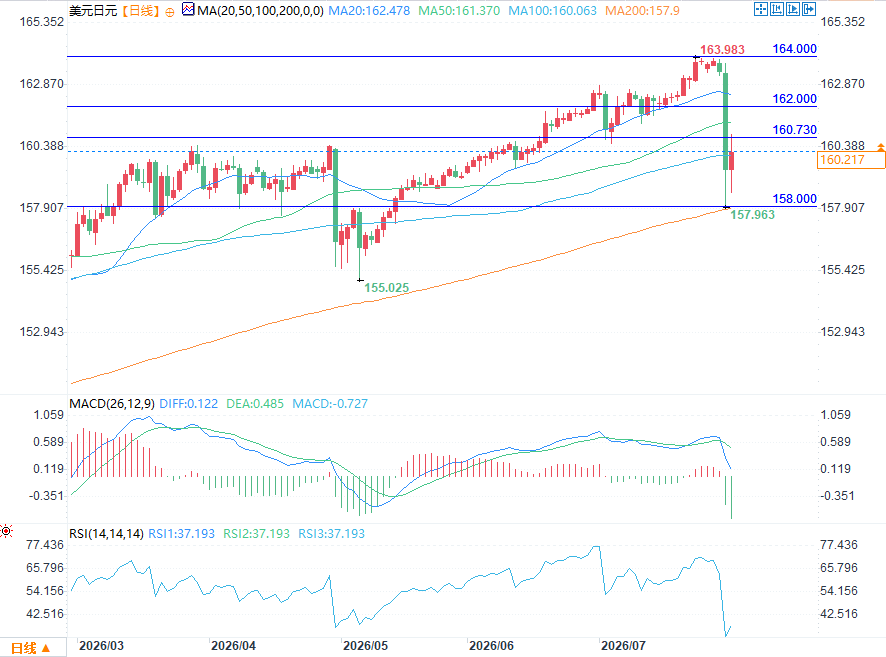 (USD/JPY Daily Chart Source: EasyForex) The daily chart clearly shows that even with billions of dollars in intervention, USD/JPY is still strictly adhering to key technical structures. The previous sharp drop precisely stopped at the confluence of the 200-day moving average and the previous breakout level of 157.92, followed by a rebound driven by buying pressure. Currently, the exchange rate has returned to the core resistance level of 160.73 (the year's all-time high). This level is the current absolute trading center: there is significant resistance above and solid support below. Shorting logic: Based on the resistance at 160.73 and the risk of continued intervention, short positions can be opened below this level, with a stop loss above the breakout point, targeting a pullback to the intervention low near 158, betting on a second wave of downward pressure. Longing logic: If the exchange rate effectively holds above 160.73, it means that the short-term intervention selling pressure has been largely exhausted, and long positions can be opened accordingly, with a stop loss below the breakout point, targeting 162, 162.84, and 164 respectively. Overall Summary: The medium- to long-term bullish trend of USD/JPY remains unchanged, but the risk of repeated foreign exchange market intervention has completely limited the upside potential. In the short term, the market is expected to fluctuate at high levels, requiring cautious trading. Blindly chasing highs is strictly prohibited.
Powerful Intervention Takes Effect: US and Japan Coordinate Market Support, Yen Rebounds Violently The biggest variable in this round of market fluctuations came from Japan's epic intervention in the foreign exchange market. Account data released by the Bank of Japan on Friday, along with calculations from multiple market institutions, corroborated the findings: Japanese authorities appeared to have intervened in the foreign exchange market with approximately $52.8 billion (8.45 trillion yen) during Thursday's New York trading session. Further money market data showed that the scale of dollar sales reached as high as $58.97 billion, significantly exceeding market expectations and highlighting the government's zero-tolerance attitude towards excessive yen depreciation. This heavy intervention directly triggered a strong yen rebound, with the USD/JPY exchange rate plummeting by approximately 3.3% intraday, marking its largest single-day gain in nearly three years since December 2023. It is worth noting that this action was not a unilateral operation by Japan. Market sources confirmed that the US simultaneously conducted currency inquiry operations in the early hours of Thursday Beijing time, indicating that the US and Japan formed a coordinated communication and joint market stabilization mechanism during the period of sharp fluctuations, significantly enhancing the substance and deterrent effect of the intervention. More importantly, the Japanese authorities continued their mature strategy of "multiple rounds of phased intervention" rather than a one-off short-term market support. The market witnessed two clear rounds of official intervention within 24 hours: the first round of intervention on Thursday violently pushed the USD/JPY exchange rate down from a high of 163.00 to 157.80; a new round of intervention on Friday further suppressed the exchange rate from 160.51 to 158.90. These consecutive actions definitively confirmed Japan's firm resolve to defend the yen. Faced with a barrage of intervention rumors, Japanese Finance Minister Satsuki Katayama remained silent throughout Friday, continuing the usual low-key rhetoric before and after official interventions. The options market sounded the alarm for continued intervention, with bullish sentiment towards the yen surging to its highest level this year . With the two rounds of intervention now in place, the derivatives market has already priced in the risk of continued intervention, providing strong sentiment support for the yen's future movement. Currently, the USD/JPY options market continues to issue intervention warnings, with the premium for yen call options soaring to its highest level since April 2025, and market bets on a temporary strengthening of the yen significantly increasing. Many institutional investors have preemptively positioned themselves with yen call options to hedge against depreciation risk, a strategy perfectly suited to this round of intervention. Taking a 1-month call option at 160.00 yen as an example, when the spot rate is high at 163.00, the option premium is only 49 points, far lower than the cost of 137 points for an at-the-money option, making it highly cost-effective. Although this product requires significant exchange rate volatility to realize profits, the extreme volatility created by concentrated official intervention provides an excellent profit environment. Core risk indicators simultaneously confirm the market's tense sentiment: the 1-month 25-delta risk reversal indicator continued to rise driven by intervention expectations, jumping sharply after the first round of intervention on Thursday, and further rising to about 2.8 implied volatility points on Friday, marking the largest difference between long and short option premiums since April 2025. This indicates that the market has not relaxed its vigilance after the first round of intervention, and expectations for repeated interventions and a significant appreciation of the yen continue to ferment. Bank of Japan holds rates steady: the pace of rate hikes slows, and the dovish decision helps the yen to pull back. Under the cover of large-scale intervention to support the market, the Bank of Japan implemented a dovish policy decision as expected. The Bank of Japan's July policy meeting maintained the benchmark interest rate at 1%, fully in line with market expectations. Previously, the market had speculated that the central bank might unexpectedly raise interest rates to solidify the yen's rise, but ultimately the policy maintained a stable stance. Only one vote against a rate hike was cast at this meeting, by committee member Takada. He believed that the risks to rising prices had accumulated sufficiently, necessitating an earlier rate hike. However, this single dissenting vote, compared to the multiple votes in previous tightening cycles, clearly indicates that the Bank of Japan's policy normalization pace has slowed significantly. A September rate hike is highly unlikely, and the next rate hike window is likely to be postponed to October or December, consistent with current market pricing. The Bank of Japan's latest Economic Outlook report shows that the authorities have slightly lowered short-term inflation expectations but are optimistic about AI, semiconductor investment, and corporate spending driving economic growth. Overall, the report maintains the tone of "inflation slowly approaching the 2% target, with a long-term gradual tightening of policy," with no signs of accelerated tightening in the short term. The intervention's effects quickly faded, and USD/JPY rebounded above 160, but risks remain. Following the dovish central bank decision, market bulls quickly rallied, causing the yen's previous gains to retreat rapidly, and USD/JPY regained the 160 level. This also clarified the core purpose of this round of intervention: to strongly support the yen in the short term, ensuring the implementation of the Bank of Japan's dovish policy and preventing a runaway surge in the exchange rate caused by maintaining interest rates. The market rebound does not mean the intervention risk is completely over. Referring to Japan's operational patterns this year, interventions are often carried out in batches over multiple days, rather than ending all at once. The biggest hidden danger in the market at present remains the potential for a new round of sudden intervention; chasing the USD/JPY at a high point in the short term offers extremely poor risk-reward ratios. After the decision was announced, Bank of Japan Governor Ueda's subsequent remarks were hawkish: emphasizing that the overall inflation target was close to 2%, and that the risk of upward movement needed to be more vigilant than before. Factors such as AI demand, a weak yen, and oil prices could push up prices, and the pace of interest rate hikes could be accelerated if necessary. Interest rate hikes will be discussed in more detail starting next (September). Hawkish statements support expectations of a medium-term appreciation of the yen. A key technical battleground: 160.73 becomes the watershed between bulls and bears. (USD/JPY Daily Chart Source: EasyForex) The daily chart clearly shows that even with billions of dollars in intervention, USD/JPY is still strictly adhering to key technical structures. The previous sharp drop precisely stopped at the confluence of the 200-day moving average and the previous breakout level of 157.92, followed by a rebound driven by buying pressure. Currently, the exchange rate has returned to the core resistance level of 160.73 (the year's all-time high). This level is the current absolute trading center: there is significant resistance above and solid support below. Shorting logic: Based on the resistance at 160.73 and the risk of continued intervention, short positions can be opened below this level, with a stop loss above the breakout point, targeting a pullback to the intervention low near 158, betting on a second wave of downward pressure. Longing logic: If the exchange rate effectively holds above 160.73, it means that the short-term intervention selling pressure has been largely exhausted, and long positions can be opened accordingly, with a stop loss below the breakout point, targeting 162, 162.84, and 164 respectively. Overall Summary: The medium- to long-term bullish trend of USD/JPY remains unchanged, but the risk of repeated foreign exchange market intervention has completely limited the upside potential. In the short term, the market is expected to fluctuate at high levels, requiring cautious trading. Blindly chasing highs is strictly prohibited.
- Risk Warning and Disclaimer
- The market involves risk, and trading may not be suitable for all investors. This article is for reference only and does not constitute personal investment advice, nor does it take into account certain users’ specific investment objectives, financial situation, or other needs. Any investment decisions made based on this information are at your own risk.