Crude Oil Analysis: Supply Surplus May Return in Q4; How Much Risk Premium is Included in the Current $85 Price Level?
2026-07-31 20:40:50
On Friday, July 31st, the latest price of US crude oil was around $85.20, re-entering a high-level consolidation range. Meanwhile, the Federal Reserve saw votes against a 25 basis point rate hike, strategic petroleum reserves continued to decline, commercial crude oil inventories fell sharply, and refineries operated at high capacity. Crude oil is currently not facing a single bullish factor, but rather a repricing of supply risks, policy constraints, and demand elasticity. 
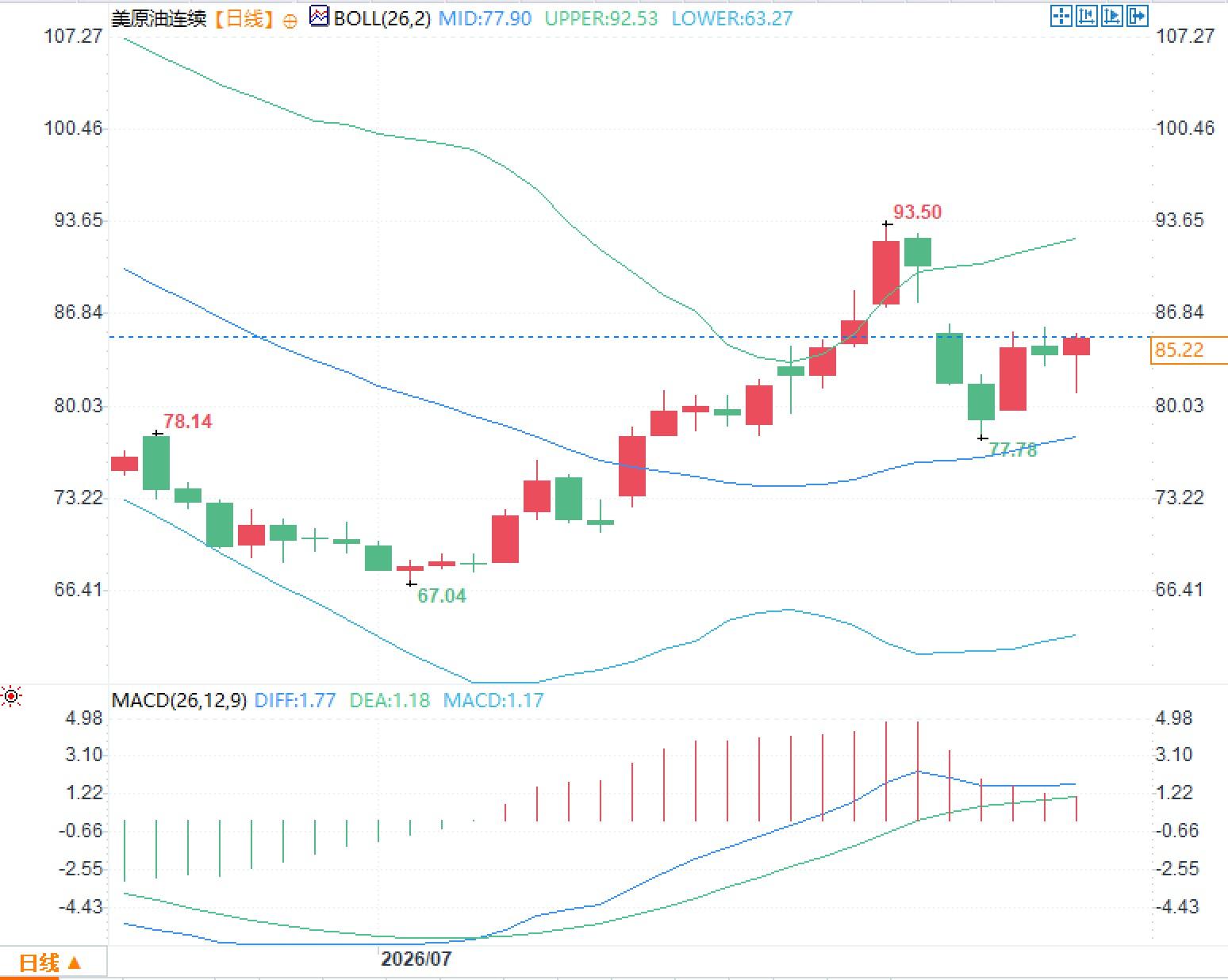
Why 93.50 has become a short-term sentiment dividing line
US crude oil rebounded from around $67.04 to $93.50, a gain of nearly 40%. The main pricing logic was not a sudden expansion in end-user demand, but rather a risk premium resulting from disruptions to supply and transportation in the Middle East. The US Energy Information Administration estimates that global oil inventories fell by an average of 5.1 million barrels per day in the second quarter and may continue to fall by 2.2 million barrels per day in the third quarter. This means that even with some recovery in production and shipping, the spot market still lacks sufficient buffer in the short term. However, the rapid pullback near $93.50 indicates that the market is beginning to distinguish between "actual supply losses" and "worst-case scenario premiums." The daily price touched the upper Bollinger Band and then retreated, currently remaining above the middle band at $77.90, indicating that the medium-term rebound structure has not been broken. The MACD fast and slow lines remain positive but have not continued to diverge significantly upwards, reflecting that new funds are more cautious about chasing higher prices. Therefore, the area around $85 has become a key observation zone for whether the risk premium can be sustained. If the speed of supply recovery exceeds the speed of inventory replenishment, the price fluctuation center may gradually shift downwards.The decline in inventory and the full utilization of refineries create a structural contradiction.
For the week ending July 24, U.S. commercial crude oil inventories fell by 7.2 million barrels to 404.5 million barrels, about 6% lower than the five-year average for the same period; strategic petroleum reserves fell to 307.7 million barrels, a decrease of 95 million barrels from a year ago. Refinery throughput rose to 17.3 million barrels per day, with a capacity utilization rate of 97.2%, and gasoline and distillate fuel production increased to 9.9 million barrels and 5.4 million barrels per day, respectively. These data reveal a key contradiction: refineries are maximizing crude oil consumption to alleviate the shortage of refined products, but the high operating rate itself is also accelerating the destocking of commercial crude oil. Gasoline inventories are still about 7% lower than the five-year average, and distillate fuel inventories are about 10% lower, meaning that the supply chain tension has been transmitted from the crude oil end to the refined product end. The average retail price of regular gasoline in the U.S. rose to $4.096 per gallon, and diesel rose to $5.313 per gallon. Therefore, even if crude oil prices fall from their peak, it does not mean that energy inflationary pressures have disappeared simultaneously. The root cause of the expansion of refinery profits is the insufficient elasticity of refined product supply, not simply the rise in crude oil prices. As long as refinery utilization is close to its limit, any equipment failure, transportation delay, or export disruption could further amplify the gasoline and diesel crack spread.Strategic reserves and the Federal Reserve are weakening the policy buffer.
The strategic petroleum reserve arrangement announced in March was 172 million barrels, with a planned delivery time of approximately 120 days, employing an exchange structure where companies would return crude oil and additional quantities in the future. Currently, the strategic reserve has decreased to 307.7 million barrels. While still above the market's estimated minimum operating range, further releases would face higher energy security costs. The decline in reserve size means that the time and extent to which administrative measures can suppress prices are limited, and the market's sensitivity to new releases may also decrease. Monetary policy has also changed. The Federal Reserve's July meeting decided by a 9-3 vote to maintain the federal funds rate at 3.50% to 3.75%, with Hammark, Kashkari, and Logan advocating a 25 basis point rate hike. The statement explicitly stated that supply shocks in sectors such as energy are pushing up inflation. This indicates that oil prices are no longer just a commodity market variable, but an inflationary input that could potentially influence the path of policy interest rates. For crude oil, a tighter monetary policy has a two-way impact. First, high interest rates increase the cost of funding for holding inventory and forward positions, limiting speculative demand; second, the Federal Reserve's vigilance regarding energy inflation suggests that the feedback from high oil prices to macroeconomic policy is strengthening. The higher the oil price and the longer it lasts, the stronger the policy's suppression of demand will be. This could ultimately create a self-correcting mechanism where supply shocks drive up prices while monetary tightening suppresses demand. The U.S. Energy Information Administration predicts that as Middle Eastern production and trade gradually recover, global oil inventories may increase by 2.7 million barrels per day in the fourth quarter and by 5 million barrels per day by 2027; the average quarterly price of Brent crude may fall from $103 per barrel in the second quarter to $70 per barrel in the fourth quarter. This forecast is subject to significant uncertainty, but it suggests that the current high prices are more dependent on continued tight inventories than on a solidified long-term supply-demand gap.- Risk Warning and Disclaimer
- The market involves risk, and trading may not be suitable for all investors. This article is for reference only and does not constitute personal investment advice, nor does it take into account certain users’ specific investment objectives, financial situation, or other needs. Any investment decisions made based on this information are at your own risk.