Gold Analysis: Short-term market logic shifts to policy expectation repricing and technical correction.
2026-07-31 20:52:50
On Friday (July 31), international spot gold prices retreated significantly from the previous day's highs, giving back gains from above $4100/ounce throughout the day. The price steadily declined, currently trading between $4040 and $4070/ounce, a daily drop of approximately 1.2%. This reflects a typical pullback pattern: a surge driven by events followed by a decline in sentiment and profit-taking by long positions at higher levels. This round of gold price correction is not solely due to bearish pressure, but rather a result of multiple factors: easing rumors of yen intervention, a temporary stabilization of the US dollar, repeated expectations of a Fed rate hike, and a concentrated release of profit-taking by long positions. The short-term market logic has shifted from safe-haven demand to a combination of policy expectation repricing and technical correction. The following is a detailed analysis combining timelines and core driving factors.  I. Key Market Trends Last Night: Rumors of Yen Intervention Trigger Short-Term Volatility, Gold Price Surge Hints at Potential Retreat. During the New York session on July 30th, a sudden anomaly in the foreign exchange market became the core trigger for short-term volatility in gold. The USD/JPY pair plunged by over 3% intraday, hitting a low of 157.98, marking its largest single-day drop since December 2023. This rapid appreciation of the yen sparked strong speculation about intervention in the foreign exchange market by the Bank of Japan. Simultaneously, news circulated that the US had initiated currency inquiries, a common prelude to central bank intervention, further reinforcing market expectations of intervention. At the same time, US Treasury Secretary Bessenter publicly stated that the yen "appears to be severely undervalued," further boosting yen bullish sentiment and forcing the dollar index to weaken rapidly, breaking below the 100 mark and hitting a low of 99.97, a recent low. The sharp dollar pullback directly increased demand for gold as a safe haven and hedge against devaluation, causing gold prices to surge, briefly approaching a high of $4120 per ounce. However, this round of price increases relied entirely on sudden events and lacked sustained fundamental support. As market sentiment gradually calmed down, the yen quickly gave back most of its gains, the dollar index stopped falling and rebounded slightly, short-term safe-haven sentiment quickly subsided, and gold lost its core upward momentum, facing pressure at high levels and falling back, laying the foundation for today's continued correction. II. Fed Policy Game: Damaged Credibility and Repeated Interest Rate Hike Expectations Suppress Gold Price Gains The July 29 FOMC meeting concluded, with the Fed maintaining the 3.50%-3.75% interest rate range for the fifth consecutive time. However, the hawkish signals released at this meeting far exceeded market expectations, becoming the core policy logic limiting the medium- to long-term rebound of gold prices and driving a short-term decline. Significant disagreement emerged in the vote, with three members explicitly advocating a 25 basis point rate hike, and a significant increase in dissent, highlighting the escalating policy divisions within the Fed and a hardening stance on inflation control. The market's core focus was not on the surface result of "maintaining the interest rate unchanged," but rather on the lack of credibility in the Fed's inflation control efforts. The market generally believes that the Federal Reserve's previous response to inflation was slow and dovish, making it difficult to effectively suppress persistent inflation. Therefore, the market has actively raised the premium for long-term US Treasury yields, with the 30-year Treasury yield continuing to rise and reaching a multi-year high, directly reflecting the market's distrust of the Fed's policies. To repair the damaged policy credibility, the necessity for the Fed to further raise interest rates has increased significantly. CME FedWatch data shows that the market's probability of a September rate hike has remained high at around 60%, and the repeated rise in rate hike expectations has continued to suppress the upside potential of gold. In terms of market timing, in the initial period after the interest rate decision, the unwinding of short-term hawkish bets briefly benefited gold and pushed prices higher; however, the market subsequently repriced in the expectation of "the Fed's tough rate hikes to repair credibility," coupled with persistently high US Treasury yields, causing the upward momentum of gold prices to quickly weaken and fall back from its highs. III. Today's Core Adjustment: Profit-taking at High Levels Leads to Gold Price Consolidation Phase After the event-driven surge the previous day, gold encountered strong resistance in the core resistance zone of $4100-$4120, accumulating a large number of short-term long positions with profits. On July 31, as the sentiment for yen intervention cooled completely and the dollar stabilized and rebounded slightly, safe-haven buying in the market subsided across the board. Long positions entered earlier were liquidated, directly driving today's continued decline in gold prices. From a technical perspective, the $4100-$4120 range is a strong short-term resistance zone. Multiple attempts to break through failed, coupled with the fading of positive fundamental factors, the need for a technical correction has been fully released. Currently, although there is some buying support at lower levels, the bullish momentum is weak and insufficient to reverse the short-term downward trend. The price center continues to shift downward, and the market has officially transitioned from a high-level consolidation phase to a high-level pullback and narrow-range consolidation pattern. IV . Future Market Outlook: Short-term trend reversal, gold prices return to a narrow range of $4000-$4050.
 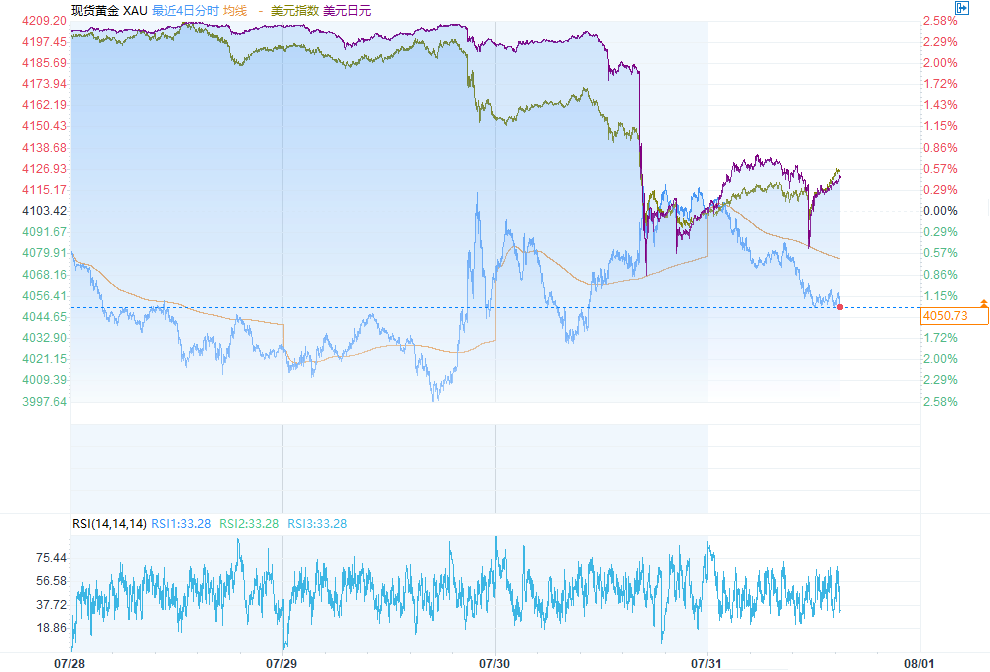 (Image source: EasyForex) Combining the current fundamental and technical signals, the previous surge in gold prices has come to a temporary halt. The market pattern has shifted from a one-sided upward surge to a consolidation and correction mode characterized by a battle between bulls and bears. There is a lack of sustained upward momentum in the short term, and a pullback to test the 4000-4050 range is possible. Overall, the market is mainly consolidating, with no clear one-sided trend. Future movements will heavily depend on key data and policy expectations; it is premature to predict the trend within a given range. From a fundamental perspective, the current market is relatively balanced between bulls and bears, with a high margin for error and weak trend. On the bearish side, high expectations for a September rate hike by the Federal Reserve, persistently high US Treasury yields, and continued profit-taking by previous bulls are continuously suppressing the rebound in gold prices. On the bullish side, the damaged credibility of the Federal Reserve's policies, the difficulty in achieving a strong one-sided trend in the US dollar index, and the continued existence of external geopolitical uncertainties provide a bottom support for gold prices, making a significant drop unlikely. With the balance of power between bulls and bears, gold will continue its volatile and fluctuating trend in the short term, with the direction awaiting guidance from key data releases. From a technical perspective, after gold prices broke below the short-term support level of 4070, the market's center of gravity continued to shift downwards, indicating a weak short-term trend. The 4000 level below provides strong structural and psychological support, having been tested multiple times without a significant breakout, demonstrating its strong support effectiveness. On the upside, the 4050 level has transformed from previous support into short-term resistance. The short-term market is likely to fluctuate and test the 4000-4050 range, but this range is not fixed. If significant data is released subsequently, it could easily break the current consolidation pattern and trigger a breakout from this range. The focus of subsequent observation will no longer be limited to the logic of existing stock trading, but will instead be on closely monitoring four key variables to determine whether the market has broken down or if a trend has shifted: First, the US non-farm payroll data, a core reference indicator for the Federal Reserve's policy adjustments. Whether non-farm payrolls, unemployment rate, and wage growth exceed or fall short of expectations will directly rewrite interest rate hike expectations, dominating the short-term direction of gold prices, and is currently the most crucial turning point data. Second, the latest public speeches by Federal Reserve officials, observing their attitude towards inflation and the pace of interest rate hikes to predict the policy inclination in September. Third, the aftermath of the yen intervention, whether further intervention will trigger abnormal movements in the foreign exchange market and safe-haven demand. Fourth, US core inflation data, verifying whether inflation remains persistent, affecting the restoration of the Federal Reserve's credibility and the strength of its policies. In terms of trading strategy, the current short-term gold price is experiencing increased volatility and a blurred trend, a typical pre-data-driven consolidation. It is strictly forbidden to rigidly adhere to one-sided thinking or fixed range judgments. In the short term, the 4000 level can be used as a support level. A rebound to above 4050 with resistance could lead to a cautious pullback. The main strategy should be short-term swing trading, buying low and selling high. All operations should allow for a margin of error. The focus should be on awaiting the release of key data such as non-farm payrolls and inflation figures, and then using the data results to determine whether the range has been broken, the trend has continued, or reversed. Overall, maintain a light position size, strictly control risk, and avoid the risks of disorderly fluctuations and data gaps before the data release.
I. Key Market Trends Last Night: Rumors of Yen Intervention Trigger Short-Term Volatility, Gold Price Surge Hints at Potential Retreat. During the New York session on July 30th, a sudden anomaly in the foreign exchange market became the core trigger for short-term volatility in gold. The USD/JPY pair plunged by over 3% intraday, hitting a low of 157.98, marking its largest single-day drop since December 2023. This rapid appreciation of the yen sparked strong speculation about intervention in the foreign exchange market by the Bank of Japan. Simultaneously, news circulated that the US had initiated currency inquiries, a common prelude to central bank intervention, further reinforcing market expectations of intervention. At the same time, US Treasury Secretary Bessenter publicly stated that the yen "appears to be severely undervalued," further boosting yen bullish sentiment and forcing the dollar index to weaken rapidly, breaking below the 100 mark and hitting a low of 99.97, a recent low. The sharp dollar pullback directly increased demand for gold as a safe haven and hedge against devaluation, causing gold prices to surge, briefly approaching a high of $4120 per ounce. However, this round of price increases relied entirely on sudden events and lacked sustained fundamental support. As market sentiment gradually calmed down, the yen quickly gave back most of its gains, the dollar index stopped falling and rebounded slightly, short-term safe-haven sentiment quickly subsided, and gold lost its core upward momentum, facing pressure at high levels and falling back, laying the foundation for today's continued correction. II. Fed Policy Game: Damaged Credibility and Repeated Interest Rate Hike Expectations Suppress Gold Price Gains The July 29 FOMC meeting concluded, with the Fed maintaining the 3.50%-3.75% interest rate range for the fifth consecutive time. However, the hawkish signals released at this meeting far exceeded market expectations, becoming the core policy logic limiting the medium- to long-term rebound of gold prices and driving a short-term decline. Significant disagreement emerged in the vote, with three members explicitly advocating a 25 basis point rate hike, and a significant increase in dissent, highlighting the escalating policy divisions within the Fed and a hardening stance on inflation control. The market's core focus was not on the surface result of "maintaining the interest rate unchanged," but rather on the lack of credibility in the Fed's inflation control efforts. The market generally believes that the Federal Reserve's previous response to inflation was slow and dovish, making it difficult to effectively suppress persistent inflation. Therefore, the market has actively raised the premium for long-term US Treasury yields, with the 30-year Treasury yield continuing to rise and reaching a multi-year high, directly reflecting the market's distrust of the Fed's policies. To repair the damaged policy credibility, the necessity for the Fed to further raise interest rates has increased significantly. CME FedWatch data shows that the market's probability of a September rate hike has remained high at around 60%, and the repeated rise in rate hike expectations has continued to suppress the upside potential of gold. In terms of market timing, in the initial period after the interest rate decision, the unwinding of short-term hawkish bets briefly benefited gold and pushed prices higher; however, the market subsequently repriced in the expectation of "the Fed's tough rate hikes to repair credibility," coupled with persistently high US Treasury yields, causing the upward momentum of gold prices to quickly weaken and fall back from its highs. III. Today's Core Adjustment: Profit-taking at High Levels Leads to Gold Price Consolidation Phase After the event-driven surge the previous day, gold encountered strong resistance in the core resistance zone of $4100-$4120, accumulating a large number of short-term long positions with profits. On July 31, as the sentiment for yen intervention cooled completely and the dollar stabilized and rebounded slightly, safe-haven buying in the market subsided across the board. Long positions entered earlier were liquidated, directly driving today's continued decline in gold prices. From a technical perspective, the $4100-$4120 range is a strong short-term resistance zone. Multiple attempts to break through failed, coupled with the fading of positive fundamental factors, the need for a technical correction has been fully released. Currently, although there is some buying support at lower levels, the bullish momentum is weak and insufficient to reverse the short-term downward trend. The price center continues to shift downward, and the market has officially transitioned from a high-level consolidation phase to a high-level pullback and narrow-range consolidation pattern. IV . Future Market Outlook: Short-term trend reversal, gold prices return to a narrow range of $4000-$4050. (Image source: EasyForex) Combining the current fundamental and technical signals, the previous surge in gold prices has come to a temporary halt. The market pattern has shifted from a one-sided upward surge to a consolidation and correction mode characterized by a battle between bulls and bears. There is a lack of sustained upward momentum in the short term, and a pullback to test the 4000-4050 range is possible. Overall, the market is mainly consolidating, with no clear one-sided trend. Future movements will heavily depend on key data and policy expectations; it is premature to predict the trend within a given range. From a fundamental perspective, the current market is relatively balanced between bulls and bears, with a high margin for error and weak trend. On the bearish side, high expectations for a September rate hike by the Federal Reserve, persistently high US Treasury yields, and continued profit-taking by previous bulls are continuously suppressing the rebound in gold prices. On the bullish side, the damaged credibility of the Federal Reserve's policies, the difficulty in achieving a strong one-sided trend in the US dollar index, and the continued existence of external geopolitical uncertainties provide a bottom support for gold prices, making a significant drop unlikely. With the balance of power between bulls and bears, gold will continue its volatile and fluctuating trend in the short term, with the direction awaiting guidance from key data releases. From a technical perspective, after gold prices broke below the short-term support level of 4070, the market's center of gravity continued to shift downwards, indicating a weak short-term trend. The 4000 level below provides strong structural and psychological support, having been tested multiple times without a significant breakout, demonstrating its strong support effectiveness. On the upside, the 4050 level has transformed from previous support into short-term resistance. The short-term market is likely to fluctuate and test the 4000-4050 range, but this range is not fixed. If significant data is released subsequently, it could easily break the current consolidation pattern and trigger a breakout from this range. The focus of subsequent observation will no longer be limited to the logic of existing stock trading, but will instead be on closely monitoring four key variables to determine whether the market has broken down or if a trend has shifted: First, the US non-farm payroll data, a core reference indicator for the Federal Reserve's policy adjustments. Whether non-farm payrolls, unemployment rate, and wage growth exceed or fall short of expectations will directly rewrite interest rate hike expectations, dominating the short-term direction of gold prices, and is currently the most crucial turning point data. Second, the latest public speeches by Federal Reserve officials, observing their attitude towards inflation and the pace of interest rate hikes to predict the policy inclination in September. Third, the aftermath of the yen intervention, whether further intervention will trigger abnormal movements in the foreign exchange market and safe-haven demand. Fourth, US core inflation data, verifying whether inflation remains persistent, affecting the restoration of the Federal Reserve's credibility and the strength of its policies. In terms of trading strategy, the current short-term gold price is experiencing increased volatility and a blurred trend, a typical pre-data-driven consolidation. It is strictly forbidden to rigidly adhere to one-sided thinking or fixed range judgments. In the short term, the 4000 level can be used as a support level. A rebound to above 4050 with resistance could lead to a cautious pullback. The main strategy should be short-term swing trading, buying low and selling high. All operations should allow for a margin of error. The focus should be on awaiting the release of key data such as non-farm payrolls and inflation figures, and then using the data results to determine whether the range has been broken, the trend has continued, or reversed. Overall, maintain a light position size, strictly control risk, and avoid the risks of disorderly fluctuations and data gaps before the data release.
- Risk Warning and Disclaimer
- The market involves risk, and trading may not be suitable for all investors. This article is for reference only and does not constitute personal investment advice, nor does it take into account certain users’ specific investment objectives, financial situation, or other needs. Any investment decisions made based on this information are at your own risk.