Funds increased their holdings at the fastest pace in four months; the shutdown of three major supply chains helped WTI crude oil rise 6.8% this week; the world is closely watching the limits of "last resort" exports!
2026-08-01 13:38:50
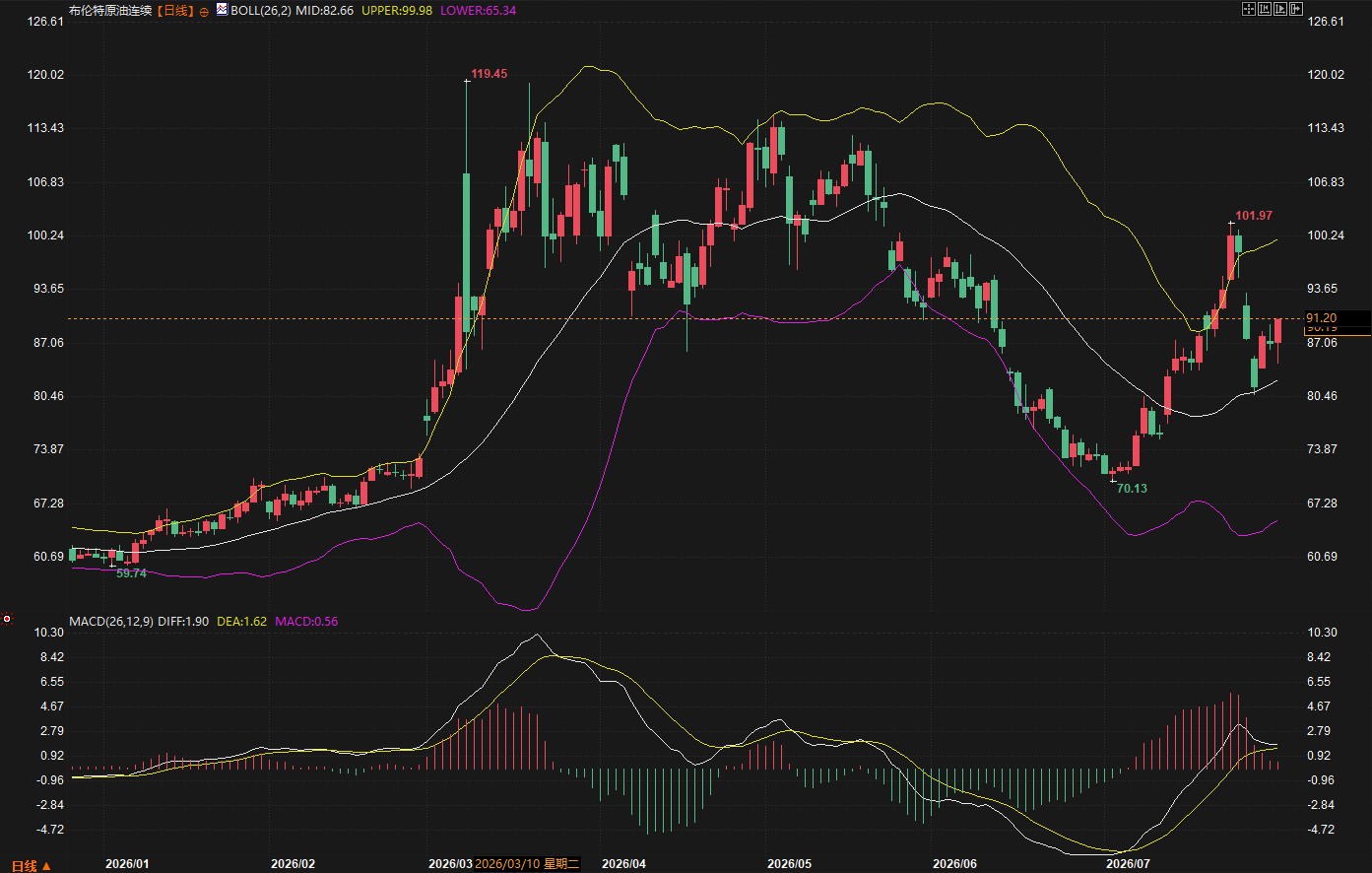
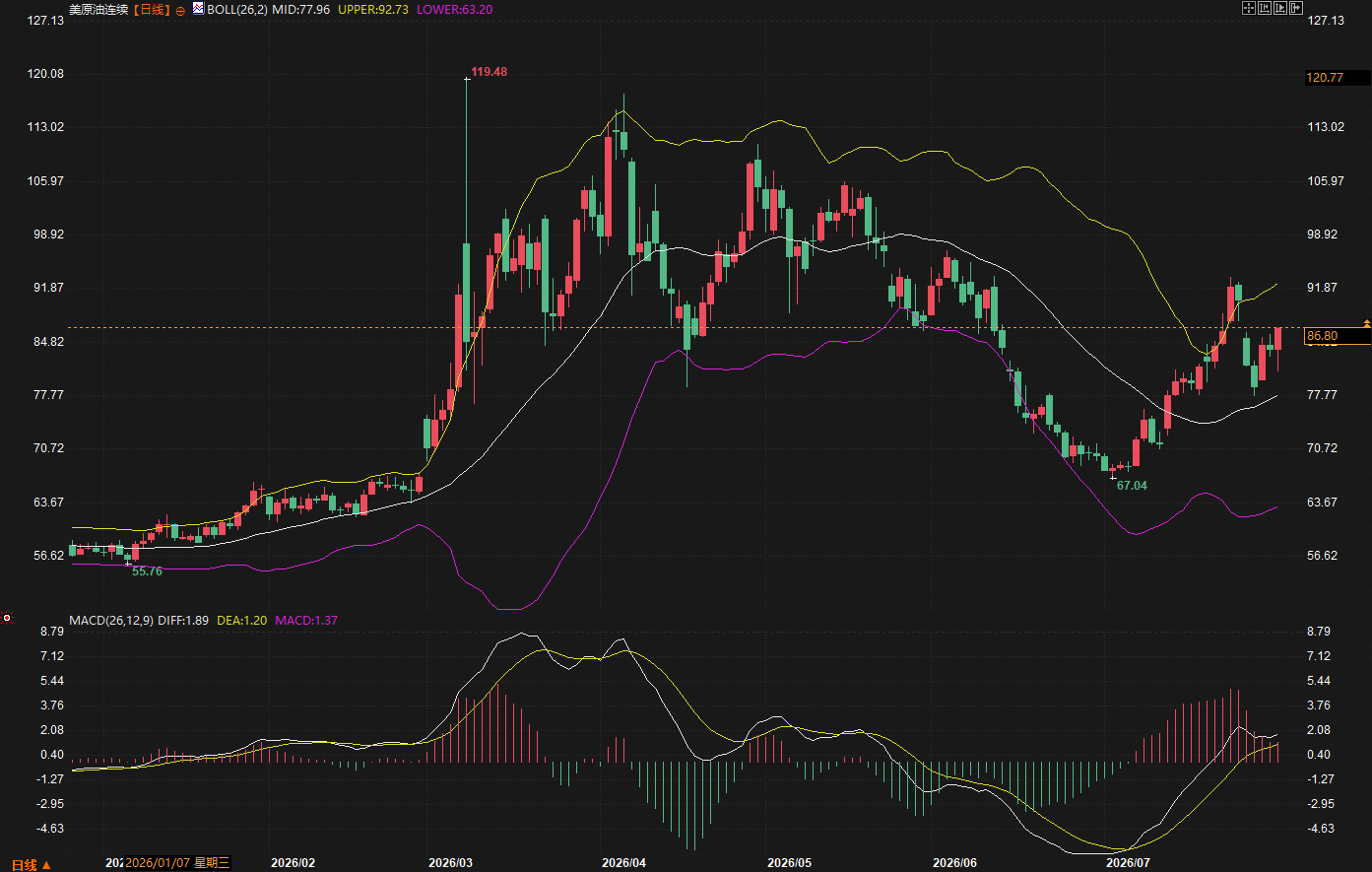
This week, global energy futures rose across all commodities, with speculative funds returning to the crude oil market in large numbers. Brent crude closed near $90.18 per barrel, surging about 6.6% for the week; WTI crude closed at $86.80, with an even larger weekly gain of 6.8%. Refined products followed suit, with US unleaded gasoline rising 2.20%, London diesel up 1.50%, and US fuel oil up 1.25%. This surge was not driven by a sudden change in demand, but rather by the simultaneous and substantial disruption of three key global energy transport routes: the Strait of Hormuz, the Bab el-Mandeb Strait in the Red Sea, and the Black Sea. Hedge funds poured into WTI crude oil long positions at the fastest pace in nearly four months, signaling a deep reassessment of geopolitical risk premiums in the market. 
 Economic Data and Event Summary Regarding positioning data, the Commitment of Traders (CFTC) report showed that in the week ending July 28, fund managers surged 21,402 net long positions in WTI crude oil to 108,307 contracts, marking the fastest increase since March of this year. Net long positions in gasoline also rose to a four-month high, while net long positions in diesel reached a near five-month peak. In stark contrast, net long positions in Brent crude oil decreased slightly by 6,948 contracts to 185,083 contracts, indicating that funds are heavily betting on US crude oil rather than broadly bullish on global oil prices. On the event-driven front, three major shipping routes were almost simultaneously under pressure. The Strait of Hormuz, due to armed conflict in the Middle East, was essentially closed again after the temporary ceasefire in mid-July was assessed as having effectively failed, bringing tanker traffic to a near standstill and disrupting approximately one-fifth of global seaborne oil transport. To mitigate the risks associated with the Strait of Hormuz, Saudi Arabia massively shifted its exports to the port of Yanbu on the Red Sea, with daily shipments surging from approximately 970,000 barrels to over 4.5 million barrels. However, this alternative route was subsequently hit by a maritime embargo declared by the Houthi rebels in Yemen and missile attacks, drastically deteriorating the security of the Bab el-Mandeb Strait. In the Black Sea region, amidst the escalating tensions between Russia and Ukraine, four oil tankers at the Caspian Pipeline Union (CPC) terminal were attacked by drones in mid-July, temporarily halting loading operations and forcing Kazakhstan to reduce its daily crude oil production from approximately 2.07 million barrels to 1.63 million barrels. The combined effect of these three routes severely challenges the normal flow of millions of barrels of crude oil daily. Analyst and institutional perspectives : Market analysis generally focuses on the "geographical immunity" of US crude oil. Major overseas institutions point out that when the Hormuz, Bab el-Mandeb, and Black Sea shipping routes are simultaneously restricted, Gulf of Mexico crude oil becomes one of the few sources of incremental supply unaffected by direct geopolitical risks. This is the core logic behind the surge in WTI net long positions and the stagnation of Brent positions. The reduction in Brent long positions is not due to a shift towards pessimism in oil prices, but rather because Brent-denominated spot commodities in the North Sea and Mediterranean also face logistical uncertainties, leading funds to concentrate their holdings on the more certain US benchmark. Regarding refined oil products, diesel long positions hit a five-month high, seen by traders as proactive positioning in anticipation of global refining capacity losses and a potential widening of crack spreads. According to a well-known foreign media analysis, the transportation crisis is unexpectedly increasing the relative attractiveness of alternative fuels. For example, Sustainable Aviation Fuel (SAF) previously cost 3 to 5 times more than conventional jet fuel; after the closure of the Strait of Hormuz, jet fuel prices surged, and the price difference has rapidly narrowed to 1.5 to 2 times. However, high geopolitical volatility makes airlines and refiners hesitant to sign long-term purchase agreements, making policy mandates seen as a key variable in unlocking this investment. The analysis suggests that governments should clearly define this price difference as an energy security premium, accelerating fuel diversification. This week's strong oil prices were not driven by an expansion in aggregate demand, but rather by concentrated pricing resulting from the simultaneous "blockage" of multiple major supply arteries. Hedge fund flows have sent a clear signal: in an environment of high global supply uncertainty, certain supply is commanding a significant premium. Looking ahead, if the three major transportation bottlenecks cannot be effectively resolved in the short term, US crude oil exports and refined oil prices may face further upward pressure. However, the highly volatile geopolitical news also dictates that intraday two-way fluctuations will be exceptionally sharp, making volatility management the core issue for current positions. QA Module Why have hedge funds significantly increased their WTI long positions while reducing their Brent long positions? This divergence in positions reflects a "certainty premium" rather than a simple judgment of oil price direction. Brent crude oil pricing is based on spot prices from the North Sea and Mediterranean, and this round of supply shocks has severely disrupted crude oil logistics in the Eastern Hemisphere. The closure of the Strait of Hormuz affected the eastward and westward flow of Middle Eastern crude oil, the danger in the Bab el-Mandeb Strait blocked Saudi Arabia's Red Sea exports, and the attack on the CPC terminal in the Black Sea cut off Kazakhstan's western passage. Most of the affected oil types are more closely linked to the Brent pricing system. Logistics disruptions mean significant uncertainty in spot market circulation, and long positions in Brent will face complex risks regarding delivery and pricing if they continue to hold large Brent positions. WTI crude oil, on the other hand, is almost entirely unaffected by the three supply routes. Shipments and exports from the Gulf of Mexico remain normal, and the shale oil production pipelines are all located within the United States, forming a natural geographical barrier. Fund managers increasing their net long positions in WTI to over 100,000 contracts essentially means they are paying a premium for the "only freely flowing incremental supply source globally." Reducing Brent holdings is not necessarily a sign of bearishness, but rather, from a paired trading perspective, more funds may be engaged in long WTI/short Brent spread trading, betting on a continued widening of the transatlantic spread. Therefore, the signal from this change in positions is that the market is not betting on a general rise in global oil prices, but rather on a repricing of the relative scarcity of US crude oil. How exactly does the simultaneous disruption of the three supply routes impact global crude oil trade flows? The severing of the first strait, the Strait of Hormuz, directly blocked the main oil export route from the Middle East to Asia and Europe. A significant portion of the nearly 20 million barrels transported daily had to find alternative routes or come to a complete standstill. To bypass Hormuz, Saudi Arabia had to shift its export route westward to the port of Yanbu on the Red Sea, causing shipments to surge to more than four times the usual volume. This created a second wave of risk transmission—the Bab el-Mandeb Strait on the Red Sea instantly became Saudi Arabia's last "oil escape route." The Houthi rebels in Yemen targeted this vulnerability, declaring a maritime embargo and carrying out attacks. If the situation continues to escalate, most of Saudi Arabia's exports will face disruption, and the market will lose approximately 7% of its global supply. Meanwhile, the CPC terminal on the Black Sea, a crucial node for Kazakhstan's oil exports to Europe, handles approximately 1.4 million barrels daily. The attack forced a production cut of over 20%, directly tightening physical supplies from the Mediterranean and Europe. The three supply routes are not independent events, but rather form a relay-like supply compression: the closure of the Strait of Hormuz forced cargo flows to be diverted, and the resulting over-concentration dramatically amplified the vulnerability of the Bab el-Mandeb Strait; meanwhile, the reduced supply from the Black Sea created additional spot premiums in the European market. The result of this three-pronged effect is a rapid collapse in the marginal supply of global seaborne crude oil, forcing the remaining freely available crude oil to rely more heavily on US exports, leading to a short-term shift in pricing power. Diesel long positions hit a five-month high, indicating what trading logic the market is trading on. The surge in diesel positions reveals not only the transmission of crude oil costs, but also a deep bet on the contraction of global refining capacity. In this geopolitical crisis, the impact extends far beyond crude oil extraction and transportation; refineries also suffer direct and indirect blows. Under the Russia-Ukraine situation, Ukraine's continued attacks on refining facilities have reduced Russian refinery crude oil processing to a 21-year low, and Moscow has essentially banned diesel exports. In the Middle East, condensate and refined oil exports from countries surrounding the Strait of Hormuz have been simultaneously hampered. When crude oil itself becomes scarce, the capacity to refine it into end products such as diesel and jet fuel becomes even tighter. Speculative funds are pushing up net long positions in diesel, betting on a continued widening of the crack spread—meaning diesel prices will rise more than crude oil prices. This logic has been repeatedly validated in historical supply crises: once the market realizes that "the shortage is not of oil, but of refined fuels," refining profits often experience a non-linear surge. Meanwhile, diesel, as an essential fuel for industry and transportation, is difficult to replace in the short term, and the supply gap will quickly be reflected in the spot premium. Therefore, the record high diesel positions indicate that funds have begun to position themselves in advance for a potential broad-based premium diffusion in refined oil products. Why did the Hormuz crisis unexpectedly shorten the price difference between sustainable aviation fuel and traditional jet fuel, but still not trigger large-scale investment? Before the closure of the Strait of Hormuz, hundreds of thousands of barrels of jet fuel from the Middle East were shipped to Europe daily, accounting for more than 40% of Europe's imports. After this supply line was cut off, European jet fuel spot prices soared. The supply chain for sustainable aviation fuel (SAF) has not been directly affected by geopolitical disruptions, and its price has remained relatively stable. This has led to a rapid narrowing of the price difference between SAF and conventional jet fuel from 3 to 5 times to 1.5 to 2 times. From an economic perspective, this narrowing is highly significant: for the first time without large-scale subsidies, alternative fuels are approaching parity with fossil jet fuel. However, this narrowing price difference has not immediately triggered investment, because geopolitical volatility itself creates a double-edged sword effect. On the one hand, airlines are suffering from profit losses due to soaring fuel costs and tight cash flow, making it impossible for them to sign multi-year SAF purchase agreements to support new capacity construction under the current uncertainty. On the other hand, although SAF producers have record-high profit margins, in an environment of volatile prices, they are more inclined to execute existing projects and optimize operations than to approve new capital expenditures. Therefore, government and regulatory mandates are seen by the market as the decisive force to break the deadlock. Without policymakers defining this price difference as an "energy security premium" and providing coordinated infrastructure support, it will be difficult for market forces alone to complete the structural shift from jet fuel to SAF in the short term. Can US crude oil exports fully compensate for the current global supply gap? Where are the potential bottlenecks? While US crude oil does possess a unique "safety buffer" status, its potential to offset the global supply gap is not unlimited. The first constraint comes from export infrastructure. Although the export terminals along the Gulf Coast have considerable capacity, facing a sudden surge in global buying, shipping schedules and port loads are already at historical highs, making it difficult to significantly increase export volumes in the short term. The second constraint comes from quality mismatch. US shale oil is mainly light, low-sulfur crude oil, while the oil types from the Middle East and Kazakhstan affected by this crisis are mostly medium-sulfur crude oil. Global refinery configurations cannot be infinitely converted to light crude oil as a substitute, especially since complex Asian refineries are highly dependent on sulfur-containing crude oil. The substitution process will push up the discount of light crude oil and may cause some refineries to reduce output. The third bottleneck lies in the depletion of strategic reserves. The US strategic petroleum reserves have been rapidly depleted in previous large-scale exports, and both the space for further release and the political will are weakening. The market cannot view this as a bottomless source of incremental growth. Furthermore, uncertainties surrounding domestic and environmental policies also limit the explosive growth of shale oil production. In summary, while US crude oil can alleviate the shortfall, it is unlikely to alone offset the potential reduction of millions of barrels per day. The current market risk premium for WTI has partially priced in this logic, and if export capacity reaches its limit, the premium may further spread to refined oil products and alternative energy sectors.
crude
This Week's Market Review : Observing the multi-period heatmap, both WTI and Brent crude oil saw weekly gains exceeding 6.5%, indicating extremely strong short-term momentum. On the daily chart, WTI crude oil has staged a deep V-shaped rebound from its previous low near $67, and the current price has stabilized above the Bollinger Band's middle band. The MACD histogram is positive and the momentum bars continue to expand, indicating a clear short-term bullish trend. Brent crude oil's movement is synchronized with this, with the middle band providing effective support. After rebounding above $91, the price has fluctuated slightly, still some distance from the upper Bollinger Band at $99.98, but volatility has increased significantly. It's worth noting that while crude oil has seen a slight daily decline of 0.77%, both the 1-hour and 4-hour charts have recorded gains of nearly 2%, suggesting active intraday trading by short-term funds, with the main divergence between bulls and bears compressed within shorter trading timeframes. Economic Data and Event Summary Regarding positioning data, the Commitment of Traders (CFTC) report showed that in the week ending July 28, fund managers surged 21,402 net long positions in WTI crude oil to 108,307 contracts, marking the fastest increase since March of this year. Net long positions in gasoline also rose to a four-month high, while net long positions in diesel reached a near five-month peak. In stark contrast, net long positions in Brent crude oil decreased slightly by 6,948 contracts to 185,083 contracts, indicating that funds are heavily betting on US crude oil rather than broadly bullish on global oil prices. On the event-driven front, three major shipping routes were almost simultaneously under pressure. The Strait of Hormuz, due to armed conflict in the Middle East, was essentially closed again after the temporary ceasefire in mid-July was assessed as having effectively failed, bringing tanker traffic to a near standstill and disrupting approximately one-fifth of global seaborne oil transport. To mitigate the risks associated with the Strait of Hormuz, Saudi Arabia massively shifted its exports to the port of Yanbu on the Red Sea, with daily shipments surging from approximately 970,000 barrels to over 4.5 million barrels. However, this alternative route was subsequently hit by a maritime embargo declared by the Houthi rebels in Yemen and missile attacks, drastically deteriorating the security of the Bab el-Mandeb Strait. In the Black Sea region, amidst the escalating tensions between Russia and Ukraine, four oil tankers at the Caspian Pipeline Union (CPC) terminal were attacked by drones in mid-July, temporarily halting loading operations and forcing Kazakhstan to reduce its daily crude oil production from approximately 2.07 million barrels to 1.63 million barrels. The combined effect of these three routes severely challenges the normal flow of millions of barrels of crude oil daily. Analyst and institutional perspectives : Market analysis generally focuses on the "geographical immunity" of US crude oil. Major overseas institutions point out that when the Hormuz, Bab el-Mandeb, and Black Sea shipping routes are simultaneously restricted, Gulf of Mexico crude oil becomes one of the few sources of incremental supply unaffected by direct geopolitical risks. This is the core logic behind the surge in WTI net long positions and the stagnation of Brent positions. The reduction in Brent long positions is not due to a shift towards pessimism in oil prices, but rather because Brent-denominated spot commodities in the North Sea and Mediterranean also face logistical uncertainties, leading funds to concentrate their holdings on the more certain US benchmark. Regarding refined oil products, diesel long positions hit a five-month high, seen by traders as proactive positioning in anticipation of global refining capacity losses and a potential widening of crack spreads. According to a well-known foreign media analysis, the transportation crisis is unexpectedly increasing the relative attractiveness of alternative fuels. For example, Sustainable Aviation Fuel (SAF) previously cost 3 to 5 times more than conventional jet fuel; after the closure of the Strait of Hormuz, jet fuel prices surged, and the price difference has rapidly narrowed to 1.5 to 2 times. However, high geopolitical volatility makes airlines and refiners hesitant to sign long-term purchase agreements, making policy mandates seen as a key variable in unlocking this investment. The analysis suggests that governments should clearly define this price difference as an energy security premium, accelerating fuel diversification. This week's strong oil prices were not driven by an expansion in aggregate demand, but rather by concentrated pricing resulting from the simultaneous "blockage" of multiple major supply arteries. Hedge fund flows have sent a clear signal: in an environment of high global supply uncertainty, certain supply is commanding a significant premium. Looking ahead, if the three major transportation bottlenecks cannot be effectively resolved in the short term, US crude oil exports and refined oil prices may face further upward pressure. However, the highly volatile geopolitical news also dictates that intraday two-way fluctuations will be exceptionally sharp, making volatility management the core issue for current positions. QA Module Why have hedge funds significantly increased their WTI long positions while reducing their Brent long positions? This divergence in positions reflects a "certainty premium" rather than a simple judgment of oil price direction. Brent crude oil pricing is based on spot prices from the North Sea and Mediterranean, and this round of supply shocks has severely disrupted crude oil logistics in the Eastern Hemisphere. The closure of the Strait of Hormuz affected the eastward and westward flow of Middle Eastern crude oil, the danger in the Bab el-Mandeb Strait blocked Saudi Arabia's Red Sea exports, and the attack on the CPC terminal in the Black Sea cut off Kazakhstan's western passage. Most of the affected oil types are more closely linked to the Brent pricing system. Logistics disruptions mean significant uncertainty in spot market circulation, and long positions in Brent will face complex risks regarding delivery and pricing if they continue to hold large Brent positions. WTI crude oil, on the other hand, is almost entirely unaffected by the three supply routes. Shipments and exports from the Gulf of Mexico remain normal, and the shale oil production pipelines are all located within the United States, forming a natural geographical barrier. Fund managers increasing their net long positions in WTI to over 100,000 contracts essentially means they are paying a premium for the "only freely flowing incremental supply source globally." Reducing Brent holdings is not necessarily a sign of bearishness, but rather, from a paired trading perspective, more funds may be engaged in long WTI/short Brent spread trading, betting on a continued widening of the transatlantic spread. Therefore, the signal from this change in positions is that the market is not betting on a general rise in global oil prices, but rather on a repricing of the relative scarcity of US crude oil. How exactly does the simultaneous disruption of the three supply routes impact global crude oil trade flows? The severing of the first strait, the Strait of Hormuz, directly blocked the main oil export route from the Middle East to Asia and Europe. A significant portion of the nearly 20 million barrels transported daily had to find alternative routes or come to a complete standstill. To bypass Hormuz, Saudi Arabia had to shift its export route westward to the port of Yanbu on the Red Sea, causing shipments to surge to more than four times the usual volume. This created a second wave of risk transmission—the Bab el-Mandeb Strait on the Red Sea instantly became Saudi Arabia's last "oil escape route." The Houthi rebels in Yemen targeted this vulnerability, declaring a maritime embargo and carrying out attacks. If the situation continues to escalate, most of Saudi Arabia's exports will face disruption, and the market will lose approximately 7% of its global supply. Meanwhile, the CPC terminal on the Black Sea, a crucial node for Kazakhstan's oil exports to Europe, handles approximately 1.4 million barrels daily. The attack forced a production cut of over 20%, directly tightening physical supplies from the Mediterranean and Europe. The three supply routes are not independent events, but rather form a relay-like supply compression: the closure of the Strait of Hormuz forced cargo flows to be diverted, and the resulting over-concentration dramatically amplified the vulnerability of the Bab el-Mandeb Strait; meanwhile, the reduced supply from the Black Sea created additional spot premiums in the European market. The result of this three-pronged effect is a rapid collapse in the marginal supply of global seaborne crude oil, forcing the remaining freely available crude oil to rely more heavily on US exports, leading to a short-term shift in pricing power. Diesel long positions hit a five-month high, indicating what trading logic the market is trading on. The surge in diesel positions reveals not only the transmission of crude oil costs, but also a deep bet on the contraction of global refining capacity. In this geopolitical crisis, the impact extends far beyond crude oil extraction and transportation; refineries also suffer direct and indirect blows. Under the Russia-Ukraine situation, Ukraine's continued attacks on refining facilities have reduced Russian refinery crude oil processing to a 21-year low, and Moscow has essentially banned diesel exports. In the Middle East, condensate and refined oil exports from countries surrounding the Strait of Hormuz have been simultaneously hampered. When crude oil itself becomes scarce, the capacity to refine it into end products such as diesel and jet fuel becomes even tighter. Speculative funds are pushing up net long positions in diesel, betting on a continued widening of the crack spread—meaning diesel prices will rise more than crude oil prices. This logic has been repeatedly validated in historical supply crises: once the market realizes that "the shortage is not of oil, but of refined fuels," refining profits often experience a non-linear surge. Meanwhile, diesel, as an essential fuel for industry and transportation, is difficult to replace in the short term, and the supply gap will quickly be reflected in the spot premium. Therefore, the record high diesel positions indicate that funds have begun to position themselves in advance for a potential broad-based premium diffusion in refined oil products. Why did the Hormuz crisis unexpectedly shorten the price difference between sustainable aviation fuel and traditional jet fuel, but still not trigger large-scale investment? Before the closure of the Strait of Hormuz, hundreds of thousands of barrels of jet fuel from the Middle East were shipped to Europe daily, accounting for more than 40% of Europe's imports. After this supply line was cut off, European jet fuel spot prices soared. The supply chain for sustainable aviation fuel (SAF) has not been directly affected by geopolitical disruptions, and its price has remained relatively stable. This has led to a rapid narrowing of the price difference between SAF and conventional jet fuel from 3 to 5 times to 1.5 to 2 times. From an economic perspective, this narrowing is highly significant: for the first time without large-scale subsidies, alternative fuels are approaching parity with fossil jet fuel. However, this narrowing price difference has not immediately triggered investment, because geopolitical volatility itself creates a double-edged sword effect. On the one hand, airlines are suffering from profit losses due to soaring fuel costs and tight cash flow, making it impossible for them to sign multi-year SAF purchase agreements to support new capacity construction under the current uncertainty. On the other hand, although SAF producers have record-high profit margins, in an environment of volatile prices, they are more inclined to execute existing projects and optimize operations than to approve new capital expenditures. Therefore, government and regulatory mandates are seen by the market as the decisive force to break the deadlock. Without policymakers defining this price difference as an "energy security premium" and providing coordinated infrastructure support, it will be difficult for market forces alone to complete the structural shift from jet fuel to SAF in the short term. Can US crude oil exports fully compensate for the current global supply gap? Where are the potential bottlenecks? While US crude oil does possess a unique "safety buffer" status, its potential to offset the global supply gap is not unlimited. The first constraint comes from export infrastructure. Although the export terminals along the Gulf Coast have considerable capacity, facing a sudden surge in global buying, shipping schedules and port loads are already at historical highs, making it difficult to significantly increase export volumes in the short term. The second constraint comes from quality mismatch. US shale oil is mainly light, low-sulfur crude oil, while the oil types from the Middle East and Kazakhstan affected by this crisis are mostly medium-sulfur crude oil. Global refinery configurations cannot be infinitely converted to light crude oil as a substitute, especially since complex Asian refineries are highly dependent on sulfur-containing crude oil. The substitution process will push up the discount of light crude oil and may cause some refineries to reduce output. The third bottleneck lies in the depletion of strategic reserves. The US strategic petroleum reserves have been rapidly depleted in previous large-scale exports, and both the space for further release and the political will are weakening. The market cannot view this as a bottomless source of incremental growth. Furthermore, uncertainties surrounding domestic and environmental policies also limit the explosive growth of shale oil production. In summary, while US crude oil can alleviate the shortfall, it is unlikely to alone offset the potential reduction of millions of barrels per day. The current market risk premium for WTI has partially priced in this logic, and if export capacity reaches its limit, the premium may further spread to refined oil products and alternative energy sectors.
- Risk Warning and Disclaimer
- The market involves risk, and trading may not be suitable for all investors. This article is for reference only and does not constitute personal investment advice, nor does it take into account certain users’ specific investment objectives, financial situation, or other needs. Any investment decisions made based on this information are at your own risk.