Gold Trading Alert: Trump's "feints" fail to resolve the Middle East crisis; gold prices fluctuate wildly. When will this stalemate break out?
2026-08-04 07:40:51
Spot gold initially surged to around $4,082 per ounce in early trading on Monday (August 3), before fluctuating back to around $4,020, ultimately closing at $4,055.34, a decrease of 0.22%. August gold futures settled at $4,090.50, down 0.4%. On the surface, this appears to be a minor correction, but it reflects a fierce interplay of multiple forces: the unresolved Middle East conflict, volatile oil prices, resurgent inflation expectations, and high uncertainty surrounding the Federal Reserve's policy path. Gold has been oscillating within a narrow range of $4,000 to $4,200 for over a month, with each geopolitical "feint" testing the market's patience and pricing logic. On Tuesday (August 4) in early Asian trading, spot gold continued to fluctuate narrowly around $4,050. The market will continue to focus on further news regarding the Middle East situation. The US June JOLTs job openings data will be released today, which investors should pay close attention to. 
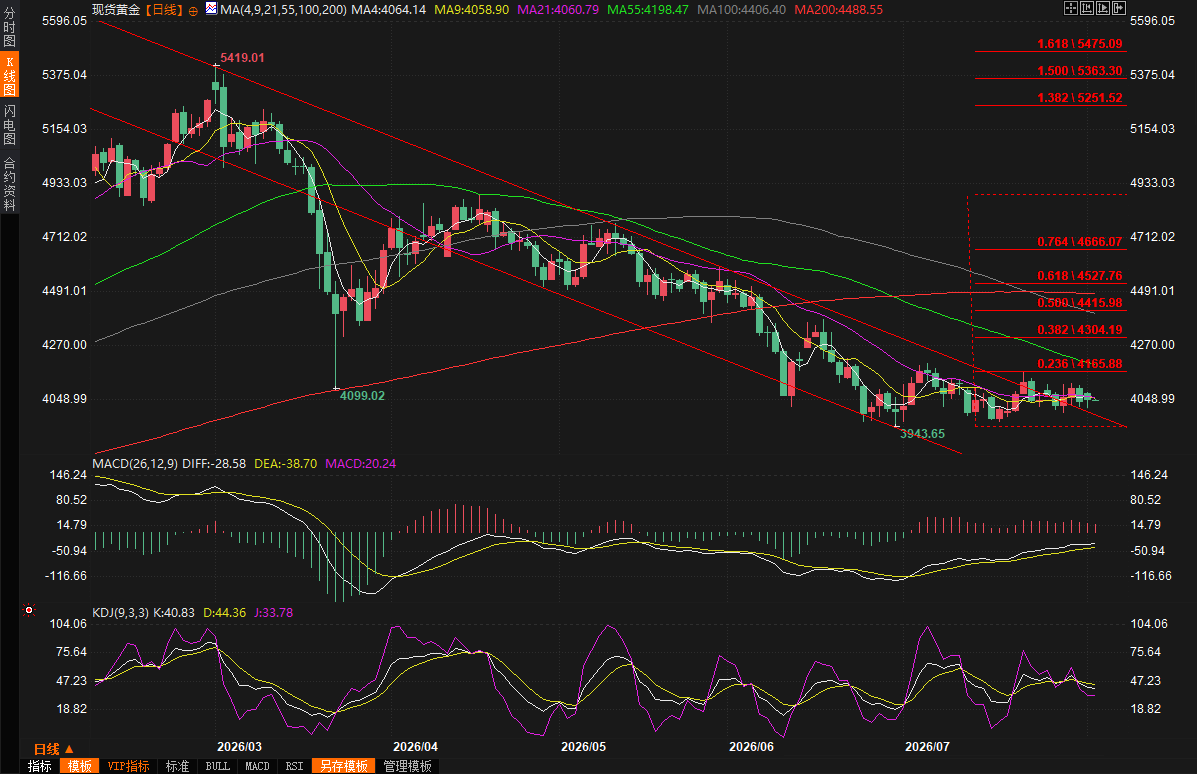 (Spot gold daily chart, source: FX678) At 07:37 Beijing time, spot gold is currently trading at $4051.37 per ounce.
Trump's "cancel strike" and Iran's steadfast denial: Risk aversion sentiment repeatedly eroded.
The immediate trigger for the recent surge and subsequent decline in gold prices was US President Trump's sudden halt to the planned "mass strike" against Iran over the weekend, along with his announcement that negotiations would take place. This statement initially boosted gold prices on Monday, as the market briefly interpreted it as a de-escalation of the conflict and a temporary easing of safe-haven demand. However, Iran quickly denied this. A spokesperson for the Iranian Foreign Ministry stated explicitly that there were currently no negotiations with the US, nor were there any plans for meetings; all relevant negotiators were in Iran, and the only ongoing discussions were administrative contacts with Oman regarding the management of the Strait of Hormuz. Trump subsequently accused Iran of "extreme hypocrisy" on social media and reiterated the US's "complete control" over the Strait of Hormuz, warning that "nothing will enter" unless an agreement is reached or there is total surrender. This contradictory statement almost perfectly replicates the pattern of the conflict over the past five months: Trump repeatedly threatened military action, only to withdraw those threats under the pretext of diplomatic contact; while Iran, since the breakdown of the memorandum of understanding in June, has openly refused direct negotiations with Washington. The conflict has entered a cycle of repeated escalations and temporary de-escalations, thus continuously depleting safe-haven demand. As a traditional safe-haven asset, gold struggles to maintain a sustained upward trend in an environment rife with false signals. Each temporary de-escalation of conflict leads some funds to shift from gold to other riskier assets, while gold prices quickly find support again once tensions rise once more. Currently, the market tends to view the Middle East situation as a long-term "background noise" rather than a decisive factor that can immediately push gold prices above $4200.Oil price rollercoaster and the looming shadow of renewed inflation: the core supporting logic for gold remains unchanged.
Almost simultaneously with the fluctuations in gold prices, the crude oil market experienced significant volatility. Last month, Brent crude futures prices surged by over 20% as the US-Iran conflict reignited and several oil tankers near Oman were attacked. On Monday, spurred by news that Trump had paused the attacks, Brent crude plummeted by about 7%, falling to a three-week low, settling at $83.77 per barrel; US crude also fell by over 5%. The sharp drop in oil prices temporarily eased market concerns about runaway energy costs, but analysts generally believe this may just be another "false alarm" in the conflict. If the war continues or takes the form of a long-term standoff, restrictions on shipping in and around the Strait of Hormuz will continue to provide upward support for oil prices. Inflation risk has therefore become one of the core supporting factors for gold prices. Marex analyst Edward Meir pointed out that gold has been fluctuating between $4,000 and $4,200 for more than a month, with the market anticipating a possible resurgence of inflation, especially as July data is likely to reverse most of the losses from June. The US ISM Manufacturing PMI rose to 55.6 in July, a more than four-year high, with new orders and employment indices improving simultaneously. However, extended supplier delivery times and a still high input price index of 71.1 indicate that supply chain pressures and rising costs have not truly subsided. In business feedback, price volatility and the Iran-Iraq conflict were frequently mentioned, with some manufacturers stating that the current situation is even more difficult to manage than during the pandemic. The Federal Reserve kept interest rates unchanged last week, but three members publicly advocated for a rate hike, and New York Fed President Williams also stated that the Fed is prepared to act if inflationary pressures do not ease. The market currently prices in a 68% probability of a September rate hike. In this environment, gold's status as an inflation hedge is reinforced—even if it falls in the short term due to geopolitical easing, it still has strong support in the medium to long term.Dollar rebound after hitting a low and the employment data window: factors disrupting short-term trading rhythm.
The US dollar index rebounded on Monday after hitting a one-and-a-half-month low of 99.42 in early trading, before closing at 99.96, a gain of about 0.17%, ending a four-day losing streak. A temporary easing of geopolitical tensions typically weakens the dollar's safe-haven appeal while supporting the euro and yen. However, analysts pointed out that the US Treasury's reported intervention through the euro was intended to avoid signaling a broader weakening of the dollar. The stabilization of the dollar put some pressure on gold prices, as dollar-denominated gold tends to be under pressure when the dollar strengthens. Another focus for the market this week is US employment data. The ADP employment report and non-farm payroll data will be released, with economists expecting approximately 80,000 new jobs added in July. These data will directly influence market expectations regarding the Federal Reserve's policy path. Strong employment data could further reinforce expectations of interest rate hikes, thus putting short-term pressure on gold prices; weak data could alleviate tightening concerns, giving gold some breathing room. At the same time, the Bank of Korea announced that it would purchase gold from domestic producers to diversify its supply sources and increase reserves. Although the move was limited in scale, it signaled that the government would continue to increase its gold holdings, providing marginal support to market sentiment.Range-bound trading may continue; a clearer catalyst is needed for a breakout.
In summary, the current volatile pattern in gold prices is not accidental. The recurring conflicts in the Middle East have weakened the sustainability of the safe-haven premium, while the rollercoaster ride of oil prices has caused inflation expectations to switch back and forth between "easing" and "re-emerging," and the high degree of uncertainty surrounding the Federal Reserve's policy has further amplified market hesitation. Gold has established a foothold above $4,000, but to effectively break through $4,200 and open up further upside potential, a clearer catalyst is still needed—either a genuine long-term escalation of the Middle East situation that pushes up oil prices and inflation, a clear signal of a shift towards easing by the Federal Reserve, or a further expansion of global central bank gold purchases. Until then, the market is more likely to continue seeking equilibrium within the range. Every "tug-of-war" between Trump and Iran, every sharp rise and fall in oil prices, and every release of employment data will become triggers for short-term volatility. For investors, rather than chasing every geopolitical "false move," it is better to focus more on the actual path of inflation and the Federal Reserve's true response function. The long-term logic of gold has not been broken, but the short-term trading rhythm has been dominated by the complexity of the Middle East conflict and the oscillating policy expectations. In this uncertain August, every pullback in gold prices may be a way of building momentum for a stronger rebound. (Spot gold daily chart, source: FX678) At 07:37 Beijing time, spot gold is currently trading at $4051.37 per ounce.
- Risk Warning and Disclaimer
- The market involves risk, and trading may not be suitable for all investors. This article is for reference only and does not constitute personal investment advice, nor does it take into account certain users’ specific investment objectives, financial situation, or other needs. Any investment decisions made based on this information are at your own risk.