Concerns about weak Australian data are rising, coupled with the resilience of the US dollar: What are the risks of a short-term pullback in the Australian dollar?
2026-08-04 08:26:52
On Tuesday (August 4) in early Asian trading, the Australian dollar was trading around the 0.7000 level against the US dollar. The exchange rate had previously tested 0.7050 yesterday but subsequently gave back gains, ultimately closing at 0.6998. Despite generally positive risk appetite in global markets, the US dollar recovered some lost ground supported by strong economic data, while signs of easing geopolitical tensions in the Middle East combined to put downward pressure on the Australian dollar. The US July ISM Manufacturing PMI came in at 55.6, higher than the previous reading of 53.3, reaching its highest level since 2022. Sub-indices showed continued hiring by businesses, but the prices paid index reflected persistently high input costs. Overall, although the sub-indices showed mixed results, the overall manufacturing sector's expansion momentum was strong, providing upward momentum for the US dollar. 
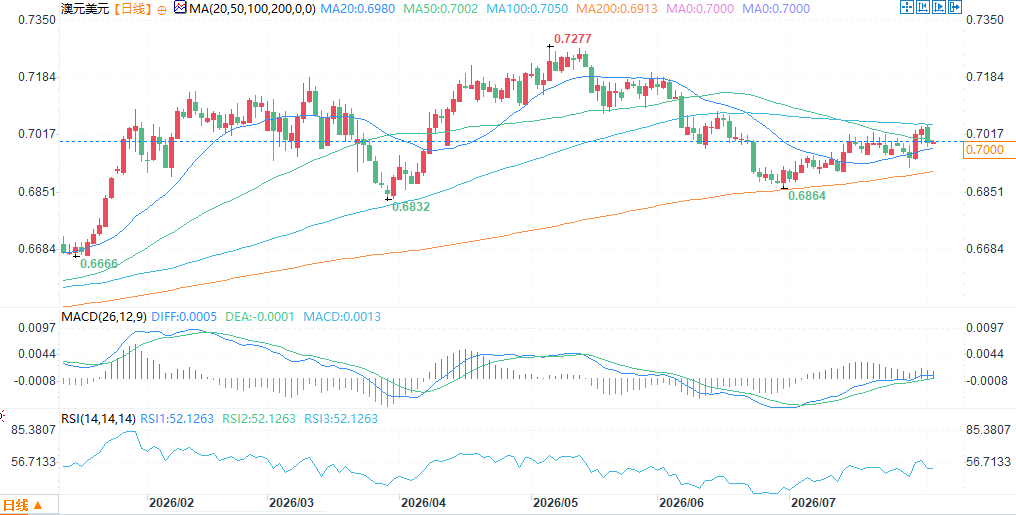 (Australian dollar against US dollar daily chart, source: EasyForex) At 8:17 AM Beijing time on August 4, the Australian dollar was trading at 0.7000/01 against the US dollar.
The plunge in oil prices eased expectations of interest rate hikes, but the US dollar remained favored.
Progress in US-Iran negotiations eased concerns about supply disruptions in the Middle East, causing US WTI crude oil futures to plunge over 7.70% in a single day, briefly falling below $80 per barrel. While the oil price crash somewhat alleviated market concerns about further interest rate hikes by the Federal Reserve, the dollar did not weaken significantly—the market was also digesting news of two consecutive days of intervention in the foreign exchange market by US and Japanese authorities to boost the yen. New York Fed President Williams stated that the current monetary policy stance is conducive to pushing inflation back to the 2% target, and if the economic situation indicates that inflation is unlikely to fall, the Fed will not hesitate to raise interest rates further. However, he remains optimistic that inflation will eventually move towards the target level. This hawkish statement provided additional support for the dollar.Australian domestic data is coming soon.
The Australian dollar opened higher in the morning due to intervention in the US and Japanese currency markets, but subsequently weakened as yen cross rates declined. Going forward, Australian economic data will be the focus of market attention, including ANZ's June job advertisement data and the Australian consumer confidence index. Weak data could further weaken buying support for the Australian dollar.US employment data becomes a key short-term variable.
US employment data is becoming a core variable influencing short-term market trends. Looking ahead, the US economic calendar will be exceptionally busy, with a series of key employment indicators to be released, serving as crucial indicators for investors to assess economic resilience and the Federal Reserve's policy path. The ADP employment report, JOLTS job openings, initial jobless claims, and non-farm payrolls report will be released successively, comprehensively revealing the latest state of the labor market from multiple dimensions, including private sector hiring, corporate hiring intentions, unemployment claim trends, and overall job growth. If the job market continues to remain strong, wage growth pressures may rise again, and the inflation data to be released next week could trigger more significant market volatility. Bond yields may climb rapidly, the dollar may strengthen, and the stock market may face valuation pressures, as the Federal Reserve remains highly focused on curbing five years of high inflation. The correlation between employment and inflation will directly influence market expectations regarding the timing of interest rate cuts, potentially amplifying short-term volatility.Summarize
In summary, the Australian dollar is currently constrained by the rebound of the US dollar and the plunge in oil prices, with the 0.7000 level becoming a key battleground between bulls and bears. Its future trajectory will heavily depend on US employment data and Australian domestic confidence indicators. If the US labor market remains strong, coupled with a further decline in geopolitical risk premiums, the Australian dollar may face a deeper correction; conversely, if risk sentiment improves and oil prices stabilize, the Australian dollar is still expected to rebound, supported by the trendline. Until key data and geopolitical developments become clearer, the tug-of-war around 0.7000 is likely to continue. (Australian dollar against US dollar daily chart, source: EasyForex) At 8:17 AM Beijing time on August 4, the Australian dollar was trading at 0.7000/01 against the US dollar.
- Risk Warning and Disclaimer
- The market involves risk, and trading may not be suitable for all investors. This article is for reference only and does not constitute personal investment advice, nor does it take into account certain users’ specific investment objectives, financial situation, or other needs. Any investment decisions made based on this information are at your own risk.