Crude Oil Trading Alert: Oil prices rebound after a decline; US-Iran tensions to influence the next wave of market movements.
2026-08-04 10:06:56
On Tuesday (August 4) during Asian trading hours, international oil prices rebounded slightly. US crude oil futures were up about 0.8% to around $81 per barrel, while Brent crude oil futures were up about 1% to around $84.45 per barrel. Oil prices temporarily halted their overnight decline of over 7%. 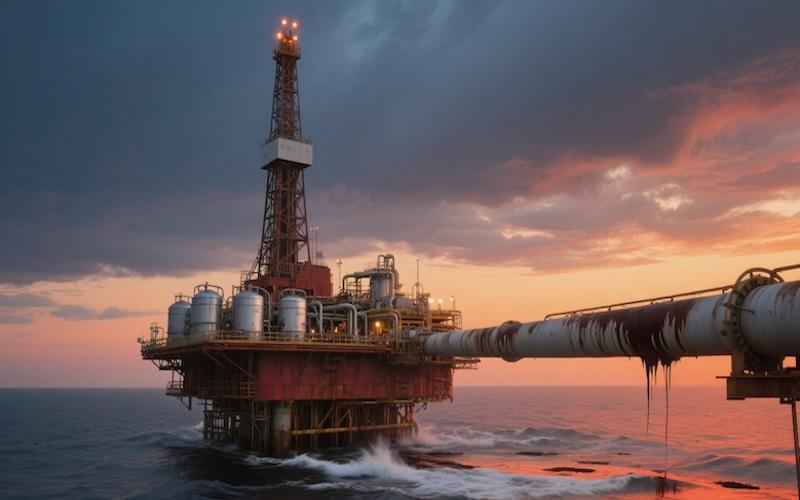
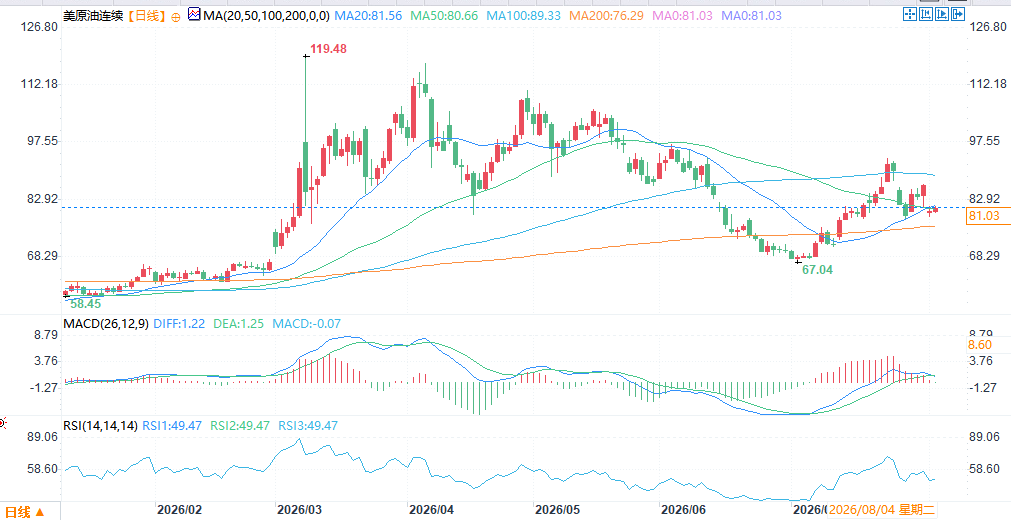 (US crude oil futures daily chart, source: FX678) At 10:04 AM Beijing time on August 4, US crude oil futures were trading at $80.84 per barrel.
Tracing the source of the plunge
The core driver of Monday's oil price plunge was Trump's remarks regarding US-Iran negotiations. On Sunday, US President Trump stated that he would postpone new attacks on Iran given the ongoing negotiations aimed at ending the conflict with Iran and resolving the dispute over control of the Strait of Hormuz. On Monday, Trump further stated that negotiations were "ongoing" and warned that Tehran would face "decapitation" if it did not agree to an agreement. However, Iran's response completely refuted the US claims. Iranian Foreign Ministry spokesman Bagaei clearly stated that Iran is currently not conducting any negotiations with the US, nor has it arranged any meetings, and has no plans to host foreign delegations or send negotiators abroad in the coming days. The contradictory statements from both sides make the prospect of a diplomatic solution to the conflict still bleak, but the market clearly chose to "believe it" immediately, significantly squeezing out the previously priced-in risk of Middle East supply disruptions. Analysts from well-known institutions pointed out that the sharp sell-off in crude oil futures on Monday appears to be another overreaction to Trump's remarks—Trump stated that an agreement with Iran was imminent, just over the weekend he had said a large-scale strike was imminent. This "threat first, then withdraw" pattern has repeatedly triggered sharp two-way fluctuations in oil prices.Multiple negative factors on the supply side
Besides the anticipated US-Iran negotiations, oil prices faced multiple supply-side pressures on Monday: OPEC+ production increases were implemented. The OPEC+ alliance officially approved on Sunday to increase oil production quotas by approximately 188,000 barrels per day starting in September, further increasing short-term supply expectations. High US refinery utilization rates limited exports. Data from the US Energy Information Administration showed that the four-week average capacity utilization rate of US refineries was approximately 96.3%, the highest level since 2018, with crude oil processing reaching a seven-year high. High utilization rates mean more crude oil remains for domestic processing, reducing the amount flowing into the export market. US crude oil exports fell to 3.66 million barrels per day in July, the lowest level in eight months. The export destination structure changed significantly. In July, the share of US crude oil exports to Asia shrank from 52% in June to approximately 40%. Japan's US crude oil imports in July fell 67% from the May peak to 324,000 barrels per day, while South Korea's imports fell 39% to 474,000 barrels per day. Crude oil shipments to Europe have also shrunk from a peak of 2.5 million barrels per day in May to approximately 1.7 million barrels per day. However, analysts expect exports to rebound in August and September. The recent widening of the WTI-Brent discount to $5.42 is expected to stimulate interest from overseas buyers. Leading institutions predict exports of approximately 4.58 million barrels per day in August and approximately 4.45 million barrels per day in September.The support logic behind the rebound
Despite a sharp drop on Monday, oil prices rebounded in Asian trading on Tuesday, supported by the following factors: The outlook for US-Iran negotiations remains uncertain. Iran's complete denial of contact suggests a diplomatic breakthrough is unlikely in the short term, and the supply risks in the Middle East have not truly been eliminated. KCM Trade's chief market analyst pointed out that while some pressure on oil prices has eased with Trump's suspension of strikes and declaration of negotiations, the downward trend remains fragile—because if missiles are fired again, or tankers sailing near the Strait of Hormuz are attacked again, oil prices could rebound quickly. Saudi tankers were forced to change course. According to ship tracking data, six Saudi-flagged supertankers recently changed course in the Gulf of Aden, heading towards southern Africa, due to threats from the Houthi rebels in Yemen to target Saudi vessels. This detour increases transportation costs and time, reflecting that the security risks in the Red Sea-Gulf of Aden shipping route have not dissipated. Although two tankers carrying Saudi oil passed through the Bab el-Mandeb Strait last weekend, the overall shipping security situation remains uncertain. Traffic in the Strait of Hormuz has slowed. Reports indicate that ship traffic in the Strait of Hormuz, between Iran and Oman, has slowed following news of the attack on the vessel. This strait is a vital waterway for approximately one-fifth of the world's oil and liquefied natural gas (LNG) shipments, and any reduction in its efficiency would substantially impact supply schedules. The US export capacity has limitations. Analysts point out that, constrained by factors such as pipeline capacity, vessel availability, and loading schedules, the US currently has a monthly export capacity of approximately 6 million barrels per day. While the US might be required to further increase exports if the Middle East conflict escalates and widens the global supply gap, physical bottlenecks will limit its short-term response capabilities.Market Outlook
In summary, the crude oil market is currently caught in a tug-of-war between "geopolitical risk premium reversal" and "unresolved supply disruption concerns." Trump's "hard and soft" strategy has so far failed to bring Iran back to the negotiating table, and Iran's firm denials mean that a diplomatic breakthrough is unlikely in the short term. Meanwhile, substantial risk signals such as Saudi oil tankers circumnavigating Africa and slowing traffic in the Strait of Hormuz have not disappeared despite Trump's negotiating rhetoric. On the fundamental side, US crude oil exports fell to an eight-month low in July, but are expected to rebound to over 4 million barrels per day in August and September; OPEC+'s decision to increase production by 188,000 barrels per day starting in September has been finalized, and the overall supply side is trending towards easing. However, structural factors such as high refinery operating rates and export capacity bottlenecks mean that the supply elasticity of US crude oil is limited. In the short term, oil prices will continue to fluctuate widely around the $80-85 range, and any new statements from either side or actual developments in the Strait of Hormuz could trigger sharp two-way fluctuations. Traders should be wary of another change in Trump's rhetoric or any substantial military response from Iran—variables that could quickly reverse the current weak and volatile pattern. Until the facts become clearer, news-driven high volatility is expected to be the norm.Summarize
Oil prices plunged on Monday after Trump announced talks with Iran, with Brent crude falling 7% to a three-week low. Iran subsequently denied the allegations, leaving supply risks unresolved. Prices rebounded slightly during Asian trading hours on Tuesday. Negative fundamental factors, including the OPEC+ production increase and high US refinery utilization rates suppressing exports, coexist with geopolitical risks such as Saudi tanker rerouting and slower traffic in the Strait of Hormuz. Against this backdrop of intertwined geopolitical and fundamental factors, coupled with continued news disruptions, the high volatility in oil prices is expected to persist in the short term. (US crude oil futures daily chart, source: FX678) At 10:04 AM Beijing time on August 4, US crude oil futures were trading at $80.84 per barrel.
- Risk Warning and Disclaimer
- The market involves risk, and trading may not be suitable for all investors. This article is for reference only and does not constitute personal investment advice, nor does it take into account certain users’ specific investment objectives, financial situation, or other needs. Any investment decisions made based on this information are at your own risk.