The Bank of Japan passed an interest rate hike by a vote of 7 to 1, but internally, people are saying it's "too slow." What did the Bank of Japan's minutes reveal?
2026-08-05 13:56:53
The US dollar edged lower against the Japanese yen during Asian trading hours on Wednesday (August 6), currently trading around 157.60. The latest minutes of the Bank of Japan's June meeting have injected new policy variables into the yen's short-term trend. The minutes of the Bank of Japan's June 15-16 meeting, released Wednesday, showed that the policy committee voted 7-1 to raise the policy rate by 0.25 percentage points to approximately 1.0%, the highest level since 1995. However, the minutes revealed a more crucial signal—even in the month of the rate hike, some members were already calling for a faster pace of increases, and most members expressed growing concern about the risk of accelerating inflation. This, combined with the "concern for upside risks" signal from the July meeting, makes a September rate hike a "real-time option" priced into the market. 
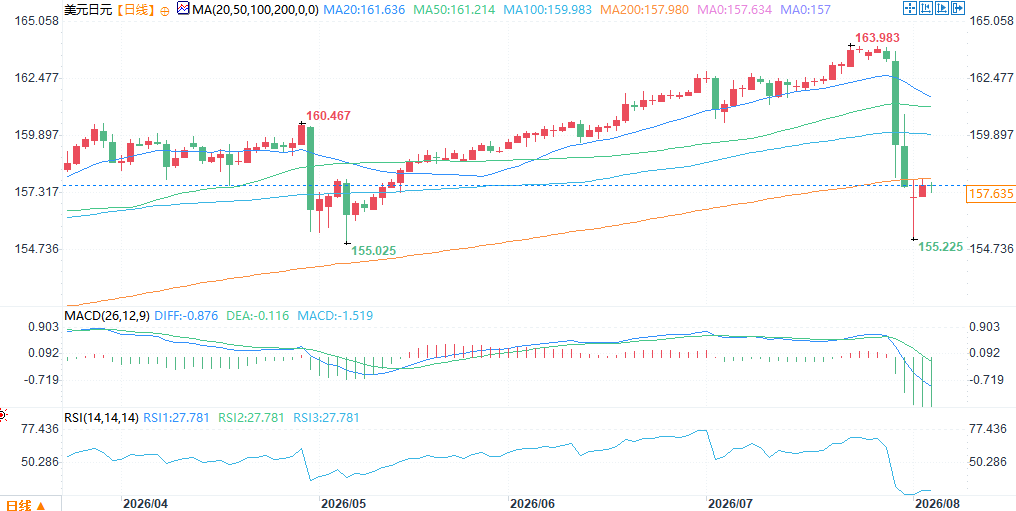 (USD/JPY daily chart, source: FX678) At 13:41 Beijing time on August 5, the USD/JPY exchange rate was 157.63/64.
Voting Results and Internal Disagreements: Undercurrents Behind the 7-1 Victory
Although the ostensible vote was 7 to 1—with only one dissenting vote, Toshiro Asada, who argued that downside risks to production and employment outweighed upside risks to inflation—the minutes revealed that the seven votes in favor did not unanimously endorse the current pace of rate hikes as sufficient. Two members explicitly called for a faster pace of rate increases, advocating for raising the policy rate to the level of the economic neutral rate as soon as possible. This view implies that, in the opinion of at least two members, the current interest rate level of approximately 1.0% is still far below the neutral range, and the central bank needs to proceed with normalization at a faster pace. This call arose at the time of the June rate hike decision, suggesting that the central bank's reaction function is more hawkish than the vote itself suggests.Risk of Inflation Spread: Price Hikes by Businesses Are Spreading
The most striking content in the minutes was the collective alarm among the committee members regarding inflation risks: A “minority committee member” anticipated a significant boost to consumer inflation in the second half of the fiscal year, driven by plans for price increases across a wider range of goods. This implies that price increases are spreading from upstream sectors such as energy and raw materials to end-consumer goods. “One committee member” further warned that even after the Middle East conflict ends and oil prices fall, inflationary pressures could persist due to high transportation and storage costs associated with procuring alternative supplies. This comment indicates that at least some committee members believe current cost pressures have a more persistent structural character, rather than being a temporary shock that will subside with easing geopolitical tensions. Most committee members agreed that the transmission of high oil prices is progressing rapidly at the business-to-business (B2B) level and could further spread to consumer prices. One committee member stated bluntly that, given this dynamic and the incentive for businesses to raise prices, “it is necessary to pay closer attention to the risk of further acceleration of inflation”—a statement that clearly focuses policy attention on the upside risks to the 2% target, rather than downside concerns about economic growth.Treasury bond purchase tapering plan: Maintain current pace
Regarding the plan to reduce Japanese government bond purchases, the committee voted 7-1 to maintain the current pace of reduction from January to March 2027, halting further reductions from April 2027, and keeping the monthly purchase amount at approximately 2 trillion yen. This plan aims to avoid market instability caused by private investors absorbing government bonds after the central bank gradually withdraws from the market. Naoki Tamura disagreed on this issue, advocating maintaining the reduction pace until January to March 2028, arguing that long-term interest rates should be determined more by market forces.September rate hike expectations rise: July meeting signals plus minutes confirm the move.
The minutes of the June meeting, which included statements such as "some members calling for faster rate hikes" and "most members' concerns about the risk of inflation spreading," provided important context for understanding the tone of the July meeting. At the July meeting, the Bank of Japan kept interest rates unchanged but clearly stated that future policy discussions would focus on the upside risks of inflation—a shift widely interpreted by the market as opening the door to further rate hikes as early as September. In summary, the June rate hike was not seen internally as the end of the inflation debate, but rather as a step in the normalization process—and some members believed that this process needed to be accelerated further, given the risk of widespread price pressures in the Japanese economy. The minutes' warning about companies planning widespread price increases in the second half of the fiscal year, coupled with the July meeting's signal that "the focus of discussion shifted to the upside risks of inflation," kept the market's pricing in a September rate hike at a high level.Summarize
The minutes of the Bank of Japan's June meeting revealed that although the committee voted 7-1 to raise interest rates to 1.0%, internal concerns about the risk of inflation contagion far exceeded the level implied by the vote. Two members called for a faster pace toward the neutral interest rate, most warned that corporate price increases were spreading from inter-firm transactions to consumer prices, and some even believed that structural cost pressures would persist even after geopolitical tensions eased. Combined with the clear signal from the July meeting that "future discussions will focus on upside risks to inflation," a September rate hike has become the "real-time option" priced into the market. The reaction of the yen and Japanese government bond yields will depend on how the market interprets this increasingly clear rate hike path. (USD/JPY daily chart, source: FX678) At 13:41 Beijing time on August 5, the USD/JPY exchange rate was 157.63/64.
- Risk Warning and Disclaimer
- The market involves risk, and trading may not be suitable for all investors. This article is for reference only and does not constitute personal investment advice, nor does it take into account certain users’ specific investment objectives, financial situation, or other needs. Any investment decisions made based on this information are at your own risk.