With unemployment soaring to an 11-year high, will the Reserve Bank of New Zealand still dare to raise interest rates?
2026-08-05 14:52:55
The New Zealand dollar traded lower against the US dollar during Asian trading hours on Wednesday (August 5), currently hovering around 0.5870. New Zealand's second-quarter unemployment rate jumped to its highest level in 11 years, far weaker than market expectations, weakening the Reserve Bank of New Zealand's case for further aggressive interest rate hikes, thus putting downward pressure on the New Zealand dollar. However, news of positive progress in US-Iran negotiations limited the New Zealand dollar's decline to some extent. 
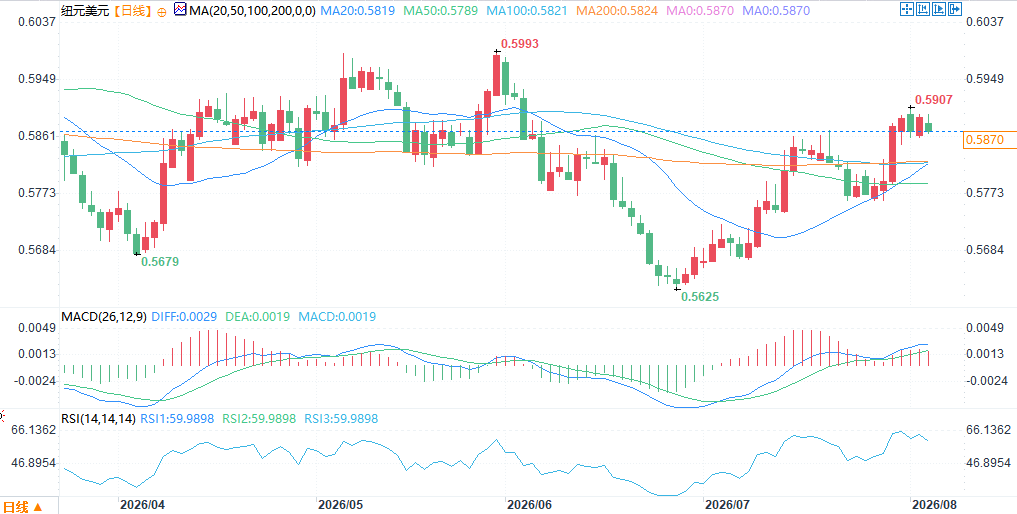 (NZD/USD daily chart, source: EasyForex) At 14:50 Beijing time on August 5, the NZD/USD exchange rate was 0.5870/71.
Employment data deteriorated across the board, severely dampening expectations of interest rate hikes.
Data released by Statistics New Zealand on Wednesday showed that the unemployment rate jumped to 5.6% in the second quarter from 5.3% in the first quarter, the highest since September 2015, and far exceeding market expectations of 5.4%. During the same period, the employment rate rose 0.5% quarter-on-quarter, higher than the previous value of 0.2%; the labor force participation rate rose from 70.4% to 70.7%. The sharp jump in the unemployment rate and the simultaneous increase in the labor force participation rate indicate that labor supply growth is outpacing job creation, and structural pressures in the labor market are accumulating. For the Reserve Bank of New Zealand, this data significantly reduces the necessity for further aggressive interest rate hikes—with the unemployment rate already at an 11-year high, the central bank's room for further significant policy tightening is significantly limited.Positive signals from US-Iran negotiations limit New Zealand dollar's decline
Despite weak domestic data putting pressure on the New Zealand dollar, positive geopolitical signals helped limit its further decline. US President Trump stated on Wednesday that negotiations with Iran were "very productive." Axios reported that the US, Iran, and Oman are close to reaching a provisional agreement to reopen the Strait of Hormuz, with Washington aiming for a formal announcement on Wednesday. Positive progress in US-Iran negotiations pushed down oil prices, easing market concerns about Middle East supply disruptions and improving global risk sentiment. As a typical risk currency, the New Zealand dollar benefited, avoiding a larger drop due to weak employment data. This logic aligns with the recent market pattern of "geopolitical easing → improved risk appetite → support for commodity currencies."Institutional View: Reserve Bank of New Zealand May Only Implement "Insurance-Style" Rate Hikes
ING, a well-known financial institution, points out that internal dynamics within the Reserve Bank of New Zealand (RBNZ) may indicate a more dovish tightening path than the market inferred from the May meeting. ING strategists "suspect that two of the six policy committee members do not fully agree with the hawkish shift in May," believing the policy debate may ultimately revolve around "a smaller 50-basis-point 'insurance' tightening cycle," namely, "an earlier rate hike in September, followed by a pause." This assessment is significant. If ING's prediction holds true, the RBNZ's policy path will shift from the market's previously anticipated "continuous tightening" to "a one-off adjustment followed by a wait-and-see approach," meaning that the New Zealand dollar's support at the interest rate level will weaken significantly. Combined with the reality that the unemployment rate has risen to an 11-year high, the RBNZ's room for rate hikes has been significantly narrowed.Summarize
New Zealand's unemployment rate jumped to an 11-year high of 5.6% in the second quarter, coupled with a simultaneous rise in the labor force participation rate. Structural pressures in the labor market have reduced the need for the Reserve Bank of New Zealand (RBNZ) to raise interest rates more aggressively. Market support for the New Zealand dollar's interest rate expectations is weakening. ING expects the central bank to implement only a 50-basis-point "insurance" tightening before pausing, further limiting the New Zealand dollar's upside potential. However, positive signals from US-Iran negotiations have improved risk sentiment, providing a floor for the New Zealand dollar and limiting its decline. The market will focus on the US ADP data and ISM services PMI later today for further directional guidance. (NZD/USD daily chart, source: EasyForex) At 14:50 Beijing time on August 5, the NZD/USD exchange rate was 0.5870/71.
- Risk Warning and Disclaimer
- The market involves risk, and trading may not be suitable for all investors. This article is for reference only and does not constitute personal investment advice, nor does it take into account certain users’ specific investment objectives, financial situation, or other needs. Any investment decisions made based on this information are at your own risk.