Saving the Yen is America's Self-Salvation: The Horrifying Truth of Joint Intervention
2026-08-06 20:44:57
This round of joint US-Japan intervention to buy yen, the first such intervention since 1998, is widely interpreted by the market as the US helping its ally stabilize the exchange rate. However, the underlying core logic is entirely in the US's own interests. This rare US intervention has only two main objectives: first, to preemptively halt the reversal of carry trades following yen polarization, preventing a valuation collapse in US stocks due to a run on funds and deleveraging; and second, to prevent Japan from passively selling trillions of dollars in US Treasury bonds, avoiding a further runaway rise in the already fragile US Treasury yield (term premium). In short, supporting the yen is not a diplomatic gesture, but a self-protective operation by the US to safeguard US stock valuations and stabilize the US debt financing system. 
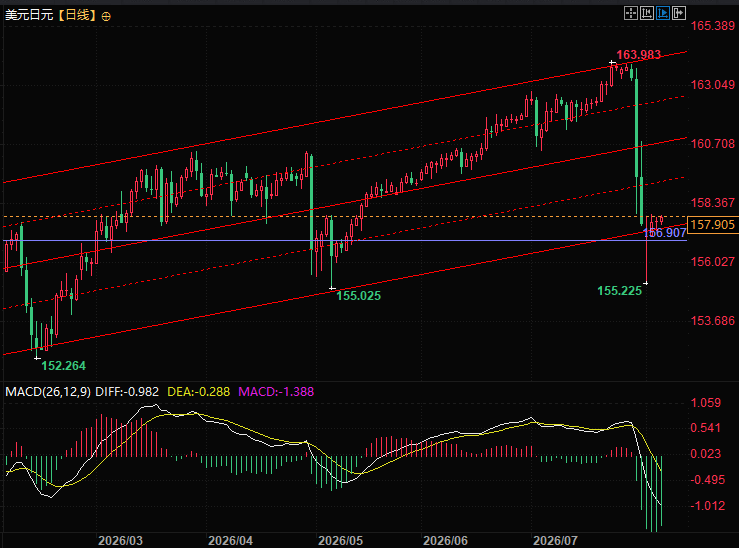 (USD/JPY daily chart, source: FX678) At 20:41 Beijing time, USD/JPY is currently trading at 157.91.
The underlying logic of carry trades: extreme volatility will trigger capital outflows from US stocks.
The Japanese yen, with its persistently low interest rates, is the world's largest and most crucial currency for carry trade financing. Traditionally, investors borrow low-cost yen, exchange it for dollars, and then invest in high-yield dollar assets such as US stocks and bonds to profit from interest rate differentials and asset appreciation. This has been a significant source of incremental funds for US stocks in recent years. Previously, the USD/JPY exchange rate surged, approaching a 40-year high of 164. However, as the exchange rate approaches extreme levels, the resulting volatility and policy intervention risks severely deteriorate the risk-reward ratio of carry trades. The biggest risk on the trading side lies in the possibility that a sharp reversal in the yen's exchange rate could occur at any time. The enormous exchange rate loss risk would force massive carry trade funds to liquidate—a concentrated sell-off of US stocks to repurchase yen and repay debts. This deleveraging panic would directly trigger a sharp tightening of liquidity and valuation squeeze in the US stock market, having a fatal impact on the US equity market.The US intervention strategy is ingenious: a one-step appreciation to lock in capital flight.
The core strategy behind the US-Japan intervention was not a minor attempt to stabilize the exchange rate, but rather to push the yen to appreciate rapidly and decisively, precisely breaking through market expectations of a one-sided short-selling move. After the intervention, the USD/JPY exchange rate quickly fell from 164 to below 158, completely reversing the extreme depreciation trend. The essence of this operation lies in the fact that when the yen appreciates rapidly and significantly in the short term, the previously accumulated short-selling pressure is quickly dissipated; simultaneously, because the exchange rate has risen sharply to a relatively high level, carry trade funds that were originally preparing to close their positions and exchange currency back into the market instead abandoned their plans to chase the high exchange rate and entered a wait-and-see state again. Through this one-time exchange rate correction, the US successfully "froze" the wave of carry trade fund liquidations, maintained liquidity in the US stock market, and achieved a self-rescue effect of "stabilizing stocks through currency."Core risk of US Treasury bonds: The US cannot tolerate further increases in yields.
Besides protecting the US stock market, stabilizing US Treasury yields is the second core bottom line for US intervention. The current US fiscal fundamentals are extremely fragile, with continued expansion of military spending, tariff rebates, and a mounting fiscal deficit, leading to a significant increase in the supply of long-term US Treasury bonds. Under this supply-demand imbalance, the term premium of long-term US Treasury bonds already faces enormous upward pressure, and domestic financing costs are already high, making it impossible to withstand a new round of interest rate hikes. Japan is the largest foreign holder of US Treasury bonds, with holdings exceeding $1.1 trillion. If the yen continues to plummet, the Japanese Ministry of Finance, in order to maintain the exchange rate and prevent domestic inflation from spiraling out of control, will have no choice but to conduct unilateral exchange rate intervention by massively selling US Treasury bonds in the secondary market to obtain dollars. This concentrated selling will completely break through the already fragile US Treasury market's absorption capacity, directly pushing up long-term US Treasury yields.Risk cascading effects: Uncontrolled US Treasury yields could severely damage the overall US economy.
US Treasury yields serve as a global asset pricing anchor and a core pricing benchmark for US domestic credit, real estate, and fiscal policies. A sustained rise in long-term yields not only directly amplifies the US government's debt repayment pressure but also significantly increases corporate financing costs and mortgage rates. More importantly, the rise in the risk-free rate (discount rate) of US Treasury bonds directly damages the valuation of long-duration assets, such as AI technology stocks, creating a comprehensive negative cycle of "falling US Treasury yields → rising discount rates → sharp declines in US stocks → economic pressure." Therefore, the US must take proactive measures to prevent the transmission of risk and avoid a passive sell-off of US Treasury bonds.The US's refined intervention: avoiding side effects and precisely protecting itself.
In this intervention, the US demonstrated extremely self-serving and precise operations: Avoiding the use of dollar reserves to stabilize dollar credibility: The intervention primarily involved selling euro reserves to purchase yen, without utilizing dollar reserves. This avoided sending a signal to the market that the Fed was actively weakening the dollar, and also prevented secondary disruptions to domestic inflation. Expanding the FIMA Repo to provide a "no-sell-off" alternative: The US was simultaneously considering expanding the Federal Reserve's Foreign Monetary Authority Repo (FIMA Repo). Its core purpose is to allow Japan to directly exchange US Treasury bonds for dollar liquidity from the Fed, enabling Japan to obtain intervention funds without dumping US Treasury bonds in the secondary market, thus creating a safety net for the US Treasury market.Key Outlook for the Market: Intervention is the Only Option; Self-Preservation Logic Remains the Mainstay
This intervention also exposed two problems within the US: the liquidity risk from overheated AI investment and the fragility of US Treasury yields. Since US Treasury yields are the valuation center for equity assets, they could easily lead to a situation where the US trips up from both sides. While the US intervened in advance to provide a safety net, this also means we cannot ignore this risk. This round of joint US-Japan intervention was not driven by any traditional financial crisis; it was a proactive risk-prevention operation by the US. Its core underlying logic remains unchanged: stabilizing the yen locks in carry trade funds and protects US stocks; preventing Japan from selling US Treasuries suppresses term premiums and stabilizes the US financial system. If the yen weakens again, carry trade deleveraging risks escalate, or long-term US Treasury yields rise again, the US will likely restart joint intervention or further ease liquidity support. Given the current fiscal fragility and high valuations of US stocks, rescuing the yen is essentially rescuing the US itself. (USD/JPY daily chart, source: FX678) At 20:41 Beijing time, USD/JPY is currently trading at 157.91.
- Risk Warning and Disclaimer
- The market involves risk, and trading may not be suitable for all investors. This article is for reference only and does not constitute personal investment advice, nor does it take into account certain users’ specific investment objectives, financial situation, or other needs. Any investment decisions made based on this information are at your own risk.