A stronger US dollar coupled with increased safe-haven demand put pressure on the New Zealand dollar as it awaits non-farm payroll data.
2026-08-07 08:30:54
The New Zealand dollar edged lower against the US dollar in early Asian trading on Friday (August 7), currently trading around 0.5865, while the US dollar index rebounded to around 100.00. As a high-beta currency, the New Zealand dollar was under pressure amid a stronger US dollar. Despite oil prices surging over 3% due to geopolitical risks, this factor, typically favorable for commodity currencies, failed to save the New Zealand dollar – expectations of slower-than-expected Chinese trade data and cautious sentiment ahead of the US non-farm payroll report are limiting its upside potential. 
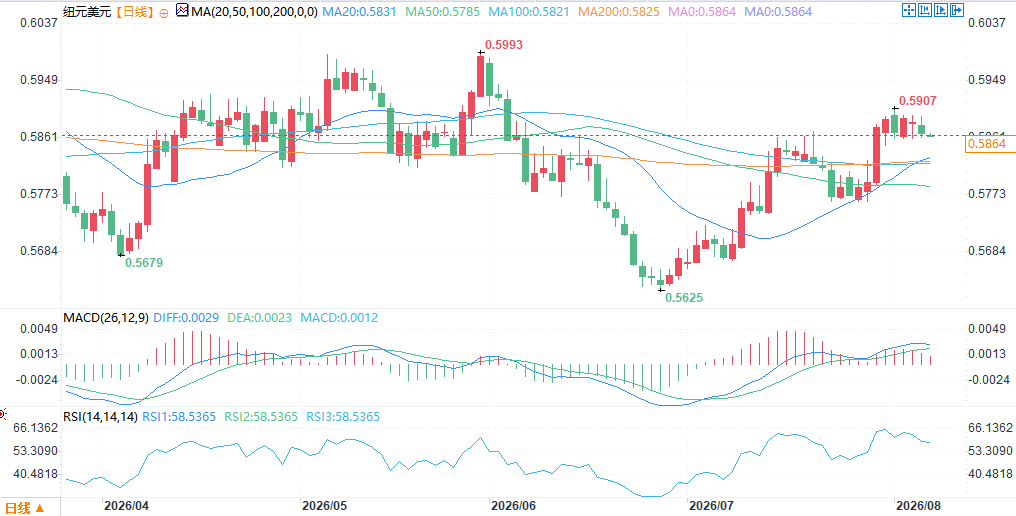 (NZD/USD daily chart, source: EasyTrade) At 8:21 AM Beijing time on August 7, the NZD/USD exchange rate was 0.5863/64.
A stronger dollar: a confluence of safe-haven demand and expectations of interest rate hikes.
The US dollar index rose 0.26% on Thursday, recovering some of its losses for the week. News of a proposed agreement by Iran to ban "hostile" vessels from the US and Israel from passing through the Strait of Hormuz boosted geopolitical risk premiums, leading to a return of safe-haven funds to the dollar. Meanwhile, the market's pricing in a September rate hike by the Federal Reserve remained around 55%. Kansas City Fed President Schmid signaled a hawkish stance on Thursday, stating that AI-related investments are exacerbating inflation and that further monetary tightening is needed to bring inflation back to the 2% target. Against the backdrop of a stronger dollar and heightened risk aversion, commodity currencies such as the New Zealand dollar generally came under pressure.The surge in oil prices failed to boost the New Zealand dollar.
Brent crude futures rose more than 4% intraday on Thursday, closing up $3.04, or 3.83%, at $82.49 a barrel, as an Iranian parliamentary committee considered a draft bill to ban US and Israeli ships from passing through the Strait of Hormuz. Theoretically, rising oil prices should support the New Zealand dollar through improved trade terms, but Thursday's market reaction was quite different—gold and silver both fell, and the New Zealand dollar also weakened. This anomaly suggests that the market's interpretation of the Middle East situation is shifting from the traditional transmission path of "supply disruption → rising oil prices → benefiting commodity currencies" to a new narrative of "escalating geopolitical risks → increased risk aversion → stronger dollar → pressure on commodity currencies." In a market environment dominated by risk aversion, the positive effects of rising oil prices are completely offset by a surge in safe-haven demand.Market Focuses on US Non-Farm Payroll Report
Market focus has shifted to Friday's release of the US July non-farm payrolls report. The market expects job growth to rebound to 80,000 from 57,000 in June, with average hourly earnings rising 0.3% month-on-month. The unemployment rate is expected to remain at 4.2%. This data will be a key variable for the short-term direction of the US dollar—if wage growth exceeds expectations, it will further strengthen expectations that the Federal Reserve will maintain high interest rates, driving the dollar to continue its rebound, putting double pressure on the New Zealand dollar; if the data is weak, it may trigger a dollar pullback, providing some breathing room for the New Zealand dollar. Until then, the exchange rate is expected to remain range-bound.Summarize
The New Zealand dollar (NZD) faced resistance around 0.5865 against the US dollar. Escalating geopolitical risks boosted the safe-haven dollar, while cautious sentiment ahead of the non-farm payroll report limited the NZD's upside potential. A surge in oil prices failed to provide support, as the market focused more on safe-haven demand stemming from escalating geopolitical risks. Against the backdrop of a strengthening dollar and intertwined geopolitical risks, the NZD still faces downside risks in the short term. (NZD/USD daily chart, source: EasyTrade) At 8:21 AM Beijing time on August 7, the NZD/USD exchange rate was 0.5863/64.- Risk Warning and Disclaimer
- The market involves risk, and trading may not be suitable for all investors. This article is for reference only and does not constitute personal investment advice, nor does it take into account certain users’ specific investment objectives, financial situation, or other needs. Any investment decisions made based on this information are at your own risk.