Gold Trading Alert: Iran's "Preliminary Bill" Helps Oil Prices Rebound Over 3%, Gold Prices Under Slight Pressure Ahead of Non-Farm Payrolls!
2026-08-07 07:38:53
On Thursday (August 6), spot gold prices rose and then fell back. In the early morning, it continued Wednesday's gains, reaching a high of $4303.90 per ounce, a new high since June 18, before fluctuating downwards to a low of $4223 per ounce, closing at $4240.55 per ounce, down 0.15%. US gold futures closed at $4291.30, down 0.3%. This rise and fall is not a simple technical correction, but rather the result of a fierce collision of geopolitical, energy market, and Federal Reserve policy expectations. The market is at a critical juncture: the Iranian parliament's review of a bill banning "hostile" vessels from entering the Strait of Hormuz directly pushed up oil prices and reignited inflation concerns; meanwhile, Friday's upcoming US non-farm payroll report will be a key variable determining the Fed's interest rate path and even the medium-term trend of gold. On Friday (August 7) in early Asian trading, spot gold fluctuated slightly higher, currently trading at $4245 per ounce. 
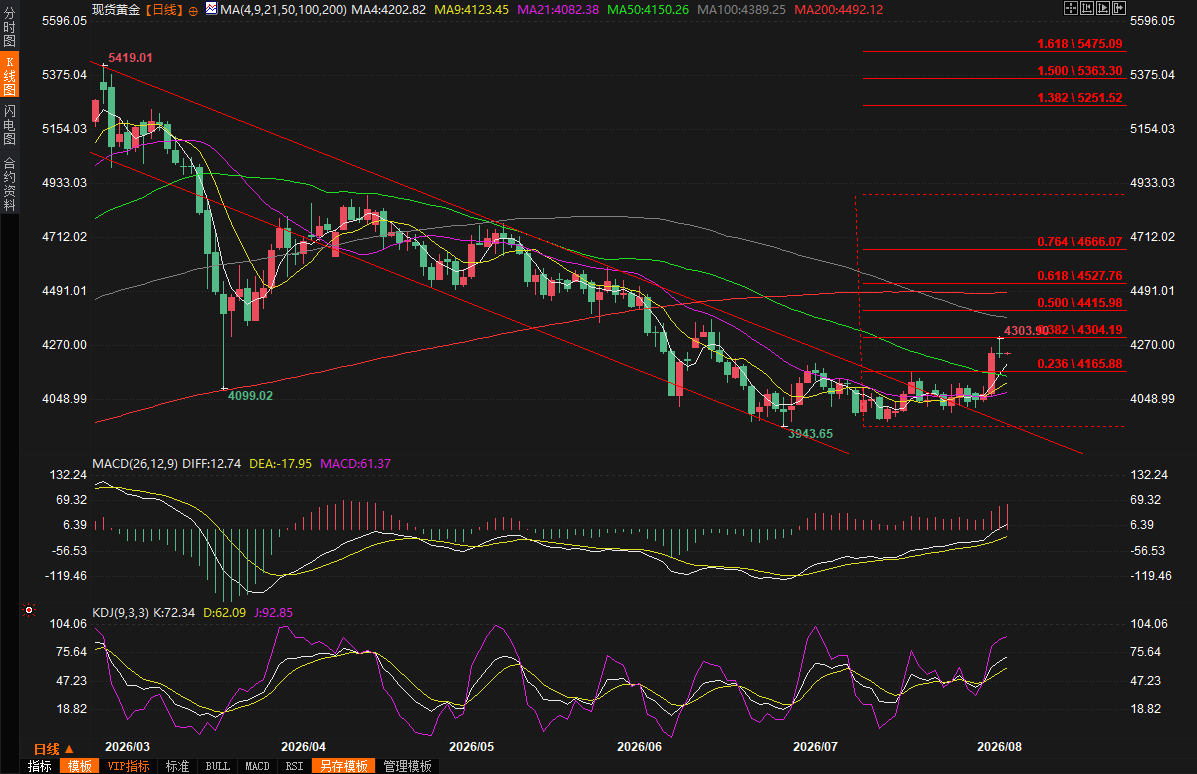 (Spot gold daily chart, source: FX678) At 07:32 Beijing time, spot gold is currently trading at $4247.17 per ounce.
Geopolitical shockwaves: Inflation repricing under the shadow of the Strait of Hormuz
The core catalyst for this round of gold price increases stems from the sharp escalation of tensions in the Middle East. According to Iran's semi-official Fars News Agency, citing lawmakers, a committee in the Iranian parliament is reviewing a preliminary bill to ban ships from the United States, Israel, and other countries considered "hostile" from passing through the Strait of Hormuz, with fines of up to 20% of the value of the goods carried by violators. This news instantly ignited the oil market. Brent crude futures rose more than 4% intraday on Thursday, closing up $3.04, or 3.83%, at $82.49 a barrel; US crude futures rose $2.07 to $77.29. As the world's most important energy trade route, any news of restrictions on passage through the Strait of Hormuz quickly impacts oil prices. Jim Wyckoff, an analyst at the US Gold Exchange, stated bluntly that if oil prices rise again, Iran's draft bill "could have a profound impact due to increased inflation." Rising energy prices mean higher costs for manufacturers, which will ultimately be passed on to consumers, thus pushing up overall inflation. Against the backdrop of already high global inflation, this cost-push inflationary pressure will directly reinforce the policy inclination of central banks to maintain higher interest rates for longer periods. Meanwhile, the actions of the Houthi rebels in Yemen have further exacerbated market concerns about supply disruptions. The Houthis claimed responsibility for missile and drone attacks on "Saudi forces" within Yemen and attacked Saudi oil tankers. Senior Saudi officials warned that Iraqi militias and the Houthis are expected to launch coordinated attacks on Saudi Arabia from the north and south under the command of the Iranian Revolutionary Guard, targeting energy infrastructure, ports, and airports. These signals combined have created persistent doubts about the navigability of the Strait of Hormuz. Although President Trump stated on Thursday that the war with Iran "will soon be over" and that some US military weapons supplies are tight, the market remains highly cautious about whether a short-term agreement can truly be implemented. Gold, as a traditional safe-haven asset, naturally gains support in this uncertainty, but its sensitivity to inflation also means it cannot ignore rapid adjustments in interest rate expectations.Rebalancing Interest Rate Expectations: How Rising Oil Prices Are Changing the Pricing Logic of Gold
The negative correlation between gold and interest rates was clearly reflected in Thursday's market movements. Soaring oil prices reignited inflation concerns, prompting traders to quickly adjust their pricing for the Federal Reserve's policy path. According to the CME FedWatch tool, the market currently expects a 57% to 59% probability of a rate hike at the Fed's September meeting, and a staggering 84% probability of a December rate hike. The two-year U.S. Treasury yield rose 7.26 basis points to 4.252% on Thursday, while the 10-year Treasury yield rose 5.67 basis points to 4.674%. The rising yields directly increased the opportunity cost of holding gold, a non-interest-bearing asset, thus suppressing gold prices. Bob Haberkorn, senior market strategist at StoneX, pointed out that the Fed's policy outlook remains the main driver of gold prices, and Friday's U.S. employment data will directly influence the Fed's stance on interest rates. Last week, the Fed maintained its overnight rate target range at 3.50%-3.75%, but three members voted against a 25-basis-point rate hike. Fed Chairman Warsh clearly stated his commitment to suppressing inflation, leaving room for a possible rate hike in September. Governor Cook also expressed openness to addressing "excessive" inflation by raising short-term interest rates. San Francisco Fed President Daly emphasized the need for more data before the September 15-16 meeting. Against this backdrop, the pullback in gold prices can be interpreted as a temporary shift in market sentiment from "safe-haven dominance" to "interest rate dominance." Wednesday's surge in gold prices reflected an immediate reaction to escalating geopolitical risks; Thursday's pullback reflected investors' repricing of renewed inflation and the increased probability of interest rate hikes. The dollar index rose 0.3% to 99.95 on Thursday, further supporting this logic—a strong dollar further increases the cost of holding dollar-denominated gold.The key test of employment data: Can labor market stability halt the pace of interest rate hikes?
The upcoming US July non-farm payrolls report, due on Friday, is the focus of market attention. Economists generally expect non-farm payrolls to increase by 80,000 in July, with the unemployment rate remaining at 4.2%. The importance of this data lies not only in its monetary value but also in its potential to alter the Federal Reserve's assessment that the labor market is robust and inflation remains high. Leading indicators already released suggest that the US labor market remains relatively stable. Initial jobless claims rose slightly by 1,000 to 199,000 last week, lower than market expectations; planned layoffs in July fell 27% to 33,429, a two-year low; and second-quarter labor productivity grew at an annualized rate of 1.4%, higher than the expected 0.6%, with relatively moderate increases in unit labor costs. These data indicate that although service sector employment growth has slowed, overall layoff pressure is limited, and wage inflation has not spiraled out of control. Economists believe that the surge in investment in artificial intelligence is driving productivity growth, which helps to curb some cost pressures. However, the market does not believe that a single weak employment report will reverse the Federal Reserve's policy path. FHN Financial macro strategist Will Compennor stated that even if Friday's report is weak, it will likely be viewed as noise for the time being, given numerous other strong indicators that don't appear to affect inflation trends or the Fed's policy path. Against the backdrop of ongoing Middle East conflict and impacted oil prices, the Fed is more focused on whether inflation expectations will rise again due to energy prices. In other words, the "good" or "bad" employment data may have a limited short-term impact on gold; the true determinant of gold's medium-term price trend remains whether oil prices can remain high and the resulting changes in inflation expectations.Gold's Outlook Amidst Mixed Signals: A Protracted Tug-of-War Between Safe-Haven Demand and Interest Rates
Considering current factors, gold is currently in a typical phase of tug-of-war between bulls and bears. On one hand, geopolitical risks in the Middle East are far from over. The proposed agreement between Iran and Oman could allow Tehran to control shipping traffic through the Strait of Hormuz, while US officials insist they will never agree to Iran controlling this crucial passage. Although Trump has stated the war will end soon, the reality of tight ammunition stockpiles and Saudi Arabia's warnings about coordinated attacks mean the situation could still fluctuate. As long as the risk to the Strait of Hormuz persists, oil prices are unlikely to fall significantly, supporting expectations of a Fed rate hike, thus limiting the upside potential for gold prices. On the other hand, the Fed's "higher and longer" stance is being reinforced by rising oil prices. If Friday's non-farm payroll data is robust, rate hike expectations could further intensify, thus putting downward pressure on gold prices; even if the data is weak, as long as inflation concerns persist, the market's pricing space for rate cuts will be very limited. Ultimately, the long-term value of gold still depends on the direction of real interest rates. In the current environment, the upside risk to real interest rates outweighs the downside risk, which determines that gold prices are unlikely to see a repeat of the one-sided upward trend seen at the beginning of the year. From a broader perspective, the recent surge and subsequent decline in gold prices reflects a profound shift in the global asset pricing logic. Traditional safe-haven assets no longer solely benefit from geopolitical conflicts but must also absorb the impact of energy inflation on monetary policy. Investors need to constantly recalibrate between "risk premium" and "opportunity cost." In the coming weeks, the actual passage through the Strait of Hormuz, the final outcome of the Iran legislation, and the statements made by Federal Reserve officials after the non-farm payroll data will all be key drivers of gold price fluctuations. (Spot gold daily chart, source: FX678) At 07:32 Beijing time, spot gold is currently trading at $4247.17 per ounce.
- Risk Warning and Disclaimer
- The market involves risk, and trading may not be suitable for all investors. This article is for reference only and does not constitute personal investment advice, nor does it take into account certain users’ specific investment objectives, financial situation, or other needs. Any investment decisions made based on this information are at your own risk.