With Japanese households "having money but not daring to spend it," is there still a chance that the Bank of Japan will raise interest rates in September?
2026-08-07 10:06:57
On Friday (August 7) during Asian trading hours, the USD/JPY pair rose to around 158.56, slightly refreshing a one-week high, before giving up all gains and currently trading around 158.30. This followed four consecutive days of gains. Weak Japanese household spending data released on Friday provided some respite for the yen – real spending fell 3.3% year-on-year in June, marking the seventh consecutive month of decline and far below market expectations of 1% growth. This data contrasts sharply with the previously released six-month streak of real wage growth, indicating that consumers are still cutting back on spending despite improved purchasing power. This adds new uncertainty to the prospect of a Bank of Japan interest rate hike in September, providing some buying support for the yen from its lower levels. 
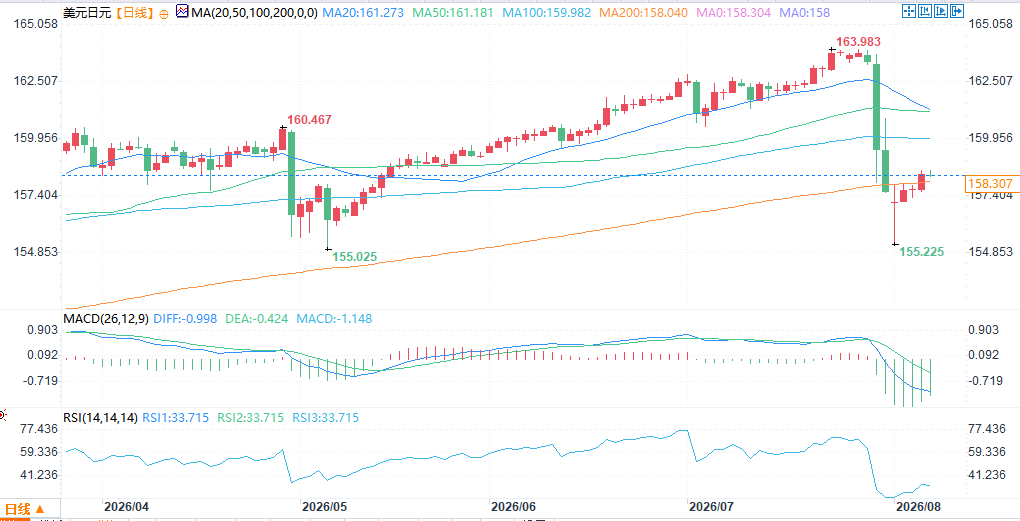 (USD/JPY daily chart, source: EasyForex) At 10:05 Beijing time on August 7, the USD/JPY exchange rate was 158.35/36.
Consumer spending data is weak across the board and out of sync with wage growth.
Data from Japan's Ministry of Home Affairs and Security showed that household spending fell 3.3% year-on-year in June, marking the seventh consecutive month of decline, while the market had expected a 1% increase. Seasonally adjusted month-on-month, it plummeted 6.4%, far below the expected 3.1% drop. This weakness far exceeded market expectations. This sluggish consumption contrasts sharply with data released earlier by the Ministry of Health, Labour and Welfare—real wages rose 1.6% year-on-year in June, marking the sixth consecutive month of positive growth. This divergence suggests that even with improving real purchasing power, Japanese consumers remain cautious, a trend that has persisted for more than half a year. While government aid has reduced utility costs and inflation-adjusted wages have been rising month by month, these measures have failed to translate into a substantial increase in consumer confidence. Although consumer confidence improved somewhat in June, it remains far below the 10-year and 20-year averages.The Bank of Japan's interest rate hike path faces uncertainty.
The Bank of Japan's (BOJ) interest rate path faces significant uncertainty. The latest weak consumer data will be a key factor in the BOJ's assessment of whether to raise rates in September. The unexpected decline in household consumption directly weakens the persuasiveness of further tightening monetary policy in the short term—even though some policymakers previously viewed sustained wage growth as important evidence that the Japanese economy could escape deflation. The contradictory signals of rising wages and declining household consumption make the economic landscape facing the BOJ more ambiguous before its next policy meeting. On the one hand, improvements in nominal wages seem to support the sustainability of the inflation target; on the other hand, weak real consumption suggests that household purchasing power remains suppressed and the foundation for domestic demand recovery is not solid. This data discrepancy increases the difficulty of policy judgment and forces the market to recalibrate its expectations for the timing of the BOJ's rate hike. Previously, the market generally considered a September rate hike an "immediate option," with some traders even pricing in a high probability. However, the shock of this consumer data may significantly reduce the feasibility of that timing, pushing rate hike expectations back to the end of the year or later. In the coming weeks, statements from Bank of Japan officials, along with subsequent inflation and employment data, will be key points of observation for the market to reprice policy paths.Impact on the Japanese Yen and the Market
Regarding the impact on the yen and the market, short-term sentiment may be significantly pressured. If the market interprets the latest data as a signal that the Bank of Japan's interest rate hike timeline will be further delayed, especially given the high uncertainty surrounding the global interest rate path and the unclear pace of the Federal Reserve's policy shift, the yen may face continued downward pressure. Once the expectation of currency depreciation strengthens, it will be quickly reflected in the spot and forward markets, increasing the attractiveness of carry trades and thus creating a self-reinforcing depreciation cycle. From the perspective of the stock market, domestic consumer-related sectors in Japan may suffer additional selling pressure. A weak yen often means higher import costs, coupled with potential inflation stickiness, which will further compress residents' actual purchasing power, negatively impacting domestic demand-sensitive industries such as retail, catering, tourism, and local services. Investors may therefore lower their profit expectations for related companies, leading to capital outflows. Conversely, export-oriented companies may gain relative support from a weaker yen. Currency depreciation helps improve the price competitiveness of export products and improves the local currency conversion of overseas income, which is beneficial to traditional export leaders such as automobiles, machinery, and electronics. The market may shift towards these beneficiaries in stages, forming a certain degree of structural differentiation. Overall, in an environment where global risk appetite remains dominated by interest rate volatility, if expectations of yen depreciation continue to fester, it will not only suppress the yen's safe-haven appeal but may also have a more significant impact on style rotation in the Japanese stock market through capital flows and valuation adjustments. In the short term, the market will pay closer attention to subsequent inflation and wage data to reassess the Bank of Japan's policy space.Summarize
Japanese household spending fell 3.3% year-on-year in June, marking the seventh consecutive month of decline and far below market expectations of a 1% increase. The month-on-month decline also significantly exceeded expectations. This data contrasts sharply with the sixth consecutive month of positive real wage growth in June—consumers are still tightening their belts despite improved purchasing power, indicating that a recovery in household confidence will take time. The divergence between weak consumption and rising wages has made the prospect of a September rate hike by the Bank of Japan uncertain, potentially delaying market expectations for the timing of a rate hike and putting downward pressure on the yen in the short term. This data provides the Bank of Japan with another variable to weigh before its next policy meeting—wage growth and inflation trends point to contraction, while consumer spending points to weakness, and the true health of consumers remains to be clarified. (USD/JPY daily chart, source: EasyForex) At 10:05 Beijing time on August 7, the USD/JPY exchange rate was 158.35/36.
- Risk Warning and Disclaimer
- The market involves risk, and trading may not be suitable for all investors. This article is for reference only and does not constitute personal investment advice, nor does it take into account certain users’ specific investment objectives, financial situation, or other needs. Any investment decisions made based on this information are at your own risk.