One chart: The Baltic Dry Index hit a more than two-month high, with a significant weekly gain.
2026-08-07 22:36:52
The latest data shows that the Baltic Dry Index (BDI) reached 3089 points on August 7, 2026, a new high since June 3, 2026, up 1.05% month-on-month, the largest increase since August 5, 2026. Looking at the short-term charts, the BDI has seen positive growth 7 times, negative growth 4 times, and zero growth 0 times in the last 11 BDI data points. Specifically, the Panamax Freight Index (BPI) was 2298 points, up 1.01% from the previous value; the Capesize Freight Index (BCI) was 5128 points, up 1.50%; and the Supramax Freight Index (BSI) was 1603 points, down 0.31%. For detailed charts of the latest 720-day and 10-year trends of the Baltic Dry Index and its three main sub-indices, please refer to the charts specially created by FX678. 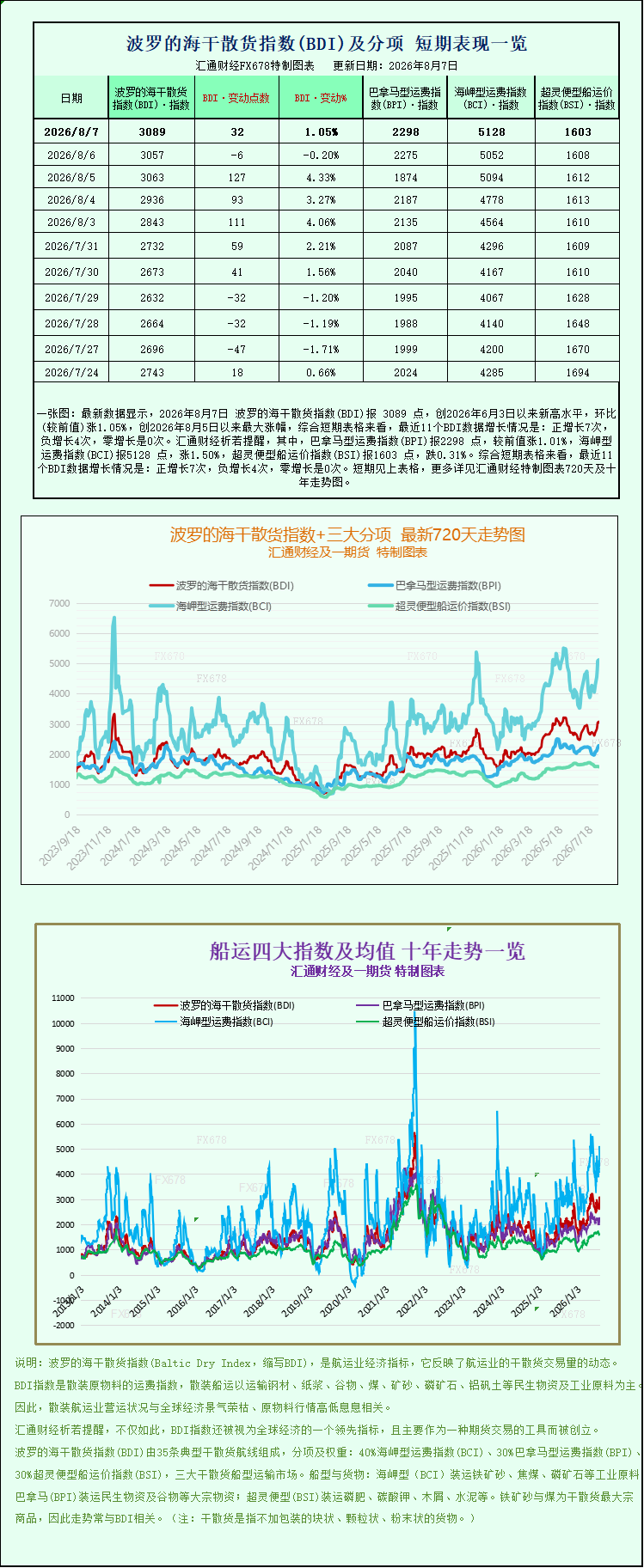 This week, the international dry bulk shipping market saw a strong rebound, with the Baltic Dry Index (BADI), a key indicator of global shipping activity, continuing its upward trend and stabilizing at its highest level in over two months on Friday, while also recording a significant weekly gain. This upward movement was driven by a combined increase in freight rates for large and medium-sized bulk carriers, coupled with multiple positive factors such as volatility in the commodity market, the release of global raw material restocking demand, and disruptions in overseas port capacity. This has completely reversed the previous volatile and sluggish shipping market, releasing a positive signal of a steady recovery in global industrial raw material maritime trade. Data shows that as of the close of trading on August 7, the Baltic Dry Index, which tracks freight rates for the three major dry bulk carrier types—Capesize, Panamax, and Supramax—rose 32 points, a daily increase of 1.1%, to 3089 points, the highest level since June 3. From a weekly perspective, the index surged 13.1% this week, demonstrating a significant rebound and becoming the most eye-catching performance in the recent global bulk shipping market. As a core indicator of global dry bulk shipping activity and supply-demand dynamics, the sharp rise in the BDI index directly reflects the current recovery in international demand for basic bulk commodities such as ore, coal, and grain. Looking at specific ship types, the core driver of this index increase comes from the Capesize bulk carrier market. This type of vessel mainly carries core industrial raw materials such as iron ore and thermal coal at a capacity of 150,000 tons or more, making it the mainstay of the dry bulk shipping market and having the greatest impact on the index weight. On Friday, the Capesize vessel-specific freight rate index rose 76 points, or 1.5%, to 5128 points, also hitting a new high since June 4th, with a cumulative increase of 19.4% this week, leading the entire market. Corresponding operating revenue data also rose, with Capesize vessels carrying 150,000 tons of iron ore, coal, and other bulk raw materials seeing an average daily revenue increase of $696, reaching a latest daily revenue of $43,009, indicating a continued recovery in shipbuilders' profit margins. This round of surge in large bulk carrier freight rates is highly correlated with the strong performance of the iron ore spot and futures markets. On Friday, domestic Dalian iron ore futures continued their strong performance, achieving a third consecutive day of gains, providing strong support for ocean-going iron ore trade. A confluence of positive market factors has emerged. On the one hand, BHP Billiton, a core iron ore exporter, is facing a strike at its core operations in Port Hedland, Australia, potentially limiting port loading, unloading, and shipping efficiency, creating short-term uncertainty in overseas iron ore supply. On the other hand, annual iron ore procurement negotiations between China and Rio Tinto have entered a crucial stage, with the market expecting a steady increase in raw material purchases. Coupled with rising domestic industrial restocking demand, global iron ore shipping orders have been released in a concentrated manner, significantly boosting long-haul ocean shipping demand and directly pushing up large bulk carrier freight rates. The medium-sized vessel market also rallied, becoming a significant contributor to the index's upward movement. Data shows that the Panamax index rose 23 points, or 1%, to 2298 points on Friday, also reaching a two-month high since June 3rd. The cumulative weekly gain reached 10.1%, demonstrating a steady and strong trend. Panamax vessels primarily transport 60,000 to 70,000 tons of bulk commodities such as thermal coal, grain, and building materials, balancing both ocean and near-sea routes to meet diversified global trade demands. Their market profitability improved simultaneously, with average daily revenue for Panamax vessels rising by $211 to $20,684, indicating a continued recovery in the revenue capacity of small and medium-sized shipping companies. Industry analysts stated that with the steady recovery of global industrial production in the second half of the year, coupled with the approaching peak season for autumn and winter heating stockpiling in the Northern Hemisphere and the autumn harvest and export of grain, the demand for cross-regional transportation of coal and grain continues to be released, supporting the steady rise in Panamax freight rates. In stark contrast to the general price increases for medium and large vessels, the small bulk carrier market showed a weak adjustment trend, with significant structural differentiation in the market. On Friday, the Supramax index fell slightly by 5 points, or 0.3%, to 1603 points, its lowest level since June 8th. It has accumulated a slight decline of 0.4% this week, showing overall weakness. Supramax vessels are mainly used for short-haul, small-volume general cargo transportation. Affected by stable regional short-haul trade demand and relatively ample supply of small vessels, the market lacks upward momentum, contrasting sharply with the price increases of larger vessels due to long-haul demand shortages. This also reflects the current structural pattern of "strong large vessels, weak small vessels" in the dry bulk shipping market. Considering the overall market fundamentals, the recent rebound in the Baltic Dry Index is not a short-term speculative play, but a genuine reflection of the optimized supply and demand situation. On the demand side, industrial production in major global economies continues to recover, China's manufacturing sector is maintaining steady growth, and infrastructure investment is progressing steadily, driving a recovery in import demand for industrial raw materials such as iron ore and coal. At the same time, the global food trade is accelerating, creating a synergistic effect of multiple demands. On the supply side, the pace of new dry bulk vessel deliveries globally slowed in 2026, with a significant amount of shipbuilding capacity being squeezed out by LNG carriers and container ships. This limited short-term increase in effective shipping capacity, coupled with unforeseen disruptions at overseas ports and longer turnaround times on long-haul routes, led to a temporary shortage of shipping capacity, providing solid support for rising freight rates. Looking ahead, industry institutions are generally optimistic about the future trend of the dry bulk shipping market. With the traditional peak shipping season approaching, global demand for commodity restocking is expected to continue, further increasing the volume of seaborne transactions for iron ore, coal, and grain. However, uncertainties remain. Progress on labor disputes at overseas ports, the pace of global industrial recovery, and fluctuations in commodity prices may influence freight rate trends in the short term. Overall, the current supply and demand dynamics in the dry bulk market continue to improve, and the upward trend in the index is expected to continue, with the shipping industry's prosperity continuing to recover.
This week, the international dry bulk shipping market saw a strong rebound, with the Baltic Dry Index (BADI), a key indicator of global shipping activity, continuing its upward trend and stabilizing at its highest level in over two months on Friday, while also recording a significant weekly gain. This upward movement was driven by a combined increase in freight rates for large and medium-sized bulk carriers, coupled with multiple positive factors such as volatility in the commodity market, the release of global raw material restocking demand, and disruptions in overseas port capacity. This has completely reversed the previous volatile and sluggish shipping market, releasing a positive signal of a steady recovery in global industrial raw material maritime trade. Data shows that as of the close of trading on August 7, the Baltic Dry Index, which tracks freight rates for the three major dry bulk carrier types—Capesize, Panamax, and Supramax—rose 32 points, a daily increase of 1.1%, to 3089 points, the highest level since June 3. From a weekly perspective, the index surged 13.1% this week, demonstrating a significant rebound and becoming the most eye-catching performance in the recent global bulk shipping market. As a core indicator of global dry bulk shipping activity and supply-demand dynamics, the sharp rise in the BDI index directly reflects the current recovery in international demand for basic bulk commodities such as ore, coal, and grain. Looking at specific ship types, the core driver of this index increase comes from the Capesize bulk carrier market. This type of vessel mainly carries core industrial raw materials such as iron ore and thermal coal at a capacity of 150,000 tons or more, making it the mainstay of the dry bulk shipping market and having the greatest impact on the index weight. On Friday, the Capesize vessel-specific freight rate index rose 76 points, or 1.5%, to 5128 points, also hitting a new high since June 4th, with a cumulative increase of 19.4% this week, leading the entire market. Corresponding operating revenue data also rose, with Capesize vessels carrying 150,000 tons of iron ore, coal, and other bulk raw materials seeing an average daily revenue increase of $696, reaching a latest daily revenue of $43,009, indicating a continued recovery in shipbuilders' profit margins. This round of surge in large bulk carrier freight rates is highly correlated with the strong performance of the iron ore spot and futures markets. On Friday, domestic Dalian iron ore futures continued their strong performance, achieving a third consecutive day of gains, providing strong support for ocean-going iron ore trade. A confluence of positive market factors has emerged. On the one hand, BHP Billiton, a core iron ore exporter, is facing a strike at its core operations in Port Hedland, Australia, potentially limiting port loading, unloading, and shipping efficiency, creating short-term uncertainty in overseas iron ore supply. On the other hand, annual iron ore procurement negotiations between China and Rio Tinto have entered a crucial stage, with the market expecting a steady increase in raw material purchases. Coupled with rising domestic industrial restocking demand, global iron ore shipping orders have been released in a concentrated manner, significantly boosting long-haul ocean shipping demand and directly pushing up large bulk carrier freight rates. The medium-sized vessel market also rallied, becoming a significant contributor to the index's upward movement. Data shows that the Panamax index rose 23 points, or 1%, to 2298 points on Friday, also reaching a two-month high since June 3rd. The cumulative weekly gain reached 10.1%, demonstrating a steady and strong trend. Panamax vessels primarily transport 60,000 to 70,000 tons of bulk commodities such as thermal coal, grain, and building materials, balancing both ocean and near-sea routes to meet diversified global trade demands. Their market profitability improved simultaneously, with average daily revenue for Panamax vessels rising by $211 to $20,684, indicating a continued recovery in the revenue capacity of small and medium-sized shipping companies. Industry analysts stated that with the steady recovery of global industrial production in the second half of the year, coupled with the approaching peak season for autumn and winter heating stockpiling in the Northern Hemisphere and the autumn harvest and export of grain, the demand for cross-regional transportation of coal and grain continues to be released, supporting the steady rise in Panamax freight rates. In stark contrast to the general price increases for medium and large vessels, the small bulk carrier market showed a weak adjustment trend, with significant structural differentiation in the market. On Friday, the Supramax index fell slightly by 5 points, or 0.3%, to 1603 points, its lowest level since June 8th. It has accumulated a slight decline of 0.4% this week, showing overall weakness. Supramax vessels are mainly used for short-haul, small-volume general cargo transportation. Affected by stable regional short-haul trade demand and relatively ample supply of small vessels, the market lacks upward momentum, contrasting sharply with the price increases of larger vessels due to long-haul demand shortages. This also reflects the current structural pattern of "strong large vessels, weak small vessels" in the dry bulk shipping market. Considering the overall market fundamentals, the recent rebound in the Baltic Dry Index is not a short-term speculative play, but a genuine reflection of the optimized supply and demand situation. On the demand side, industrial production in major global economies continues to recover, China's manufacturing sector is maintaining steady growth, and infrastructure investment is progressing steadily, driving a recovery in import demand for industrial raw materials such as iron ore and coal. At the same time, the global food trade is accelerating, creating a synergistic effect of multiple demands. On the supply side, the pace of new dry bulk vessel deliveries globally slowed in 2026, with a significant amount of shipbuilding capacity being squeezed out by LNG carriers and container ships. This limited short-term increase in effective shipping capacity, coupled with unforeseen disruptions at overseas ports and longer turnaround times on long-haul routes, led to a temporary shortage of shipping capacity, providing solid support for rising freight rates. Looking ahead, industry institutions are generally optimistic about the future trend of the dry bulk shipping market. With the traditional peak shipping season approaching, global demand for commodity restocking is expected to continue, further increasing the volume of seaborne transactions for iron ore, coal, and grain. However, uncertainties remain. Progress on labor disputes at overseas ports, the pace of global industrial recovery, and fluctuations in commodity prices may influence freight rate trends in the short term. Overall, the current supply and demand dynamics in the dry bulk market continue to improve, and the upward trend in the index is expected to continue, with the shipping industry's prosperity continuing to recover.
- Risk Warning and Disclaimer
- The market involves risk, and trading may not be suitable for all investors. This article is for reference only and does not constitute personal investment advice, nor does it take into account certain users’ specific investment objectives, financial situation, or other needs. Any investment decisions made based on this information are at your own risk.