













Voices within the Bank of Japan are urging faster tightening; where will the yen go next?
2026-08-10 11:40:56
On Monday (August 10) during Asian trading hours, the USD/JPY pair fluctuated higher, currently trading around 158.15, up approximately 0.25%. The immediate catalyst for the rise in the exchange rate came from the summary of opinions from the Bank of Japan's July meeting, released earlier in the morning. The summary of opinions from the Bank of Japan's July 30-31 monetary policy meeting, released on Monday, revealed a significant divergence within the committee regarding the next policy direction: some members advocated maintaining the current interest rate to assess the impact of the previous rate hike, while others pushed for continued or even accelerated tightening due to inflation approaching the 2% target. At least one member explicitly stated that the pace of rate hikes might be faster than currently expected by the market. Oil price volatility caused by the Middle East situation, demand related to artificial intelligence, and a weak yen were considered key risks to rising inflation by the committee members. Government representatives called for close cooperation between the central bank and the government to jointly advance the 2% inflation target, while also mentioning contingency plans for the 2026 Kumamoto earthquake. 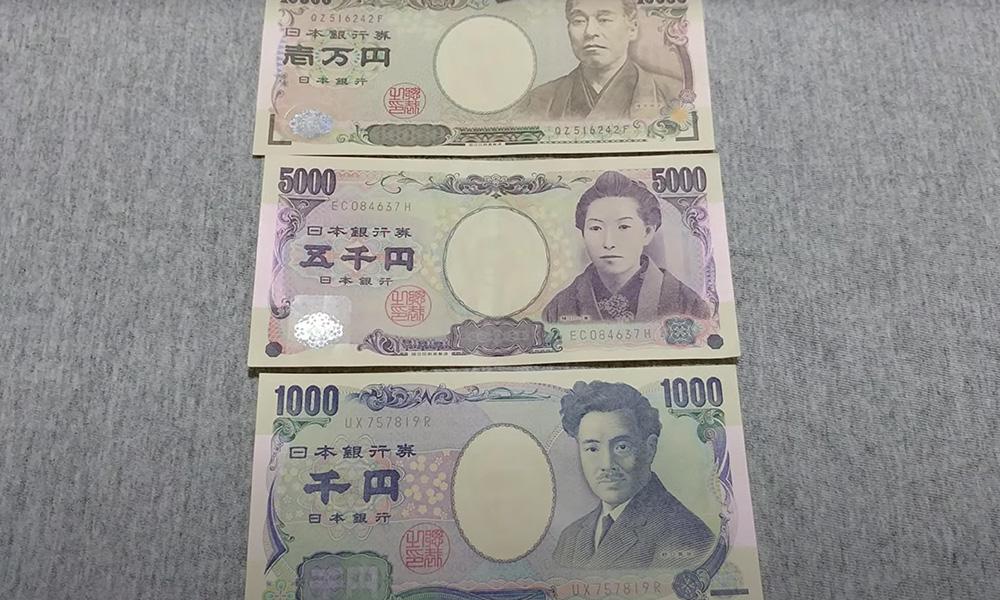
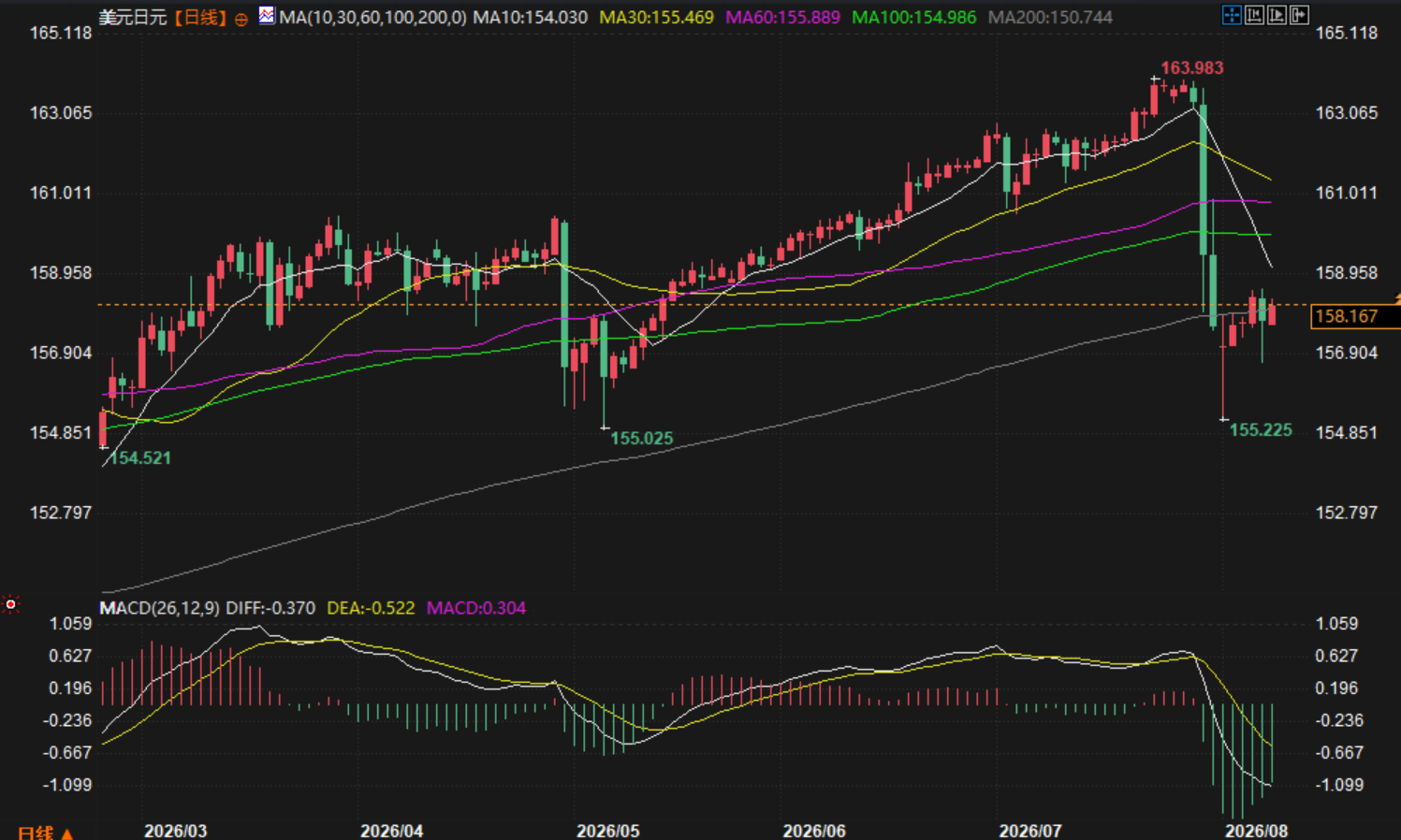 (USD/JPY daily chart, source: FX678) At 11:38 Beijing time on August 10, the USD/JPY exchange rate was 158.18/19.
Interest Rate Hike Path: Intense Internal Debate, Voices Emerging for "Faster Tightening"
The summary of opinions reveals a significant divergence within the committee regarding the pace of interest rate hikes. The "maintain" camp: Some members advocate keeping interest rates unchanged, arguing that the impact of rate hikes on inflation and economic activity has a lag of approximately one to one and a half years, requiring sufficient time to assess the transmission effects of previous rate hikes; therefore, maintaining the policy rate unchanged at this stage is appropriate. The "accelerate" camp: Other members believe that current financial conditions remain sufficiently loose, and the central bank should continue to raise interest rates. Some members further pointed out that given the increasing upside risks to inflation, the pace of rate hikes may ultimately be faster than the market currently expects. This clear voice advocating for "faster tightening" is the most tradable signal of this meeting—if this camp prevails at the next meeting, the yen is expected to strengthen, and Japanese government bond yields will also rise.Economic assessment: Moderate recovery, but facing multiple headwinds.
The Bank of Japan board members unanimously judged that the Japanese economy remains on a path of moderate recovery, a baseline scenario unshaken by changes in the external environment. However, the recovery process faces multiple intersecting pressures: geopolitical conflicts in the Middle East are dragging down economic activity; the depreciation of the yen has a dual impact—both positive for export competitiveness and higher import costs. Amid these headwinds, the continued expansion of AI-related demand has provided strong hedging support for the economy, becoming a structural bright spot in this round of recovery. Looking ahead, the board members expect economic growth to slow temporarily in fiscal year 2026 due to rising oil prices, but growth is expected to rebound from fiscal year 2027 onwards as the impact of oil prices subsides. Notably, one member pointed out that although Japan has experienced sharp deteriorations in demand and inflation during past major external shocks, the Japanese economy has so far demonstrated unexpected resilience under the dual test of US tariff policies and Middle East conflicts.Inflation Outlook: Approaching the 2% Target, with Significant Upside Risks
Regarding inflation, the Bank of Japan board members expect core CPI inflation to reach a level roughly consistent with the 2% price stability target between the second half of fiscal year 2026 and fiscal year 2027, providing a clear timeline for policy normalization. However, the inflation outlook faces significant upside risks. The continued tensions in the Middle East, the potential for further increases in AI-related demand, and the upward pressure on import prices from a weaker yen all combine to create the possibility of inflation exceeding expectations. Regarding oil prices, the board noted that crude oil and naphtha prices have fallen from their April peaks, partly due to a short-term increase in supply caused by delayed tanker departures from the Persian Gulf. However, the board also warned that once this temporary effect subsides, supply and demand conditions could tighten again. Domestically, rising distribution costs and packaging material prices are expected to drive a renewed acceleration in consumer price increases around early autumn. Several board members described the risks to the inflation outlook as "significantly skewed to the upside," citing reasons including Japan's positive output deficit and potential additional price pressures from AI demand.Summarize
The summary of opinions from this Bank of Japan meeting released several key signals: First, internal divisions were significant and public. The committee was caught in a tug-of-war between "maintaining a wait-and-see approach" and "accelerating tightening," with the explicit statement that "the pace of interest rate hikes may be faster than market expectations" being noteworthy. If the hawkish camp gains the upper hand at future meetings, the yen will be supported, and Japanese government bond yields will face upward pressure. Second, oil prices are a core variable in the inflation outlook. Committee members generally viewed the situation in the Middle East as a key risk to rising inflation. It is worth noting that if the standoff in the Strait of Hormuz deteriorates further (consistent with current situation tracking analysis), oil prices may surge again, further pushing up Japanese import prices and inflation, thereby reinforcing the hawkish stance within the committee. Third, the internal divisions within the Bank of Japan have injected new variables into the two-way fluctuations of the USD/JPY exchange rate. In the short term, the dollar side (Federal Reserve expectations + geopolitical risk aversion) will still dominate. After consolidating around the 158 level, this week's US CPI data will determine its short-term breakout direction. If hawkish expectations continue to take hold and the dollar weakens, the USD/JPY pair may retreat towards 156; if the situation in the Middle East deteriorates or US inflation becomes stickier than expected, then 159-160 remains a possibility. (USD/JPY daily chart, source: FX678) At 11:38 Beijing time on August 10, the USD/JPY exchange rate was 158.18/19.- Risk Warning and Disclaimer
- The market involves risk, and trading may not be suitable for all investors. This article is for reference only and does not constitute personal investment advice, nor does it take into account certain users’ specific investment objectives, financial situation, or other needs. Any investment decisions made based on this information are at your own risk.

