The US-Iran rivalry strategy shift and weakening US employment provide a tailwind for gold prices.
2026-08-10 21:38:55
On Monday (August 10), spot gold fluctuated at high levels during the European and American trading sessions, holding onto almost all of the gains from the previous trading day, currently trading at $4336 per ounce. The core pricing logic of the global market is currently being reshaped by two key variables: First, the months-long US-Iran conflict has reached a strategic turning point, with the US abandoning aggressive military strikes and shifting towards extreme economic pressure, leading to a tug-of-war in the Middle East geopolitical game; second, the US job market has weakened more than expected, breaking the market's established expectations of high inflation and strong interest rate hikes. The interplay of geopolitical conflict, energy inflation, and the Fed's monetary policy has completely rewritten the pricing logic of gold, creating a hedging game between traditional safe-haven logic and interest rate pricing logic, which is dominating recent gold price movements. Meanwhile, Wednesday's CPI may become another key support for gold prices, and the gold bulls are currently in a very favorable position. 
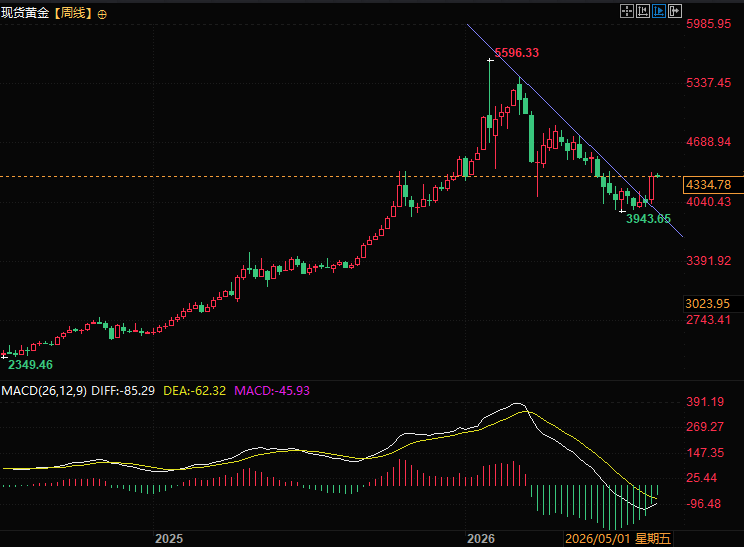 (Spot gold weekly chart, source: FX678) At 21:36 Beijing time, spot gold is currently trading at $4336 per ounce.
The US-Iran rivalry has taken a complete turn: economic pressure has replaced military offensive, and negotiations have reached a stalemate.
Since the US-Israel military strikes against Iran in late February, and the ensuing 23-week conflict, the Trump administration has completed a core strategic adjustment. It abandoned its previous threats of a "devastating military strike" and instead focused on economic sanctions to pressure Iran, initiating a new game of "low-key pressure, using pressure to force talks." This strategic shift was not accidental, but an inevitable choice under multiple real-world constraints. Militarily, the US faces significant real-world constraints. Multiple media reports indicate that the US military's ammunition reserves are running low due to the dual conflicts in the Middle East and Ukraine. The shortage of air defense interceptors has constrained the US military's operational capabilities in the Middle East and the protection capabilities of its allies. Although US officials have stated that ammunition is sufficient to support current military operations, the cost and sustainability of sustained high-intensity military strikes have significantly decreased. Simultaneously, the Trump administration is mired in domestic political pressure. With the midterm elections approaching, only 35% of the American public supports the war against Iran, indicating strong public anti-war sentiment. For the first time, the opposition party has surpassed the ruling party in public support for counterterrorism and war governance, and its radical military strategy has lost its domestic popular support. To this end, the United States has focused its core approach on economic blockade, relying on the Persian Gulf maritime blockade system launched in April to build an "ironclad" control structure, continuously intercepting, expelling, and inspecting passing merchant ships, directly causing a near-total halt to Iranian crude oil exports. Iran was already deeply mired in economic difficulties due to long-term sanctions, domestic governance imbalances, and infrastructure damage from war. The collapse of oil revenues further exacerbated the crisis, leading to rampant hyperinflation, fiscal strain, and even difficulties in paying military salaries. The Trump administration believed that by continuously amplifying Iran's economic decline, it could force Iran to compromise and make concessions, achieving the US's negotiating demands. However, the actual effect of this economic pressure strategy fell far short of US expectations, and the US-Iran game reached a stalemate of two-way confrontation. At the negotiating level, the two sides' positions are severely divergent: the US has stated a "semi-negotiating" status with Iran, while Iran has consistently refused direct dialogue with the US. The memorandum reached on June 17th regarding the resumption of shipping in the Strait of Hormuz quickly collapsed, with core disagreements focusing on key issues such as strait control, the lifting of sanctions, and the unfreezing of assets. The US attempted to retain its demands for restrictions on Iran's ballistic missile program and regional proxy forces, abandoning its initial goal of regime change. Iran, on the other hand, insisted that the US lift the blockade, remove sanctions, and compensate for war losses as preconditions for a ceasefire and the resumption of shipping across the Strait. The core demands of both sides were incompatible. More importantly, Iran developed a counter-measure system, breaking the US's one-way pressure pattern. Iran used missiles and drones to strike Gulf states where US troops are deployed, pressuring regional powers such as Qatar, the UAE, and Saudi Arabia to lobby the US for concessions, creating a reverse game chain of "Iran pressuring regional countries, and regional countries pressuring the US." Compared to the US government, which is constrained by public opinion, elections, and economic data, Iran's decision-makers are less constrained by domestic public opinion, and its regime is more stable. It is unlikely to compromise due to economic difficulties in the short term, meaning that the US's economic pressure strategy will not be effective quickly, and the US-Iran conflict will remain in a protracted stalemate.The US job market has weakened significantly, signaling a turning point in the Federal Reserve's monetary policy.
Against the backdrop of ongoing geopolitical conflicts in the Middle East driving up energy inflation, the US domestic labor market has cooled more than expected, creating a unique economic landscape of "high inflation + weak employment." This has completely reversed the Federal Reserve's monetary policy expectations and become a core variable influencing global asset pricing. The latest data from the US Bureau of Labor Statistics shows a comprehensive weakening of the US job market. Non-farm payrolls unexpectedly decreased by 23,000 in July, significantly deviating from the market expectation of 80,000 new jobs. Meanwhile, the cumulative downward revision of new jobs in May and June is 103,000, confirming the weak employment recovery this summer. The job decline is mainly concentrated in local government education, retail, wholesale, supermarkets, gas stations, and other physical service industries, with widespread job contraction. Wage and unemployment rate data show structural divergence: although the number of jobs decreased, the US unemployment rate fell slightly to 4.1%, but the core reason was a slight decrease in the number of people participating in the labor force, not a recovery in the job market. Wage growth continued to slow, with the average hourly wage increasing by 3.2% year-on-year in July, lower than the market expectation of 3.5%, further easing endogenous inflationary pressures. Analysts point out that the decline in the US labor market has far exceeded market expectations, with the labor force participation rate returning to pre-pandemic levels, job creation capacity continuing to weaken, and economic growth momentum slowing significantly. This weak employment data has greatly alleviated pressure on the Federal Reserve to raise interest rates. Currently, US inflation remains high. Driven by the Middle East conflict and a rebound in international oil prices, the average price of gasoline in the US has returned to above $4 per gallon, diesel prices have soared, and overall inflation remains high at 3.5%. The Fed's core objective of curbing inflation has not yet been achieved. However, the Fed has a dual mission of stabilizing inflation and protecting employment. The significantly weak employment data has completely dispelled market expectations for a September rate hike, and even led to predictions of a rate cut. The new Fed chairman has also temporarily suspended its tightening policy guidance, maintaining the current interest rate range of 3.5%-3.75%.Geopolitical competition and monetary policy are driving a complete restructuring of the logic behind gold pricing.
As a zero-interest safe-haven asset, gold's price movement is consistently determined by three core factors: geopolitical safe-haven demand, the US dollar interest rate cycle, and inflation expectations. The current combination of the protracted US-Iran conflict, weak US employment, and high inflation has led to a complex structural market for gold, completely reshaping traditional pricing logic. On one hand, the ongoing US-Iran standoff provides long-term safe-haven support. The Strait of Hormuz, a crucial global energy corridor, remains a risk of shipping disruptions, and the geopolitical uncertainty in the Middle East has not subsided, continuously supporting the safe-haven demand for gold. Simultaneously, the prolonged US economic blockade of Iran and the unresolved deadlock in US-Iran negotiations mean that the global geopolitical risk premium will not decline rapidly, solidifying a downside floor for gold prices. On the other hand, expectations of monetary policy easing due to weakening US employment are the core driver of gold price increases. Historical trends show a high negative correlation between gold and US Treasury yields and the US dollar index. Previously, the market bet on continued Federal Reserve rate hikes due to soaring oil prices and high inflation, leading to higher US Treasury yields and a strong dollar that suppressed gold prices. However, current weak employment data has completely reversed rate hike expectations, causing US Treasury yields to fall and the dollar's strength to slow, significantly reducing the opportunity cost of holding gold and driving a recovery in gold valuations. It's worth noting that the current market is characterized by a triple positive pattern: resilient inflation supporting gold prices, a receding rate hike trend driving gold prices, and geopolitical risks providing a floor for gold prices, while simultaneously offsetting previous negative factors. The failure to quickly resolve the US-Iran conflict and the ongoing economic sanctions have eliminated systemic risk selling pressure in the market; and the US economic landscape of "weak growth, moderate inflation, and stable currency" is precisely the most favorable pricing environment for gold. Compared to the previous negative feedback loop where geopolitical conflicts pushed up inflation, forcing rate hikes and suppressing gold prices, the current policy expectation inflection point has emerged, and gold has officially entered a valuation recovery phase.Market Outlook: The balance between bulls and bears continues, and the upward trend in gold prices is established.
In the short term, the US-Iran standoff is unlikely to see any breakthroughs, and the protracted economic pressure tug-of-war will continue, with ongoing Middle East geopolitical risks providing a safe-haven foundation for gold prices. Meanwhile, the cooling of the US job market is a growing trend, the Fed's monetary policy tightening cycle has essentially ended, and expectations of an interest rate inflection point continue to benefit gold. Although high energy inflation will limit the Fed's easing pace, making a one-sided surge in gold prices unlikely, the combined effect of multiple positive factors has established a core upward trend for gold. In the medium to long term, the limited effectiveness of US economic pressure on Iran, coupled with Iran's continued counter-offensive, and the long-term geopolitical uncertainty, combined with the backdrop of a weak US economic recovery and marginally loose monetary policy, will simultaneously highlight gold's safe-haven value and financial attributes. Gold is expected to continue to benefit from the current dual shifts in the global macroeconomic and geopolitical landscape, becoming a core beneficiary asset in this round of market restructuring. (Spot gold weekly chart, source: FX678) At 21:36 Beijing time, spot gold is currently trading at $4336 per ounce.
- Risk Warning and Disclaimer
- The market involves risk, and trading may not be suitable for all investors. This article is for reference only and does not constitute personal investment advice, nor does it take into account certain users’ specific investment objectives, financial situation, or other needs. Any investment decisions made based on this information are at your own risk.