A chart shows that the Baltic Dry Index declined slightly, and Capesize bulk carrier freight rates weakened.
2026-08-10 23:02:57
The latest data shows that on August 10, 2026, the Baltic Dry Index (BDI) was 3083 points, a decrease of 0.19% compared to the previous period, marking the largest drop since August 6, 2026. Looking at the short-term charts, the BDI has seen positive growth 6 times, negative growth 5 times, and zero growth 0 times in the last 11 BDI data points. Specifically, the Panamax Freight Index (BPI) was 2306 points, up 0.35% from the previous period; the Capesize Freight Index (BCI) was 5105 points, down 0.45%; and the Supramax Freight Index (BSI) was 1603 points, unchanged. For detailed charts of the latest 720-day and 10-year trends of the Baltic Dry Index and its three main sub-indices, please refer to the charts specially created by FX678. 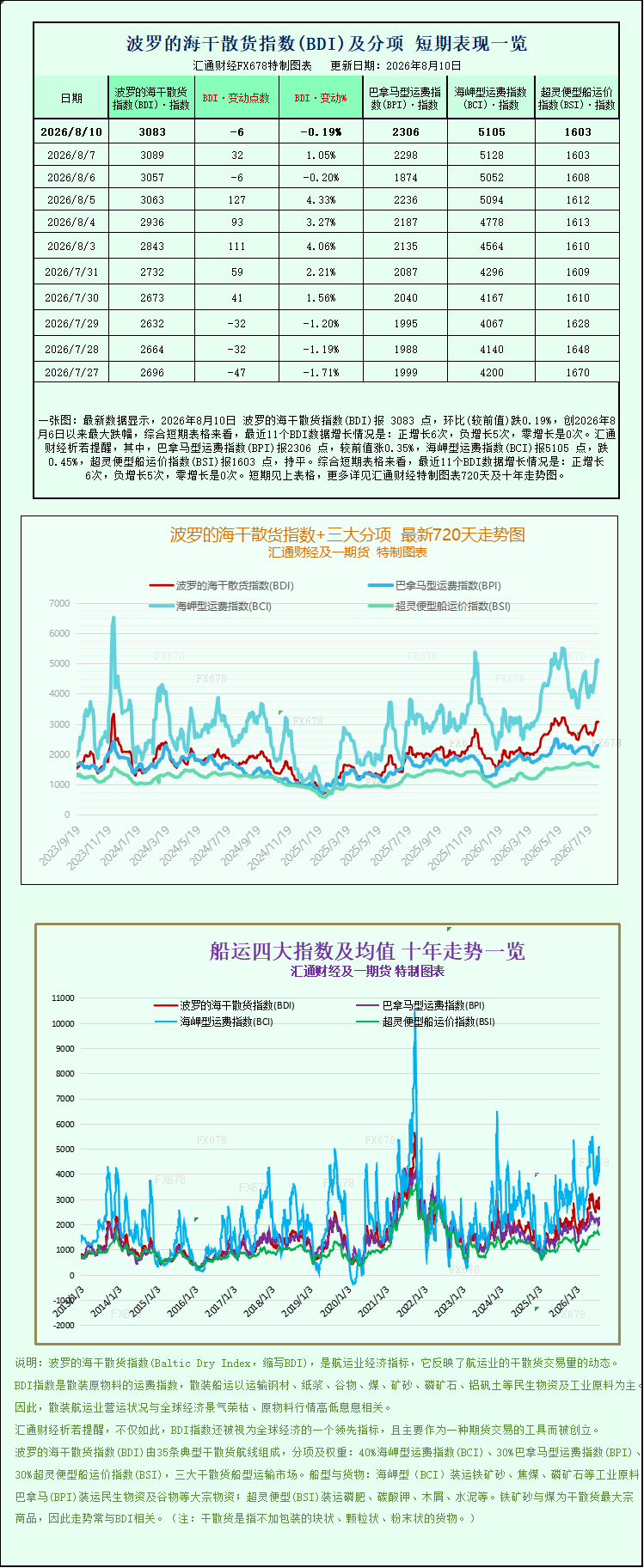 The Baltic Dry Index (BDI), which tracks global dry bulk shipping rates, edged lower on Monday, revealing a distinct structural divergence within the market. Capesize rates declined significantly, dragging down the overall index, while Panamax rates bucked the trend, climbing to a more than two-month high. This offsetting effect of rising and falling rates for these two vessel types ultimately led to a slight pullback in the composite index. As the most important indicator of the global dry bulk shipping market, the Baltic Dry Index directly reflects the state of global commodity seaborne trade and the supply and demand dynamics of raw materials such as iron ore, coal, and grain, attracting widespread attention from traders, shipowners, and commodity investors. The Baltic Dry Index, which aggregates freight rates for Capesize, Panamax, and Supramax bulk carriers, fell 6 points, or 0.2%, to 3083 points on Monday. The index has retreated from its recent high since June 3rd, indicating a brief consolidation in the previously strong dry bulk market. However, the overall index remains within a relatively high range for the year. From a market structure perspective, this decline in the composite index is not a broad-based drop across the entire industry. Significant differences exist in the market performance of different tonnage vessels: large Capesize vessels weakened, medium-sized Panamax vessels strengthened, and small Supramax vessels remained stable. This fully reflects that the current dry bulk market is not a one-sided trend, but rather a structural market driven by demand for different cargo types. As the largest dry bulk vessel type, Capesize vessels primarily handle the ocean transport of bulk raw materials such as iron ore and coal, and their freight rate fluctuations are often a key indicator of market sentiment. Data shows that the Capesize index fell 23 points, a decrease of 0.5%, closing at 5105 points. This index had just reached its highest point since June 4th last Friday, experiencing a rapid decline after a short-term surge. In terms of actual vessel earnings, the average daily revenue of Capesize vessels, which mainly carry 150,000 tons of iron ore and coal, decreased by $212 to $42,797 per day, resulting in a significant contraction in shipowner profitability. The weakening of Capesize freight rates is deeply intertwined with changes in the fundamentals of the iron ore market. As the world's largest iron ore consumer, China's domestic factory output data was weak, leading to concerns about future demand for steelmaking raw materials and directly putting downward pressure on iron ore prices. Although a strike at a key Australian export hub should have disrupted iron ore export supply and supported prices, limiting further price declines, pessimistic expectations on the demand side prevailed, offsetting the positive effects of the supply-side disruption. The overall iron ore market exhibited a weak and volatile pattern, directly suppressing freight demand for Capesize vessels. The pace of cargo release slowed, forcing shipowners to lower charter rates to compete for limited cargo. In stark contrast to the weak Capesize market, the Panamax market experienced an independent upward trend. The Panamax index rose 8 points, or 0.4%, to 2306 points, reaching its highest level in over two months since June 2nd. Panamax vessels primarily carry 60,000 to 70,000 tons of coal and grain cargo. The average daily earnings for this type of vessel increased by $71 to $20,755 per day, leading to a steady rise in shipowner profits. The strength in Panamax vessels was mainly due to the release of grain and regional coal trade cargoes, a recovery in freight demand on some Atlantic and Pacific routes, and a temporary tightening of available shipping capacity, pushing charter rates upward. Driven by global grain trade flows and inter-regional coal transportation, the Panamax market deviated from the broader market trend and rose, becoming one of the few bright spots in the dry bulk market that day. The smaller Supramax market remained stable, with the Supramax index remaining unchanged at 1603 points. This type of vessel is widely used for short-distance, small-volume transportation of minerals, grains, and building materials, covering a wide range of routes and attracting numerous market participants. Currently, there has been no significant increase in cargo volume in the market, while the number of vessels available for chartering remains stable, indicating a relative balance between supply and demand. Therefore, freight rates have not fluctuated significantly, acting as a stabilizer for the market. Overall, the slight pullback in the Baltic Dry Index on August 10th is more of a structural adjustment after the previous surge, and does not indicate a complete bearish trend in the dry bulk market. Capesize vessels are under pressure due to weakening demand expectations in China's steel industry chain, while Panamax vessels continue to rise due to stronger grain trade. Small and medium-sized vessels remain stable, and the divergence in performance between different vessel types has further widened. The future market trend will continue to depend on multiple variables, including the strength of the recovery in China's manufacturing and steel industries, whether labor disputes at Australian ports escalate further, the pace of global grain exports, and changes in the effective supply of global shipping capacity. If downstream demand for iron ore recovers, Capesize freight rates are expected to stop falling; while with the peak season for grain exports in the Northern Hemisphere approaching, Panamax vessels still have the potential to continue strengthening, and the dry bulk shipping market will likely maintain a high volatility pattern.
The Baltic Dry Index (BDI), which tracks global dry bulk shipping rates, edged lower on Monday, revealing a distinct structural divergence within the market. Capesize rates declined significantly, dragging down the overall index, while Panamax rates bucked the trend, climbing to a more than two-month high. This offsetting effect of rising and falling rates for these two vessel types ultimately led to a slight pullback in the composite index. As the most important indicator of the global dry bulk shipping market, the Baltic Dry Index directly reflects the state of global commodity seaborne trade and the supply and demand dynamics of raw materials such as iron ore, coal, and grain, attracting widespread attention from traders, shipowners, and commodity investors. The Baltic Dry Index, which aggregates freight rates for Capesize, Panamax, and Supramax bulk carriers, fell 6 points, or 0.2%, to 3083 points on Monday. The index has retreated from its recent high since June 3rd, indicating a brief consolidation in the previously strong dry bulk market. However, the overall index remains within a relatively high range for the year. From a market structure perspective, this decline in the composite index is not a broad-based drop across the entire industry. Significant differences exist in the market performance of different tonnage vessels: large Capesize vessels weakened, medium-sized Panamax vessels strengthened, and small Supramax vessels remained stable. This fully reflects that the current dry bulk market is not a one-sided trend, but rather a structural market driven by demand for different cargo types. As the largest dry bulk vessel type, Capesize vessels primarily handle the ocean transport of bulk raw materials such as iron ore and coal, and their freight rate fluctuations are often a key indicator of market sentiment. Data shows that the Capesize index fell 23 points, a decrease of 0.5%, closing at 5105 points. This index had just reached its highest point since June 4th last Friday, experiencing a rapid decline after a short-term surge. In terms of actual vessel earnings, the average daily revenue of Capesize vessels, which mainly carry 150,000 tons of iron ore and coal, decreased by $212 to $42,797 per day, resulting in a significant contraction in shipowner profitability. The weakening of Capesize freight rates is deeply intertwined with changes in the fundamentals of the iron ore market. As the world's largest iron ore consumer, China's domestic factory output data was weak, leading to concerns about future demand for steelmaking raw materials and directly putting downward pressure on iron ore prices. Although a strike at a key Australian export hub should have disrupted iron ore export supply and supported prices, limiting further price declines, pessimistic expectations on the demand side prevailed, offsetting the positive effects of the supply-side disruption. The overall iron ore market exhibited a weak and volatile pattern, directly suppressing freight demand for Capesize vessels. The pace of cargo release slowed, forcing shipowners to lower charter rates to compete for limited cargo. In stark contrast to the weak Capesize market, the Panamax market experienced an independent upward trend. The Panamax index rose 8 points, or 0.4%, to 2306 points, reaching its highest level in over two months since June 2nd. Panamax vessels primarily carry 60,000 to 70,000 tons of coal and grain cargo. The average daily earnings for this type of vessel increased by $71 to $20,755 per day, leading to a steady rise in shipowner profits. The strength in Panamax vessels was mainly due to the release of grain and regional coal trade cargoes, a recovery in freight demand on some Atlantic and Pacific routes, and a temporary tightening of available shipping capacity, pushing charter rates upward. Driven by global grain trade flows and inter-regional coal transportation, the Panamax market deviated from the broader market trend and rose, becoming one of the few bright spots in the dry bulk market that day. The smaller Supramax market remained stable, with the Supramax index remaining unchanged at 1603 points. This type of vessel is widely used for short-distance, small-volume transportation of minerals, grains, and building materials, covering a wide range of routes and attracting numerous market participants. Currently, there has been no significant increase in cargo volume in the market, while the number of vessels available for chartering remains stable, indicating a relative balance between supply and demand. Therefore, freight rates have not fluctuated significantly, acting as a stabilizer for the market. Overall, the slight pullback in the Baltic Dry Index on August 10th is more of a structural adjustment after the previous surge, and does not indicate a complete bearish trend in the dry bulk market. Capesize vessels are under pressure due to weakening demand expectations in China's steel industry chain, while Panamax vessels continue to rise due to stronger grain trade. Small and medium-sized vessels remain stable, and the divergence in performance between different vessel types has further widened. The future market trend will continue to depend on multiple variables, including the strength of the recovery in China's manufacturing and steel industries, whether labor disputes at Australian ports escalate further, the pace of global grain exports, and changes in the effective supply of global shipping capacity. If downstream demand for iron ore recovers, Capesize freight rates are expected to stop falling; while with the peak season for grain exports in the Northern Hemisphere approaching, Panamax vessels still have the potential to continue strengthening, and the dry bulk shipping market will likely maintain a high volatility pattern.
- Risk Warning and Disclaimer
- The market involves risk, and trading may not be suitable for all investors. This article is for reference only and does not constitute personal investment advice, nor does it take into account certain users’ specific investment objectives, financial situation, or other needs. Any investment decisions made based on this information are at your own risk.