The underlying logic behind four consecutive days of price increases: What signals is Brent crude oil releasing?
2026-08-11 17:58:54
On Tuesday, August 11th, the global energy market experienced renewed volatility, with Brent crude oil prices rising for the second consecutive day. The market is refocusing on supply risks, inflationary pressures, and future policy paths of major central banks. Currently, Brent crude oil prices are up about 2%, reaching around $89.50 per barrel. Against the backdrop of rapidly rising energy prices, inflation expectations have shifted significantly. Data from the European inflation swap market shows that the 1-year euro inflation swap rate rose 12.6 basis points to 2.39%, reflecting a market reassessment of the impact of energy costs on future price levels. This oil price increase is not merely a fluctuation within the commodity market, but also involves changes in global macroeconomic trading logic. Energy prices affect inflation through transportation costs, production costs, and consumer prices, and may also alter market perceptions of the policy pace of major central banks such as the Federal Reserve and the European Central Bank. 
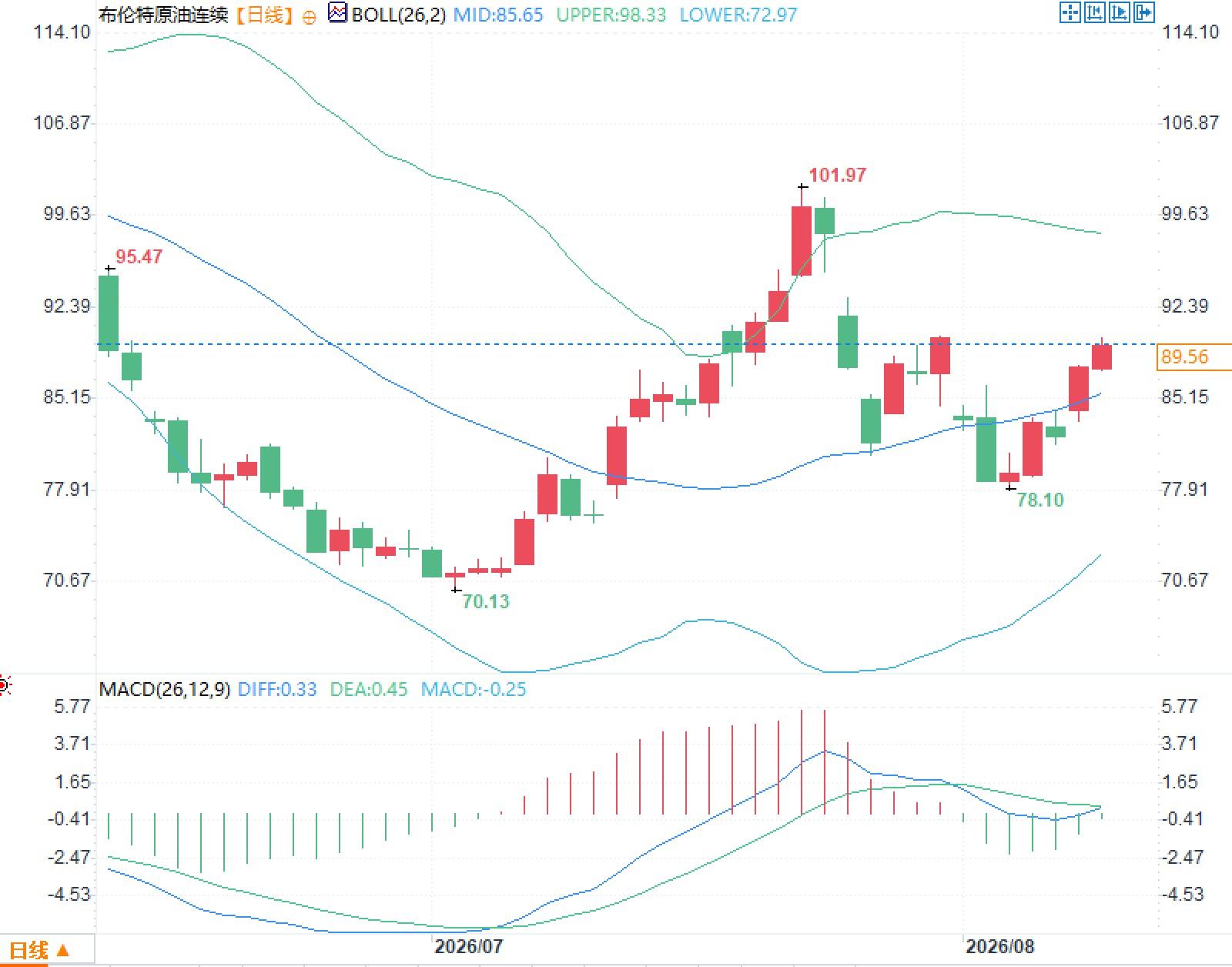 Regarding the MACD indicator, after the sustained release of bearish momentum in the previous period, the indicator shows signs of convergence, indicating a slight improvement in short-term market momentum. However, technical indicators primarily reflect historical price behavior and cannot solely determine future market direction.
Behind the four consecutive oil price increases: Supply risk becomes the core variable in the market.
Recent price movements in Brent crude oil have shown a continuous upward trend, with market focus concentrated on supply-side uncertainties. The continued closure of the Hormuz Pass has been a significant factor driving up risk premiums. This region has long been a crucial node in global energy transportation; disruptions to transportation typically lead to increased market valuations of supply disruption risks. The core logic of the energy market is shifting. Previously, the market primarily focused on demand growth, inventory changes, and economic cycle factors; recently, supply security has once again become a key variable influencing prices. However, the sustainability of the oil price increase depends on the speed of supply recovery, changes in inventory levels, and the performance of global economic demand. Commodity prices are typically influenced by multiple factors, and the impact of a single event on long-term trends requires further observation in conjunction with subsequent data.How energy prices are transmitted to inflation expectations and interest rate markets
The biggest impact of energy prices on the macro market is not the price itself, but rather the change in inflation expectations. Rising crude oil prices first affect energy consumption costs and then propagate to other sectors through transportation, industrial production, and the commodity supply chain. If the market believes that rising energy prices may continue, businesses and consumers' expectations of future price levels may change. Recent changes in the European inflation swap market reflect this impact. The 1-year euro inflation swap rate has risen again, indicating that investors are increasing their estimates of future inflationary pressures. Meanwhile, the yield on the 10-year US Treasury bond has recently risen by about 6 basis points, indicating a shift in market expectations regarding the future interest rate path. Some expectations of interest rate cuts that emerged after the release of employment data have cooled, and the market is refocusing on the impact of inflation on monetary policy. For central banks, the challenge of rising energy prices lies in determining whether it is a short-term shock or persistent inflationary pressure. If energy prices are only fluctuating in stages, the policy impact may be limited; however, if energy costs remain high, it may increase the pressure on policymakers to maintain a tight monetary policy environment.Technical Structure Changes: Market Focuses on Volatility and Trend Signals
From a technical perspective, Brent crude oil prices have recently shown a clear rebound. After a period of adjustment, Brent crude oil prices on the daily chart have risen continuously, approaching the upper half of the Bollinger Bands. The Bollinger Bands indicate that the middle band is around 85.65, the upper band is around 98.33, and the lower band is around 72.97, meaning the current price range has significantly widened compared to before. Regarding the MACD indicator, after the sustained release of bearish momentum in the previous period, the indicator shows signs of convergence, indicating a slight improvement in short-term market momentum. However, technical indicators primarily reflect historical price behavior and cannot solely determine future market direction.The global policy environment faces new balancing challenges.
Energy price fluctuations are increasing the complexity of policy decisions for major central banks. If inflationary pressures resurface due to energy factors, central banks will need to find a balance between controlling price stability and maintaining economic growth. The Federal Reserve has been consistently monitoring the downward trend in inflation, while the European Central Bank also needs to assess the impact of energy cost changes on price levels. The core issue currently on the market is not simply rising oil prices, but whether the energy shock will alter the downward path of inflation. Historically, the impact of energy prices on overall inflation has a phased nature. Some shocks may be quickly reflected in price data, while others may gradually weaken due to supply adjustments. Therefore, it is necessary to monitor the recovery of energy supply, inventory changes, and inflation data. In the current market environment, energy factors are once again becoming a significant variable influencing global asset pricing. Changes in crude oil prices not only affect commodity markets but also influence bond markets and monetary policy expectations through inflation expectations.- Risk Warning and Disclaimer
- The market involves risk, and trading may not be suitable for all investors. This article is for reference only and does not constitute personal investment advice, nor does it take into account certain users’ specific investment objectives, financial situation, or other needs. Any investment decisions made based on this information are at your own risk.