Pakistan re-enters the mediation, causing oil prices to plummet by $2! What hurdles remain before the US-Iran agreement is truly implemented?
2026-08-11 19:44:57
On Tuesday, August 11, diplomatic news surrounding US-Iran contacts once again became a key source of volatility in the global energy market. Pakistan signaled that there was room for progress in negotiations, and its Interior Minister arrived in Tehran for a new round of communication. Meanwhile, Oman's consultations regarding shipping arrangements in the Strait of Hormuz were nearing a crucial stage. Brent crude, which had been trading above $89 per barrel, fell by about $2 in the short term, hitting a low near $87 per barrel, influenced by this news. However, a significant gap remains between diplomatic statements and actual agreements. The US and Iran have yet to reach an enforceable common framework regarding compensation, sanctions, asset arrangements, and a passage mechanism through the Strait. Consequently, the market has shifted from a brief period of easing pricing to a reassessment of real supply constraints. 
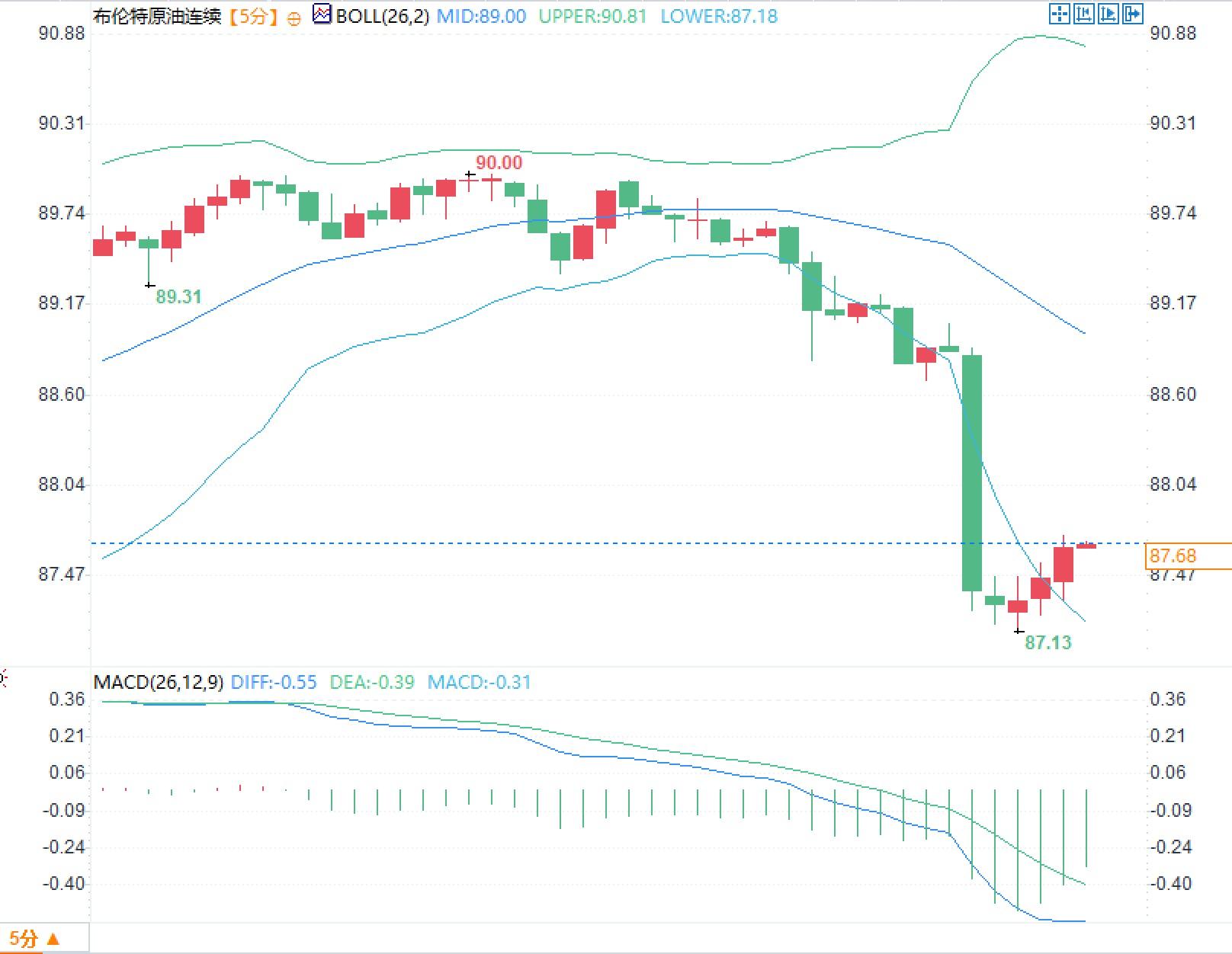 Observing the 5-minute chart of Brent crude oil, the price briefly dipped after the release of optimistic diplomatic news, followed by a recovery. The Bollinger Bands widened significantly, and the MACD remained below the zero line. This does not reflect a trend conclusion, but rather a typical event-driven volatility structure: news first changes the risk premium, and then the actual supply of physical goods re-influences pricing.
Diplomatic signals have improved, but what the energy market is really trading is the ability to enforce agreements.
Pakistan's recent renewed emphasis on its mediating role is not primarily about adding another diplomatic participant, but rather about its ability to act as an intermediary, facilitating information dissemination, condition testing, and proposal revision when a stable direct communication channel between the US and Iran is lacking. The recent arrival of Pakistan's Interior Minister in Tehran is seen as a move to discuss new proposals to break the deadlock in negotiations. Meanwhile, arrangements between Iran and Oman regarding shipping routes in the Strait of Hormuz have entered a later stage, indicating that the current diplomatic agenda has moved beyond a principled ceasefire to the operational levels of restoring shipping lanes, transportation, and commerce. The market is focused on three variables: whether strait traffic will return to normal, whether insurance and freight risks will decrease, and whether energy exporters can re-establish stable shipping schedules. Currently, none of these three conditions have been fully met. Following the renewed public disagreement between the US and Iran over compensation, the market's previous expectations for a rapid easing of tensions have cooled significantly. Recent public information shows that the two sides not only differ on compensation but also lack a consensus on issues such as the lifting of sanctions, frozen assets, and the management of the Strait of Hormuz. Therefore, the so-called "approaching agreement" is more accurately understood as the continued existence of diplomatic channels rather than the elimination of supply risks.The Strait of Hormuz remains the most important practical constraint on crude oil pricing.
The core of the current oil price risk premium lies in the fact that the actual transport capacity of the Strait of Hormuz is far below normal levels. The latest ship statistics show that the number of ships confirmed to have passed through the Strait of Hormuz decreased from approximately 15 on Friday to 11 on Saturday, and further to 6 on Sunday, entering single-digit levels. Another set of ship tracking data shows that on some days, only a handful of cargo ships were observable, a significant difference compared to the hundreds of ships active daily during normal periods. However, the number of observable ships does not equate to the actual transport volume. Recent data released by Iraq differs from navigation activity displayed by the Automatic Identification System (AIS), meaning that some tankers may be navigating with their transponders turned off or restricted. Therefore, inferring actual export volume solely from publicly available ship numbers is prone to systematic errors. Iraq previously stated that before the conflict, exports through the Strait of Hormuz amounted to approximately 3.4 million barrels per day, but current export capacity has clearly declined. This is also why Brent crude oil is currently unusually sensitive to diplomatic news. The market is not trading on small changes in supply and demand in the traditional sense, but rather on whether the transport corridor can switch from "limited operation" back to "predictable operation." Only when strait passage, tanker insurance, port scheduling, and export plans are all normalized simultaneously can geopolitical premiums have a basis for genuine repricing.Middle distillate fuels are becoming a tighter segment than crude oil inventories.
Another easily overlooked change in this round of energy risks is the gradual transmission of pressure from crude oil transportation to the refined product supply chain. The Jazan refinery in Saudi Arabia, previously affected by attacks, had its processing capacity limited by approximately 400,000 barrels per day, and the latest incidents have further delayed its recovery. Refinery disruptions mean that the market loses not only crude oil demand but also the direct supply of middle distillates such as diesel and jet fuel. This structure is particularly important for the winter energy market. Crude oil inventories can buffer upstream shortages, but refined product inventories, refinery operating rates, and regional transportation capacity jointly determine the supply elasticity at the final consumption end. When refinery disruptions and shipping restrictions occur simultaneously, even if the total global crude oil volume does not decline to the same extent, the crack spread for middle distillates may still remain significantly higher than the seasonal norm. Therefore, the current contradiction in the energy market is no longer just about "whether the Strait of Hormuz will be restored," but rather a multi-layered risk chain forming from crude oil exports, refinery processing, refined product inventories to shipping logistics. This is also a key reason why crude oil prices occasionally fall rapidly due to diplomatic news, but diesel and related commodities still maintain a strong risk premium. Observing the 5-minute chart of Brent crude oil, the price briefly dipped after the release of optimistic diplomatic news, followed by a recovery. The Bollinger Bands widened significantly, and the MACD remained below the zero line. This does not reflect a trend conclusion, but rather a typical event-driven volatility structure: news first changes the risk premium, and then the actual supply of physical goods re-influences pricing.
- Risk Warning and Disclaimer
- The market involves risk, and trading may not be suitable for all investors. This article is for reference only and does not constitute personal investment advice, nor does it take into account certain users’ specific investment objectives, financial situation, or other needs. Any investment decisions made based on this information are at your own risk.