Gold Trading Alert: Gold Prices Retreat Slightly After Two-Month High! Escalating US-Iran Tensions and CPI Pressure: Can the Bulls Hold Their Ground?
2026-08-12 07:46:54
On Tuesday (August 12), spot gold prices edged lower after hitting a more than two-month high, as market sentiment oscillated between geopolitical uncertainty and upcoming key US inflation data. While gold failed to hold above the $4400 mark, it remained relatively high, indicating that the buying support following weak employment data had not completely dissipated. Investors are now focusing on Wednesday's US Consumer Price Index (CPI), which will directly influence the market's repricing of the Federal Reserve's policy path, thus determining the short-term direction of gold. In early Asian trading on Wednesday (August 12), spot gold was trading around $4370 per ounce, currently in a window of dual macroeconomic and geopolitical tensions. On the one hand, last week's unexpectedly weak non-farm payroll data significantly reduced expectations of a September rate hike, providing clear interest rate support for gold; on the other hand, the fluctuating situation in the Middle East, particularly the uncertainties surrounding the Strait of Hormuz, continues to influence gold prices through both oil prices and safe-haven demand. Meanwhile, the US dollar index remained generally stable, and US Treasury yields fluctuated only slightly after giving back their gains in the morning session, with the entire market awaiting clearer guidance from inflation data. 
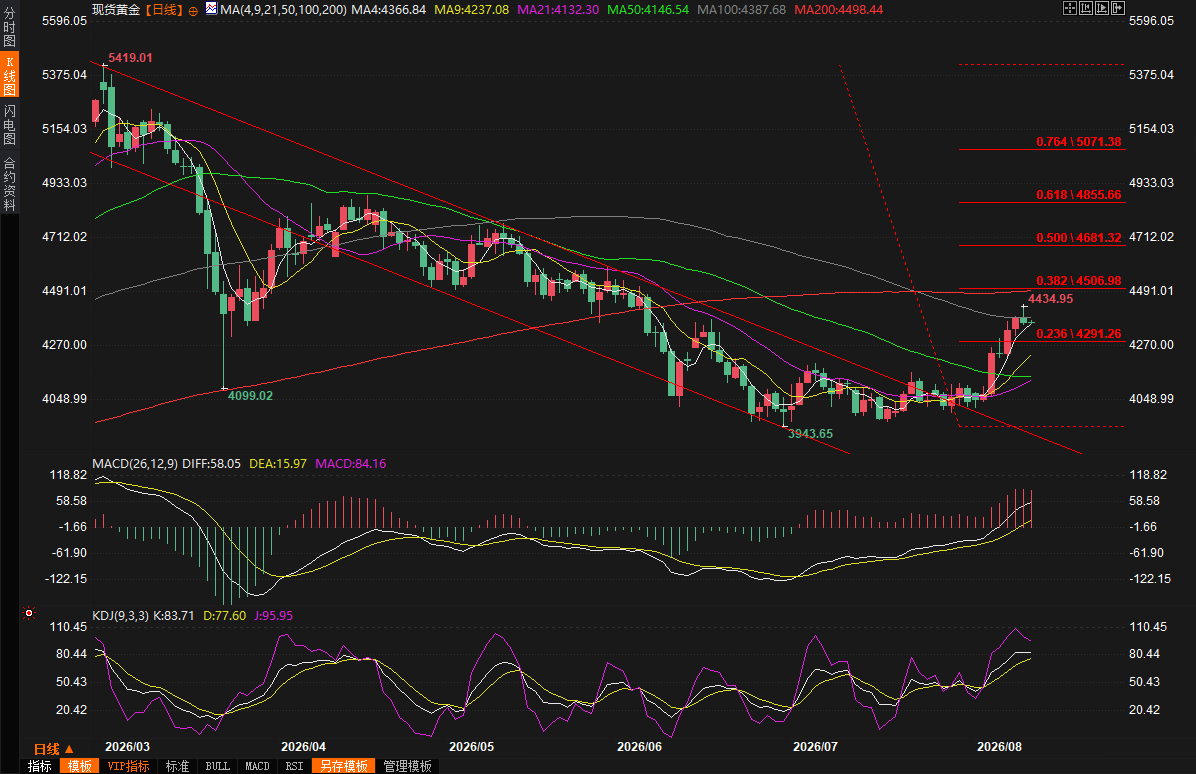 (Spot gold daily chart, source: FX678) At 07:42 Beijing time, spot gold is currently trading at $4368.31 per ounce.
Gold prices surged and then retreated, with subtle changes occurring in both technical and sentiment aspects.
Spot gold ultimately fell 0.5% on Tuesday, closing at $4,368 per ounce, slightly below the 100-day moving average of $4,388. The price briefly surged to $4,435.20, its highest point since June 5th, indicating that bulls still had the will to attempt a breakout at a key resistance level. However, with profit-taking and growing caution regarding subsequent data, gold prices ultimately failed to hold their highs, retreating back to near the moving average. This "rise and fall without a significant breakout" pattern reflects the ambivalent sentiment among market participants. On the one hand, gold surged 2.4% in a single day after last week's employment data release, clearly stimulating buying enthusiasm; on the other hand, investors are reluctant to chase the price higher before the upcoming inflation data is released. Peter Grant, Vice President and Senior Precious Metals Strategist at Zaner Metals, pointed out that the market is expecting this week's inflation data to provide some confirmation that inflation is under control, and the slowdown in annualized CPI growth should continue to support gold. He also emphasized that despite disappointing employment data that weakened expectations of a September rate hike, gold is currently supported by fairly strong buying. From a technical perspective, while the closing price near $4368 broke below the 100-day moving average, it is not far from the previous high and remains in a relatively high range over the past two months. If subsequent inflation data falls short of expectations or further reduces the probability of a rate hike, gold prices may retest the area above $4400; conversely, if inflation stickiness exceeds market expectations, it could trigger a more significant technical correction.Federal Reserve policy expectations will become a key short-term variable, and CPI data will be a crucial litmus test.
As an asset highly sensitive to real interest rates, gold's current price movement is closely tied to expectations regarding the Federal Reserve's policy path. According to the CME FedWatch tool, traders are currently pricing in a 50% probability of a September rate hike, a slight decrease from previous levels, while the probability of a December rate hike remains as high as 80%. This distribution of expectations itself provides some buffer for gold—the market hasn't completely ruled out a rate hike, but it's far from forming a firm consensus on tightening. Cleveland Fed President Hamak stated on Monday that she believes now is the right time to begin gradually raising interest rates to avoid the need for larger rate hikes later. This statement reminds the market that hawkish voices still exist within the Fed. However, the weak July jobs data released on Friday has already led the market to reassess the speed of the economic slowdown, thus limiting the spread of hawkish narratives to some extent. The Consumer Price Index (CPI) released on Wednesday and the Producer Price Index (PPI) released on Thursday will be key points for market repricing. Surveys indicate that the market generally expects the July CPI to rise slightly by 0.1% month-on-month, with the year-on-year increase slowing to 3.4% from 3.5% last month; core CPI is expected to rise 0.2% month-on-month, and the year-on-year increase falling to 2.5% from 2.6%. If the actual data meets or falls short of expectations, it will further strengthen the narrative of "controllable inflation," reducing the probability of near-term interest rate hikes and thus supporting gold prices. However, if the data again shows sticky inflation, it may push up interest rate hike expectations and put pressure on gold prices. It is worth noting that oil price movements are becoming a potential variable in inflation expectations. Brent crude and US crude futures both rose on Tuesday, closing at one-week highs, mainly driven by the cooling prospects of a potential US-Iran agreement and uncertainty surrounding navigation in the Strait of Hormuz. If the recovery in energy prices continues, it may push up overall inflation expectations, increasing expectations of a Fed rate hike and thus putting downward pressure on gold.Geopolitical risks are escalating, with the Strait of Hormuz and Trump's statements becoming new variables.
Beyond macroeconomic data, geopolitical factors have played a significant role in this round of gold price fluctuations. In response to Iran's proposed peace agreement conditions, US President Trump explicitly demanded that Iran pay compensation for victims of the war, attacks, and protests. Meanwhile, Mohsen Rezaei, the newly appointed Secretary-General of Iran's Supreme National Security Council, stated on Tuesday that the Strait of Hormuz would remain closed as long as the US did not change its behavior and accept Iran's proposed conditions for ending the war. This statement is considered the clearest signal to date, indicating that even if negotiations progress, shipping through the strait may not resume quickly. Shipping data shows that the number of ships passing through the Strait of Hormuz on Monday had dropped to six, far below the daily average of about 11 over the past 10 days, and even further below the pre-war normal of 125 to 140 ships per day. The obstruction of navigation in the strait directly increased market concerns about supply disruptions in the Middle East, supporting oil prices. Furthermore, attacks by the Houthi rebels in Yemen on Saudi ships and missile attacks on container ships off the coast of Pakistan further exacerbated regional tensions. On the one hand, the ongoing tensions in the Middle East provided traditional safe-haven buying for gold. On the other hand, this tension, by pushing up oil prices, could become an "invisible killer" suppressing gold prices. Persistently high oil prices will directly boost global inflation expectations, forcing the market to reprice the Federal Reserve's interest rate hike path. Hamad Hussain, an economist at Capital Economics, bluntly stated: "Rising oil prices are pushing up US Treasury yields, which is putting pressure on gold prices." Higher oil prices could exacerbate inflationary pressures and keep interest rates high, thus reducing the attractiveness of gold as a non-yielding asset. In other words, the short-term safe-haven premium triggered by geopolitical conflict is being eroded by the holding costs brought about by rising medium-term interest rates. This is one of the core reasons why gold prices quickly fell back after rising during Tuesday's trading session. Ukraine's continued attacks on Russian energy infrastructure, coupled with the situation in the Middle East, have significantly restricted global energy supply, pushing Brent crude futures up by about 44% so far this year. The US Energy Information Administration even warned that even if trade patterns return to normal by early next year, some oil-producing countries in the Middle East may find it difficult to restore oil production to pre-conflict levels by the end of 2027. This medium- to long-term supply concern has brought renewed attention to gold's value as a traditional safe-haven asset. In the bond market, US Treasuries gave back their early gains on Tuesday, with the 10-year yield fluctuating slightly and the 2-year yield declining somewhat. Market optimism regarding a US-Iran deal cooled due to statements from Iranian officials, and rising oil prices also limited the downside for yields to some extent. The US dollar index remained generally stable around 99.80, with traders also awaiting inflation data for a clearer direction. Overall, the relative stability of the dollar and US Treasuries provides a relatively neutral monetary environment for gold, making it more susceptible to geopolitical and data-driven factors.With both bullish and bearish factors at play, gold may continue its high-level consolidation pattern in the short term.
Based on current information, gold is currently in a phase characterized by a combination of "data-driven factors and geopolitical disturbances." Weak employment data leading to expectations of interest rate cuts (or at least a temporary halt to rate hikes), coupled with safe-haven demand stemming from the Middle East situation, forms the main basis for gold's support at higher levels. However, persistently high oil prices keep the probability of a Fed rate hike this year at 80%, causing some hesitation among gold bulls. The upcoming CPI data presents a two-way risk; if oil prices continue to strengthen due to geopolitical factors, it could reignite inflation concerns, thus exerting temporary downward pressure on gold. From a market sentiment perspective, investors have not exhibited panic selling; on the contrary, there has been buying support during pullbacks, indicating that the bullish camp has not yet collapsed. Analysts such as Peter Grant also tend to believe that as long as the slowdown in inflation is confirmed, gold will remain supported. Meanwhile, the Trump administration's tough stance on Iran and the uncertainty surrounding the Strait of Hormuz mean that the geopolitical premium is unlikely to completely subside in the short term. In the coming days, the market will revolve around inflation data, statements from Fed officials, and developments in the Middle East situation. If the CPI data is moderate, gold prices are expected to retest previous highs; if the data is strong, it may trigger a technical correction, but given the current safe-haven demand and the buffer provided by interest rate expectations, the risk of a significant breakdown is relatively limited. For investors, the focus should be on the market repricing process after the data release, rather than simply betting on a single direction. (Spot gold daily chart, source: FX678) At 07:42 Beijing time, spot gold is currently trading at $4368.31 per ounce.
- Risk Warning and Disclaimer
- The market involves risk, and trading may not be suitable for all investors. This article is for reference only and does not constitute personal investment advice, nor does it take into account certain users’ specific investment objectives, financial situation, or other needs. Any investment decisions made based on this information are at your own risk.