













The seven-week "misalignment game" surrounding central bank decisions begins: RBA's "interest rate hike discussion" versus the Fed's "50/50" expectation.
2026-08-12 08:12:54
The Australian dollar traded in a narrow range against the US dollar in early Asian trading on Wednesday (August 12), currently hovering around 0.7060. The overnight policy decision was uneventful, but the seven-week policy lull is the real focus. The Reserve Bank of Australia (RBA) kept the cash rate unchanged at 4.35%, as widely expected, with unanimous approval, and released its latest quarterly forecasts. The Australian dollar barely reacted to this decision. However, the decision itself is not the key point – the crucial element is the policy lull that follows. The RBA's next meeting is seven weeks away on September 29, while the Federal Reserve is expected to take action before then. 
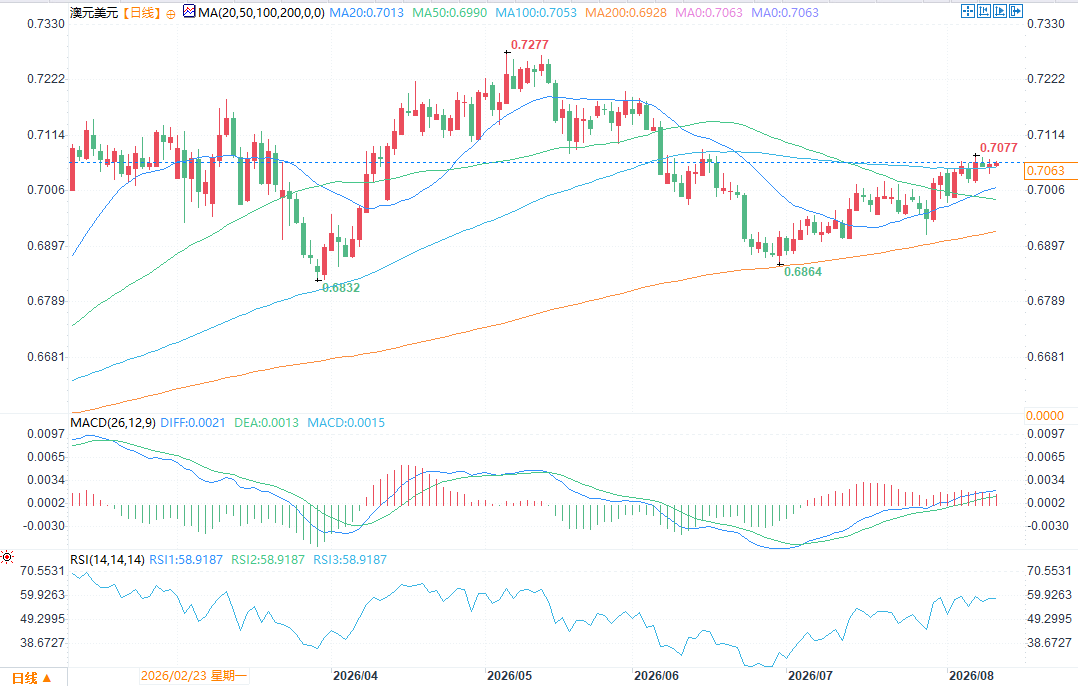 (Australian dollar against US dollar daily chart, source: EasyForex) At 7:55 AM Beijing time on August 12, the Australian dollar was trading at 0.7062/63 against the US dollar.
Seven-week policy lull: Federal Reserve acts before Reserve Bank of Australia
The Reserve Bank of Australia's next meeting isn't until September 29th, while the Federal Reserve will make its interest rate decision on September 16th—13 days earlier than the RBA. On the US calendar, the next seven weeks will see a flurry of CPI, PPI, and retail sales data releases, the minutes of the July meeting on August 19th, and the Jackson Hole symposium from August 27th to 29th. Each of these events could potentially repric interest rate expectations during this period, and almost all of them originate from the US. In contrast, Australia itself has relatively few important data releases during the same period—consumer inflation expectations are released on August 13th, the governor speaks on the same day, and monthly CPI data is released on August 26th. None of these are accompanied by policy decisions, meaning that until the last week of September, the Australian dollar will almost entirely follow the US dollar's movements.Forecasts indicate that it will take a long time for inflation to return to the target.
Despite the unanimous vote, the projected data was not reassuring. The Reserve Bank of Australia (RBA) expects inflation to return to near the midpoint of its target range only by the end of 2027, and this forecast faces upside risks. It also projects the unemployment rate to gradually climb from 4.5% at the end of this year to 4.8% by the end of 2028. A central bank that projects inflation to remain above target for more than a year is waiting for reasons to take further action, rather than having already completed its rate hikes. The press conference was more hawkish than the statement. The committee discussed rate hikes, but never rate cuts; policy was described as "restrictive and tightening"; the governor reiterated that the cash rate would be raised further if necessary. The three rate hikes this year were cited as reasons for patience, not for stopping. The recent surge in oil prices was directly mentioned, with reports suggesting more businesses are planning to pass on costs to consumers.The dual impact of oil price shocks: Australian imports and US exports
Australia's energy imports are impacted, while the US exports energy to some extent—therefore, geopolitical tensions are driving up oil prices, providing grounds for interest rate hikes for both sides. The Reserve Bank of Australia has already included this in its statement. Futures markets are pricing in a near 50/50 chance of a Fed meeting in September—slightly more than half favoring no change, and slightly less than half favoring a 25 basis point hike. It is this symmetry that makes the seven-week policy lull dangerous rather than uneventful. Both central banks are driven by the same fundamental variable, but only one can respond within seven weeks—the Fed. Escalations before September 16th, through the Fed's reaction function, will manifest as a stronger dollar, even if from an economic perspective it is inflationary for Australia—this is precisely the trap of currently holding Australian dollars to profit from interest rate differentials.Upcoming key data and schedule
The US CPI will be released on August 12th. The market expects the overall CPI to rise 0.1% month-on-month, compared to -0.4% previously; core CPI is expected to rise 0.2% month-on-month, compared to 0.0% previously. Strong core inflation will reignite expectations of a September rate hike, putting downward pressure on the Australian dollar; weak data, however, will allow the Australian dollar to maintain an interest rate differential that it wouldn't normally need to fight for, but will be unable to defend before the end of September. On August 13th, Australian consumer inflation expectations data will be released at 09:00 Beijing time, followed by US PPI and initial jobless claims data. On August 14th, retail sales and the preliminary University of Michigan consumer sentiment index will be released. During this week, Australia's only contributions are a survey and a speech.Summarize
The Australian dollar is trading around 0.7060 against the US dollar. The Reserve Bank of Australia (RBA) holding rates steady was in line with expectations, but its next meeting isn't until September 29th. In the meantime, the Federal Reserve will make its decision on September 16th, and with a busy schedule of US data releases, the Australian dollar will almost entirely follow the dollar's movements. The RBA's forecasts indicate that inflation won't return to target until the end of 2027, but the governor's tone at the press conference was hawkish, emphasizing that interest rates would be raised if necessary. The oil price shock has put pressure on both the US and Australian central banks to raise rates, but the fact that the Fed acted before the RBA means that any escalation before September 16th could manifest as a stronger US dollar – precisely the current trap of holding the Australian dollar to profit from interest rate differentials. In the coming weeks, US data will dominate the Australian dollar's movements, especially the CPI data on August 12th, which could be a key catalyst for short-term direction. (Australian dollar against US dollar daily chart, source: EasyForex) At 7:55 AM Beijing time on August 12, the Australian dollar was trading at 0.7062/63 against the US dollar.
- Risk Warning and Disclaimer
- The market involves risk, and trading may not be suitable for all investors. This article is for reference only and does not constitute personal investment advice, nor does it take into account certain users’ specific investment objectives, financial situation, or other needs. Any investment decisions made based on this information are at your own risk.

