US CPI Released! Energy and Housing Sub-items Both Showed Decline, Significantly Alleviating Interest Rate Hike Warnings, Gold Prices Surge to 4434
2026-08-12 21:16:56
On Wednesday (August 12), during the European and American trading sessions, the much-anticipated US July CPI inflation data was officially released. In this crucial report, which directly determines the direction of the Federal Reserve's interest rate meeting next month, the overall CPI year-on-year growth rate in July fell to 3.4% as expected, and the core CPI further declined to 2.5% year-on-year, in line with market expectations. This surprised the market, which had bet on easing inflation, causing gold prices to plummet. However, as the breakdown of the data was analyzed, gold prices rebounded. After rising by $10 beforehand, gold prices quickly fell by 1%, subsequently recovering to a new intraday high. Currently, spot gold is trading at $4434, up 1.50% intraday. Amid concerns about a slowdown in the labor market, evidenced by a net decrease of 23,000 non-farm payrolls in July, and hawkish comments from Boston Fed President Susan Collins warning of a possible resumption of rate hikes in September, this inflation report, without any further surprises and showing extremely moderate monthly momentum, undoubtedly injected a strong sense of reassurance into the financial markets, which were caught in an anxiety of stagflation and deflation. More importantly, a closer look at the detailed data reveals that the inflation "ballast" that has plagued the Federal Reserve for many years is undergoing substantial easing, and the necessity of starting an interest rate hike in September has been greatly weakened. 
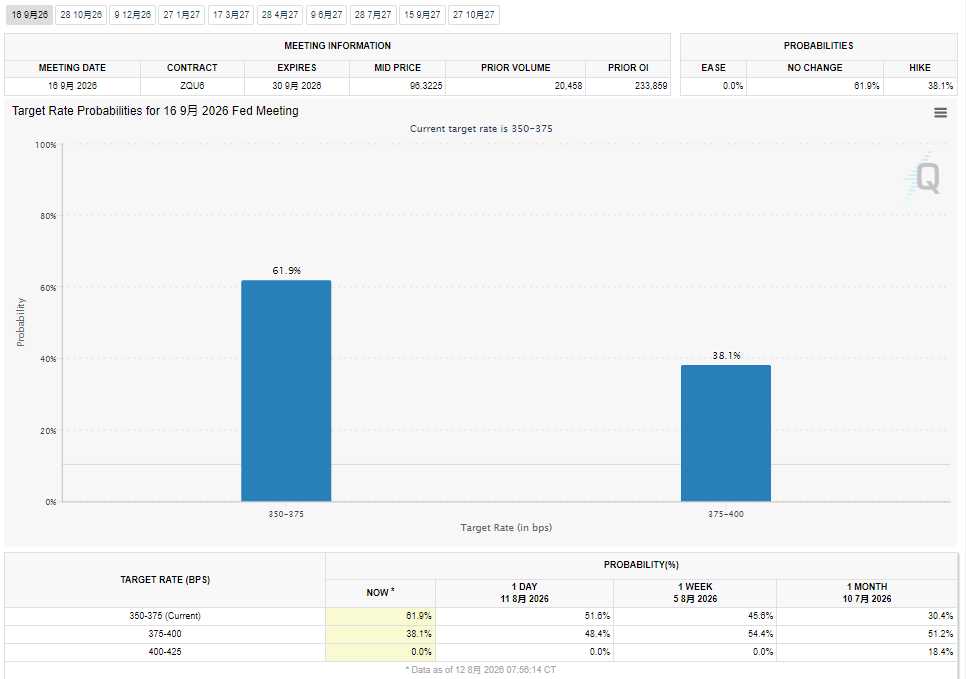 (CME FedWatch Interest Rate Futures, Source: CME Group)
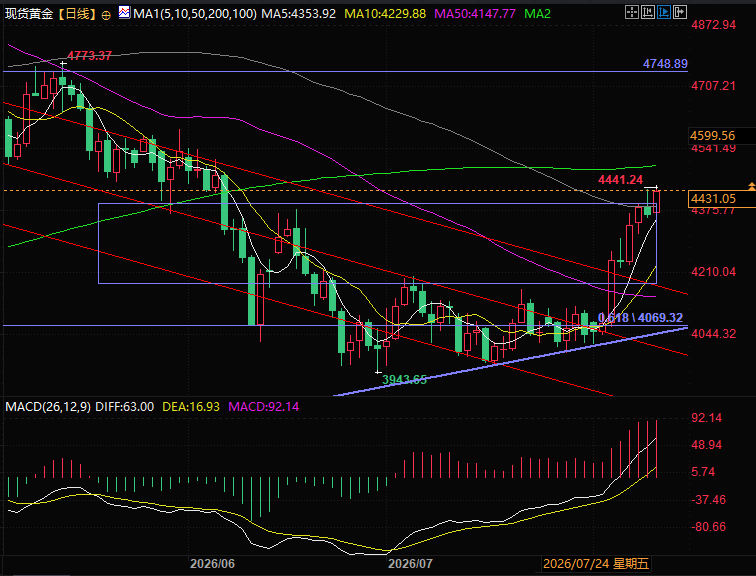 (Spot gold daily chart, source: FX678) At 21:13 Beijing time, spot gold is currently trading at $4424 per ounce.
Data Breakdown: Two Key Contributors Lowering the Inflation Rate
The newly released CPI breakdown data presents a very clear pattern of "dual-engine cooling": Looking at the details, the July CPI exhibits a clear characteristic of "overall moderate but differentiated components": Overall and core inflation: The year-on-year growth rate of overall CPI in July fell slightly by 0.1 percentage points from 3.5% in the previous month to 3.4%, effectively interrupting the rebound momentum since the second quarter; the year-on-year growth rate of core CPI also steadily declined to 2.5%, hitting a new low in nearly three years. In terms of monthly marginal changes, the month-on-month growth rates of overall and core CPI were only slightly higher by 0.1% and 0.2% respectively, extremely moderate increases, and both within the acceptable range for the Federal Reserve after annualization. Sub-factors (Energy and Housing): Among the sub-struments, energy CPI became the biggest "pressure relief valve," with its year-on-year growth rate, although still high, narrowing significantly by 1.0 percentage point from 15.7% last month to 14.7%. As the "ballast" with the highest weighting, housing CPI further slowed from 3.3% to 3.2% year-on-year, indicating that the lagged suppressive effect of high interest rates on the rental market is accelerating. Core Goods: The year-on-year decline in used car CPI widened to -1.9%, while the year-on-year decline in new car CPI remained flat at 0.5%, indicating that the core goods sector as a whole maintained a deflationary and stable trend, and the transfer of supply-side costs did not significantly suppress overall inflation.Energy items act as a "pressure relief valve" for inflation.
During the second quarter, the Trump administration's military action against Iran led to a contraction in oil shipping through the Strait of Hormuz, briefly pushing the US CPI to a three-year peak of 4.2% in May. However, the downward trend in oil prices continued into July, with the energy CPI annual rate plummeting from 15.7% to 14.7% in July. Although the situation in the Middle East remains far from calm, the temporary cooling of energy commodities has become the primary driver of lower overall CPI.The "ballast" of housing inflation is loosening rapidly.
As the most significant component of core CPI, accounting for over 40% of its weight, housing CPI slowed further from 3.3% to 3.2% year-on-year. This indicates that both CPI and housing CPI growth rates declined simultaneously, suggesting a relatively healthy decline in core CPI growth. (For example, if housing CPI growth had declined rapidly, to only 2.0%, it would have been difficult to analyze whether the overall CPI growth rate was declining due to a decrease in core components or primarily driven by the real estate sector.) This confirms that the lagged inhibitory effect of high interest rates on the rental market is finally becoming more apparent. Given the high weight of the housing component, its slowdown provides the most solid foundation for the decline in overall core inflation.Inferring “Super Core Inflation”: Wage Transmission in the Service Sector Remains Under Control
This is a key logical loop: with housing CPI cooling at an accelerated pace year-on-year and core goods (used cars -1.9%) continuing to deflate, the core CPI monthly rate only increased slightly by 0.2%. This conversely proves that the monthly momentum of "super core inflation" (core services CPI excluding housing), which Federal Reserve Chairman Warsh and hawkish officials were most concerned about, also remained low, and the labor-intensive service sector did not experience a second price rebound due to wage increases.Hidden Concerns: Survival Dilemma and Five Years of Inflation
While the July data offered a breather for the market, "declining inflation" should not be equated with "crisis averted." As President Collins emphasized in an interview at the Boston Fed headquarters, US inflation indicators have failed to reach the Fed's 2% policy target for five consecutive years. The cumulative effect of this "long-term high inflation" is causing profound damage to the bottom of the US economy: The survival plight of the lower classes: Collins frankly stated that the financial pressure on low- and middle-income families is extremely severe, with the vast majority struggling to balance their income and expenses. While the wealthy class continues to consume strongly, supported by rising asset prices (the AI boom and the wealth effect of US stocks), low-income groups are suffering from high prices, even forcing large discount retailers to lower food prices to attract customers. Strong structural stickiness: Current inflation is not a one-off shock, but rather a result of multiple factors: the transfer of tariff costs, the surge in electricity/chip costs due to AI infrastructure, the surge in defense spending, and labor shortages caused by immigration restrictions. These structural factors will make inflation exhibit strong stickiness around 3%.Institutional View: Interest Rate Hike Warnings Plunge, But Inflation Stickiness and Bond Market Concerns Remain
The stable release of July's CPI data triggered a flurry of commentary from major Wall Street financial institutions. While confirming a rapid downward revision of the probability of a September rate hike, significant differences remain regarding the medium- to long-term inflation trend and the Federal Reserve's policy space. Goldman Sachs' chief US economist pointed out that the 0.2% month-on-month increase in core CPI is entirely in line with the Fed's desired path of guiding inflation towards 2%. Combined with the recent cooling of the labor market (a decrease of 23,000 non-farm payrolls in July), the July CPI report officially stripped hawkish committee members of the "data basis" for raising interest rates in September. Goldman Sachs expects the Fed to maintain its benchmark interest rate unchanged in September, shifting its policy focus to assessing the true weakness of the labor market. Morgan Stanley's analysis team cautioned the market against blind optimism, noting that while the year-on-year decline in housing CPI to 3.2% has greatly alleviated overall pressure, the prices of services excluding housing and energy (super core inflation) are still supported by healthcare, insurance, and labor costs. Morgan Stanley believes the current decline in inflation is more of a "single-point breakthrough in commodities and housing," while structural inflationary pressures remain, and the Federal Reserve is unlikely to restart its rate-cutting cycle in the short term. BofA Securities: The bond market will replace the Fed as the "judge." BofA strategists focused on the "concerns about US Treasury yields" in the *Economic Compass* report. BofA believes that even if CPI falls to 3.4%, it will be difficult to prevent the 10-year US Treasury yield from heading towards 5%. Due to the continued expansion of the US fiscal deficit and the surge in defense and AI infrastructure spending, bond market investors are demanding a higher "term premium." If the Fed shows signs of softening due to weak employment, the rebound in long-term Treasury yields will complete the Fed's arduous task of "tightening financial conditions." Blackstone Think Tank stated that five consecutive years of inflation above 2% have fundamentally changed the behavior of businesses and consumers. Due to the transmission of import tariff costs to downstream supply chains and the increase in supply chain friction costs due to Middle East geopolitical tensions, inflation around 3% may become the new normal for the US economy. It will be difficult for Federal Reserve Chairman Warsh to completely suppress inflation back to 2% without damaging employment, which means that interest rates will remain at a higher level for a longer period of time.The Fed's Choice: Warsh's Dilemma of Expression
This CPI report, which met expectations, and the interpretations by institutions, directly reshaped the power struggles and policy roadmap within the Federal Reserve. At last month's policy meeting, a rare division erupted within the Fed—Presidents Cleveland, Dallas, and Kashkari all voted against an immediate rate hike. Subsequently, Collins, Cook, Waller, and Vice Chairman Williams, among other officials, released hawkish signals, stating that if July's inflation stickiness exceeded expectations, they would support a 25 basis point rate hike as early as September. However, the stable release of the July CPI and the moderate core CPI of 0.2% directly deprived the hawkish camp of the data excuse for an "urgent rate hike" in September. The dilemma facing new Fed Chairman Kevin Warsh: The tearing apart of the dual mandate: July's non-farm payrolls decreased by a net 23,000, the three-month average increase was halved compared to the first quarter (falling to 20,000), and the labor force participation rate fell to a five-year low. If interest rates are forcibly raised due to high inflation, the already stagnant labor market could easily be pushed into recession; however, if interest rates are blindly lowered due to weak employment, it will erode the credibility of the Federal Reserve in controlling inflation, which it has painstakingly maintained. With the July CPI not showing signs of deterioration, the probability of a 25bp rate hike in September has been rapidly revised down in the derivatives market to 38.1%, and the Federal Reserve's decision to "hold" at its September policy meeting has become the benchmark expectation for the vast majority of institutions. (CME FedWatch Interest Rate Futures, Source: CME Group)Summary and Technical Analysis:
The successful release of July's CPI data has temporarily saved the Federal Reserve from the brink of a forced rate hike. However, inflation still has a long way to go to reach the 2% target. The market's next focus will shift entirely to the Jackson Hole central bank symposium later this month. Faced with complex political pressures, a deeply divided Federal Reserve Board, and persistently high long-term Treasury yields, Chairman Warsh needs to deliver a clear and decisive speech, much like Powell did in 2022, to re-anchor the Fed's policy reaction function. For the Fed, the dawn of cooling inflation has appeared, but this five-year battle against inflation is far from over. Technically, spot gold continued its upward trend after a brief consolidation at the upper edge of its trading range, not waiting for a pullback to the 5-day moving average. Overall, it remains in a strong upward trend, with resistance at the 4500 level, which is also the 200-day moving average, and support at the upper edge of the trading range at 4431. (Spot gold daily chart, source: FX678) At 21:13 Beijing time, spot gold is currently trading at $4424 per ounce.
- Risk Warning and Disclaimer
- The market involves risk, and trading may not be suitable for all investors. This article is for reference only and does not constitute personal investment advice, nor does it take into account certain users’ specific investment objectives, financial situation, or other needs. Any investment decisions made based on this information are at your own risk.