Cooling CPI can't stem supply crisis! IEA warns crude oil deficit will double in Q3.
2026-08-12 21:44:55
On August 12th, the global energy market experienced a double shock from both macroeconomic and geopolitical factors. On one hand, a senior Iranian source confirmed that negotiations between the US and Iran to permanently end the Gulf conflict and restore the temporary ceasefire agreement reached in June had completely stalled; the blockade of the Straits of Hormuz and Bab el-Mandeb intensified, pushing WTI crude oil prices to continue rising to $82 per barrel. On the other hand, the recently released US July CPI year-on-year growth rate fell as expected to 3.4% (core CPI fell to 2.5%), coupled with the weak performance of the previous July non-farm payrolls, which showed a decrease of 23,000 jobs, reinforcing market concerns about "high interest rates squeezing demand in the real economy." The cooling of macroeconomic inflation led to the liquidation of long positions and demand resistance, causing a slight short-term correction in oil prices that had been running high. However, within the physical oil market, a battle driven by geopolitical conflict—a "supply cliff and rapid depletion of inventories"—is pushing the oil supply and demand pattern in 2026 towards a profound restructuring. 
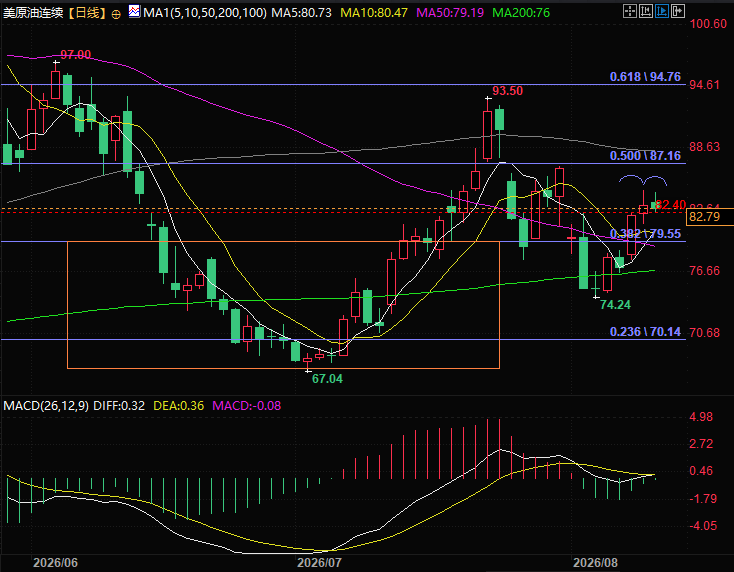 (WTI crude oil futures daily chart, source: EasyTrade) At 21:41 Beijing time, WTI crude oil futures were trading at $82.74 per barrel.
Political ceasefire illusions shattered: US-Iran standoff locks down the Gulf's choke point.
The complete breakdown of US-Iran negotiations is the biggest source of geopolitical risk in the current oil market. The ceasefire agreement was completely torn up: A 60-day temporary ceasefire agreement was reached between the US and Iran in June, but it quickly collapsed after only a short period. On July 7, the US announced the termination of the agreement, and a week later, Iran officially announced a suspension of its implementation. The US accused Iran of failing to reopen the Strait of Hormuz as agreed, while Iran refuted the US's core commitment to "lift the port blockade and unfreeze Iranian assets." Rumors of an "extension window": Iranian officials explicitly denied market rumors of a "60-day extension window," emphasizing that the US had blatantly violated the agreement and there was no room for an extension. The confrontation escalated: Iran clearly stated that the Strait of Hormuz would remain closed until the US accepted the ceasefire conditions; while the Trump administration put forward new demands, requiring Iran to pay huge sums in compensation for the past 51 years of regional conflict and casualties. This stalemate directly locks down the global energy lifeline. The Strait of Hormuz, which carries 20% of the world's ocean-going crude oil, has been frequently disrupted since the outbreak of the Gulf War in February; meanwhile, the Bab el-Mandeb Strait at the southern end of the Red Sea has also been turbulent due to Houthi attacks and US interception strikes. This "simultaneous blockage of both shipping lanes" has completely disrupted the flow of global crude oil trade.IEA issues strong warning: Demand recovers quarter by quarter, supply gap doubles.
The International Energy Agency (IEA) significantly lowered its 2026 oil supply and demand forecast in its latest August report, highlighting the severity of the imbalance in the physical market: The IEA's August report's portrait of global oil supply and demand in 2026 shows that the market is facing severe contraction and supply-demand misalignment: On the demand side, suppressed by the Straits Depression and high oil prices, global daily oil demand in 2026 will decrease by 1.6 million barrels (a significant downward revision of 510,000 barrels per day from the previous month's forecast); on the supply side, the contraction is even more severe, with daily supply for the year plummeting by 4.3 million barrels compared to the previous year, and total production falling to 102 million barrels per day. This dramatic disconnect between supply and demand directly exacerbates the shortage in the physical market, causing the global oil supply-demand gap to widen to 1.8 million barrels per day in the third quarter of 2026, more than double the size of the previous month's estimate. On the demand side: High oil prices suppress consumption, showing a "quarterly recovery." Suppressed by the Straits blockade and high terminal fuel prices, global crude oil demand is expected to decrease by 1.6 million barrels per day in 2026 (a further downward revision of 510,000 barrels per day from last month's forecast). Diesel, gasoline, and jet fuel are most significantly impacted, with the increased demand during the summer travel season being severely offset by high oil prices. However, the demand pattern will show a "decline followed by a rise": global demand will shrink by 4.9 million barrels per day in the second quarter, narrowing to 2.8 million barrels per day in the third quarter, and returning to positive growth in the fourth quarter as supply chains adapt. The IEA predicts a strong rebound in global crude oil demand in 2027, with an average daily increase of 2.4 million barrels. On the supply side: Gulf exports plummet, and increased US production alone cannot fill the huge gap left by the Middle East and Russia. Global crude oil supply is projected to be only 102 million barrels per day in 2026, a sharp decrease of 4.3 million barrels per day compared to 2025. Although US crude oil production is expected to increase by 1.4 million barrels per day this year, it is completely insufficient to fill the huge gap left by the Middle East and Russia. July's production and sales data confirmed the dire situation in the Gulf region: Gulf crude oil exports plummeted from 20 million barrels per day at the beginning of July to 12 million barrels per day at the end of the month (an average of 15 million barrels per day for the entire month, a decrease of 2.1 million barrels per day compared to the previous month). Currently, as much as 8.3 million barrels per day of production capacity in the Gulf region remains under mandatory shutdown.Inventory warning line raised: 410 million barrels buffer zone being eroded.
The severe mismatch between supply and demand is depleting global crude oil inventories at an alarming rate. The gap is doubling: IEA data shows that the global crude oil supply-demand gap has widened to 1.8 million barrels per day in the third quarter of 2026, more than double the previous month's estimate. Inventories are being drastically reduced: Global crude oil inventories are currently being depleted at a rate of 2.2 million barrels per day. In July alone, the Middle East crisis led to a reduction of 69 million barrels in global inventories, bringing total inventories below 7.9 billion barrels (a new low since April 2025). The safety cushion is being exhausted: Since the outbreak of the conflict at the end of February, global crude oil inventories have accumulated a reduction of 410 million barrels, leaving the market's strategic buffer extremely fragile.Macro vs. Geopolitics: How did the July CPI trigger a short-term correction in oil prices?
Faced with such a severe shortage, why did WTI oil prices experience a slight short-term pullback as they approached the $85 mark? This is precisely the effect of the macroeconomic transmission mechanism following the release of the July CPI data: Demand concerns that "inflation decline = economic cooling": The July CPI fell to 3.4% year-on-year, coupled with a decrease of 23,000 in non-farm payrolls in July, confirming that the Federal Reserve's five-year-long high-interest-rate policy is substantially suppressing the US real economy. Market concerns are that the pressure of high interest rates on end-user gasoline and diesel demand will continue to manifest. The stripping away of "hedging premiums" and profit-taking by long positions: The expected CPI decline weakened the financial attributes of crude oil as an "inflation-fighting tool." After six consecutive trading days of increases in Brent crude oil, the release of the July CPI data triggered profit-taking by macroeconomic funds. The "self-destructive effect" of high oil prices: As emphasized in the IEA report, high oil prices themselves are hedging against and suppressing end-user consumption, forming a spontaneous physical resistance.Market Outlook: Short-term consolidation and bottoming out; medium- to long-term outlook depends on geopolitical breakthroughs.
In summary, the global crude oil market is currently caught in a tug-of-war between "short-term macroeconomic suppression" and "medium- to long-term geopolitical constraints." Previous articles discussed the interplay between reduced demand and a second supply shock; currently, the impact of a supply shortage appears to be greater, providing more support for rising oil prices. In the short term: the Fed's September rate hike warnings were largely dispelled by the July CPI data, shifting the macroeconomic focus to demand resilience due to economic slowdown; after a period of continuous gains, oil prices are currently experiencing high-level, tight-tight fluctuations. In the medium to long term: US-Iran negotiations are completely stalled, and the shipping blockage in the Strait of Hormuz remains unresolved in the short term. With a physical shortfall of 1.8 million barrels per day and historically low inventories, oil prices have a strong geopolitical safety net, making a unilateral plunge unlikely. As the IEA report summarizes, although global supply and demand are expected to see a phase of recovery in 2027, as long as the flames of geopolitical competition in the Gulf remain lit, the global crude oil market will remain in a fragile new normal of "high premiums" for a long time. (WTI crude oil futures daily chart, source: EasyTrade) At 21:41 Beijing time, WTI crude oil futures were trading at $82.74 per barrel.
- Risk Warning and Disclaimer
- The market involves risk, and trading may not be suitable for all investors. This article is for reference only and does not constitute personal investment advice, nor does it take into account certain users’ specific investment objectives, financial situation, or other needs. Any investment decisions made based on this information are at your own risk.