Cooling US inflation in July dampened expectations of interest rate hikes, and gold maintained its upward trend with fluctuations.
2026-08-13 10:24:56
International gold prices edged lower in early Asian trading on Thursday, with XAU/USD falling back to around $4,400 per ounce. Gold had previously maintained a strong performance at higher levels, but new geopolitical risks are prompting the market to reassess energy prices and inflation prospects, leading to some profit-taking in the short term. However, the downside for gold remains limited by changes in expectations regarding US monetary policy. The fact that US inflation data for July did not accelerate again reduces pressure on the Federal Reserve to further tighten policy in September.  The current gold market faces a rather unique fundamental environment. On the one hand, continued tensions between the US and Iran, along with restrictions on shipping through the Strait of Hormuz, increase global energy supply risks, potentially pushing up oil prices and creating new inflationary pressures. On the other hand, US inflation data itself shows signs of cooling, significantly reducing market bets on a near-term Fed rate hike. This means gold is simultaneously influenced by both "positive geopolitical risks" and "negative energy inflation." Data released by the US Bureau of Labor Statistics shows that the US CPI rose 3.4% year-on-year in July, lower than June's 3.5%; core CPI rose 2.5% year-on-year, lower than the previous value of 2.6%. Both figures are in line with market expectations. Looking at the data structure, inflation has not shown a new widespread acceleration; instead, it has eased in several goods and services categories. This reduces investors' concerns that the Fed needs to quickly implement tighter policies. Changes in the interest rate market also directly affect gold pricing. Market research indicates that the implied probability of a Fed rate hike in September has fallen to approximately 40%, while the probability of a further rate hike in October has dropped from about 75% to about 60%, further delaying the market's full pricing of the next rate hike until around December. For gold, which does not generate interest income, a decline in market interest rate expectations typically means a lower opportunity cost of holding gold, thus limiting the downside potential for gold prices. Following the release of US inflation data, interest rate pressures on the gold market have further eased. TD Securities believes that the latest CPI has not significantly boosted market expectations for a Fed rate hike, and precious metals as a whole still have some upward potential. The market had already begun to reduce its bets on further US rate hikes, so the current price performance of gold reflects investors' repricing of future policy paths rather than simply trading current inflation levels. However, the situation in the Strait of Hormuz is becoming an increasingly important variable in gold price movements. Senior Iranian officials stated that significant differences remain between the US and Iran regarding how to achieve a longer-term ceasefire and restore the previous interim agreement, and related negotiations have not yet made substantial progress. If shipping routes continue to be restricted, the risk of oil supply could further increase. From a gold perspective, rising oil prices have a dual impact. First, rising energy prices may enhance market risk aversion, driving funds into gold. Second, if oil prices continue to rise and create new inflationary pressures, it could force the Federal Reserve to maintain high interest rates for a longer period, thereby increasing the cost of holding gold. In other words, rising oil prices do not necessarily mean a simultaneous rise in gold prices; the key depends on whether the market prioritizes safe-haven demand or inflation and interest rate risks. Sima Shah, Chief Global Strategist at Principal Asset Management, believes that with the Strait of Hormuz still closed, the upward inflationary risks from energy prices will continue to be a focus of the market for some time. This assessment explains why gold prices have corrected despite relatively mild US inflation data: the market is concerned that rising energy prices will ultimately affect the Federal Reserve's policy through inflation expectations. Meanwhile, gold still possesses strong asset allocation attributes. Currently, global economic policy uncertainty is high, with significant room for change in geopolitical risks, energy supply, and the policy paths of major central banks. In this environment, the demand for gold as a non-sovereign safe-haven asset has not disappeared. Therefore, the current price adjustment is more akin to high-level consolidation than a clear trend reversal. From a funding perspective, if US inflation continues to cool while the job market further slows, the Federal Reserve's policy expectations may continue to shift towards easing, and declining real interest rates will re-strengthen the upward logic for gold. Conversely, if oil prices continue to rise due to the Strait of Hormuz risk, leading to a renewed acceleration of US inflation, the market may raise its expectations for interest rate hikes again, and gold may face more significant pressure for a phase of adjustment. Therefore, it is currently necessary to monitor three variables simultaneously: US real interest rates, the dollar's performance, and the energy risk premium brought by the Strait of Hormuz. Among them, US interest rate expectations determine the cost of holding gold, the dollar determines the pricing pressure on gold, and geopolitical risks determine the strength of gold's safe-haven demand. When these three factors show a clear trend in the same direction, gold prices often form a clearer trend. From the daily chart, XAU/USD currently maintains a clear bullish trend, with the price trading above the 100-day moving average of approximately $4390 and the Bollinger Band middle line of approximately $4140, indicating that the medium-term bullish structure has not been broken. Gold prices had been trending towards the upper Bollinger Band, currently around $4410, making the $4400-$4410 area a crucial battleground for short-term bulls and bears. The 14-day Relative Strength Index (RSI) is around 67.5, nearing overbought territory, indicating strong upward momentum but also a risk of short-term technical correction. If the bulls can effectively break through and hold above $4410, the current consolidation at higher levels may extend upwards again, with further resistance at $4450 and the psychological level of $4500. If prices fail to break through $4410 and fall below $4390, short-term downward pressure will significantly increase, with initial support around $4350 and further support at the Bollinger Middle Band around $4140. Only a sustained break below the Middle Band would truly disrupt the current bullish structure on the daily chart. On the 4-hour chart, gold has shown signs of a pullback after a rapid rise, with short-term momentum slowing compared to the previous period. $4,400 is both a psychological level and an important technical zone near the current price. If gold prices can find support in the $4,390-$4,400 area and break above $4,410 again, the bulls may regain the initiative and push towards $4,450. However, if the price breaks below $4,390 on the 4-hour chart, it may enter a more significant short-term correction phase, seeking support at $4,350 or even $4,300.
 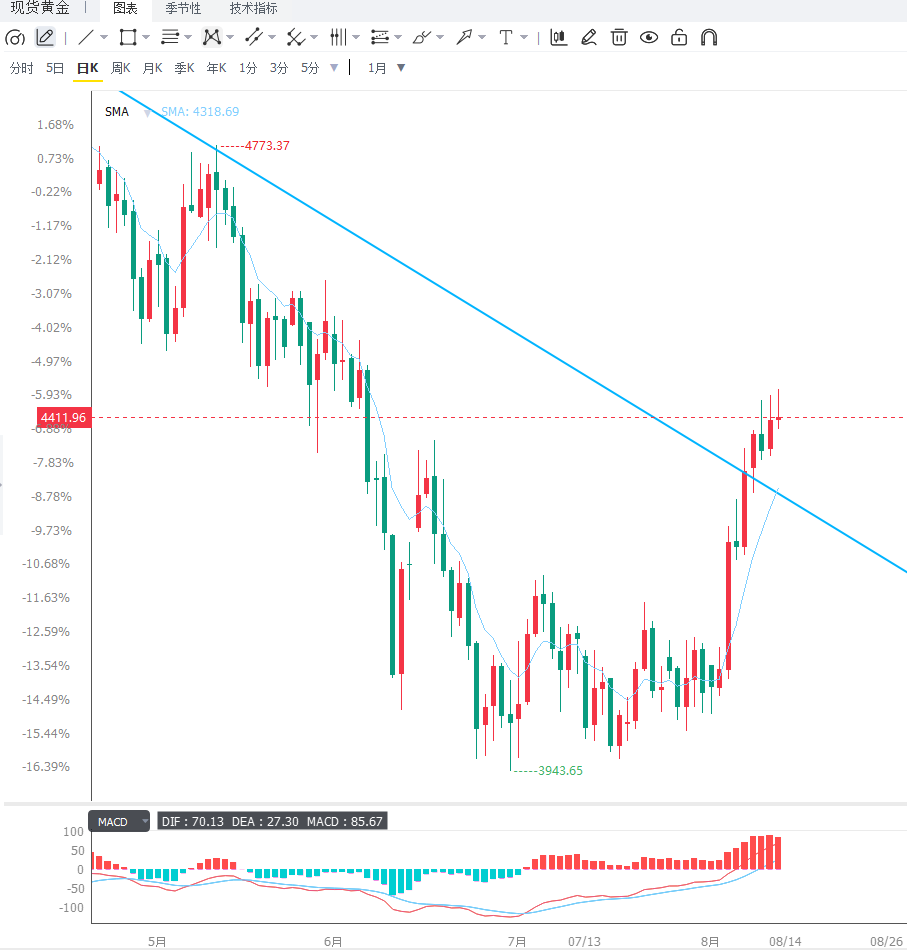 Editor's Summary: The core logic for gold's current performance is the interplay between easing monetary policy pressure and rising energy inflation risks. The cooling of the US July CPI lowered expectations for a September Fed rate hike, significantly easing interest rate pressures on gold. However, continued restrictions in the Strait of Hormuz increase the risk of rising oil prices and renewed inflation, limiting further upside potential for gold in the short term. In the short term, $4390 is a key technical support level that gold bulls need to hold, while $4410 is a key resistance level for further upward movement. If subsequent US inflation and employment data continue to cool, gold may retest $4450 or even $4500; if energy prices continue to rise and drive renewed US inflation expectations, gold prices may experience a deeper technical correction first. In the medium term, gold still has strong structural support, but the pace of the rise may shift from rapid advancement to high-level consolidation. The key to determining the next trend will be whether Fed policy expectations continue to cool and whether safe-haven demand from geopolitical risks can offset the potential upward pressure on real interest rates from energy inflation. Until these two variables are clear, the probability of gold maintaining a strong high-level consolidation remains high.
The current gold market faces a rather unique fundamental environment. On the one hand, continued tensions between the US and Iran, along with restrictions on shipping through the Strait of Hormuz, increase global energy supply risks, potentially pushing up oil prices and creating new inflationary pressures. On the other hand, US inflation data itself shows signs of cooling, significantly reducing market bets on a near-term Fed rate hike. This means gold is simultaneously influenced by both "positive geopolitical risks" and "negative energy inflation." Data released by the US Bureau of Labor Statistics shows that the US CPI rose 3.4% year-on-year in July, lower than June's 3.5%; core CPI rose 2.5% year-on-year, lower than the previous value of 2.6%. Both figures are in line with market expectations. Looking at the data structure, inflation has not shown a new widespread acceleration; instead, it has eased in several goods and services categories. This reduces investors' concerns that the Fed needs to quickly implement tighter policies. Changes in the interest rate market also directly affect gold pricing. Market research indicates that the implied probability of a Fed rate hike in September has fallen to approximately 40%, while the probability of a further rate hike in October has dropped from about 75% to about 60%, further delaying the market's full pricing of the next rate hike until around December. For gold, which does not generate interest income, a decline in market interest rate expectations typically means a lower opportunity cost of holding gold, thus limiting the downside potential for gold prices. Following the release of US inflation data, interest rate pressures on the gold market have further eased. TD Securities believes that the latest CPI has not significantly boosted market expectations for a Fed rate hike, and precious metals as a whole still have some upward potential. The market had already begun to reduce its bets on further US rate hikes, so the current price performance of gold reflects investors' repricing of future policy paths rather than simply trading current inflation levels. However, the situation in the Strait of Hormuz is becoming an increasingly important variable in gold price movements. Senior Iranian officials stated that significant differences remain between the US and Iran regarding how to achieve a longer-term ceasefire and restore the previous interim agreement, and related negotiations have not yet made substantial progress. If shipping routes continue to be restricted, the risk of oil supply could further increase. From a gold perspective, rising oil prices have a dual impact. First, rising energy prices may enhance market risk aversion, driving funds into gold. Second, if oil prices continue to rise and create new inflationary pressures, it could force the Federal Reserve to maintain high interest rates for a longer period, thereby increasing the cost of holding gold. In other words, rising oil prices do not necessarily mean a simultaneous rise in gold prices; the key depends on whether the market prioritizes safe-haven demand or inflation and interest rate risks. Sima Shah, Chief Global Strategist at Principal Asset Management, believes that with the Strait of Hormuz still closed, the upward inflationary risks from energy prices will continue to be a focus of the market for some time. This assessment explains why gold prices have corrected despite relatively mild US inflation data: the market is concerned that rising energy prices will ultimately affect the Federal Reserve's policy through inflation expectations. Meanwhile, gold still possesses strong asset allocation attributes. Currently, global economic policy uncertainty is high, with significant room for change in geopolitical risks, energy supply, and the policy paths of major central banks. In this environment, the demand for gold as a non-sovereign safe-haven asset has not disappeared. Therefore, the current price adjustment is more akin to high-level consolidation than a clear trend reversal. From a funding perspective, if US inflation continues to cool while the job market further slows, the Federal Reserve's policy expectations may continue to shift towards easing, and declining real interest rates will re-strengthen the upward logic for gold. Conversely, if oil prices continue to rise due to the Strait of Hormuz risk, leading to a renewed acceleration of US inflation, the market may raise its expectations for interest rate hikes again, and gold may face more significant pressure for a phase of adjustment. Therefore, it is currently necessary to monitor three variables simultaneously: US real interest rates, the dollar's performance, and the energy risk premium brought by the Strait of Hormuz. Among them, US interest rate expectations determine the cost of holding gold, the dollar determines the pricing pressure on gold, and geopolitical risks determine the strength of gold's safe-haven demand. When these three factors show a clear trend in the same direction, gold prices often form a clearer trend. From the daily chart, XAU/USD currently maintains a clear bullish trend, with the price trading above the 100-day moving average of approximately $4390 and the Bollinger Band middle line of approximately $4140, indicating that the medium-term bullish structure has not been broken. Gold prices had been trending towards the upper Bollinger Band, currently around $4410, making the $4400-$4410 area a crucial battleground for short-term bulls and bears. The 14-day Relative Strength Index (RSI) is around 67.5, nearing overbought territory, indicating strong upward momentum but also a risk of short-term technical correction. If the bulls can effectively break through and hold above $4410, the current consolidation at higher levels may extend upwards again, with further resistance at $4450 and the psychological level of $4500. If prices fail to break through $4410 and fall below $4390, short-term downward pressure will significantly increase, with initial support around $4350 and further support at the Bollinger Middle Band around $4140. Only a sustained break below the Middle Band would truly disrupt the current bullish structure on the daily chart. On the 4-hour chart, gold has shown signs of a pullback after a rapid rise, with short-term momentum slowing compared to the previous period. $4,400 is both a psychological level and an important technical zone near the current price. If gold prices can find support in the $4,390-$4,400 area and break above $4,410 again, the bulls may regain the initiative and push towards $4,450. However, if the price breaks below $4,390 on the 4-hour chart, it may enter a more significant short-term correction phase, seeking support at $4,350 or even $4,300. Editor's Summary: The core logic for gold's current performance is the interplay between easing monetary policy pressure and rising energy inflation risks. The cooling of the US July CPI lowered expectations for a September Fed rate hike, significantly easing interest rate pressures on gold. However, continued restrictions in the Strait of Hormuz increase the risk of rising oil prices and renewed inflation, limiting further upside potential for gold in the short term. In the short term, $4390 is a key technical support level that gold bulls need to hold, while $4410 is a key resistance level for further upward movement. If subsequent US inflation and employment data continue to cool, gold may retest $4450 or even $4500; if energy prices continue to rise and drive renewed US inflation expectations, gold prices may experience a deeper technical correction first. In the medium term, gold still has strong structural support, but the pace of the rise may shift from rapid advancement to high-level consolidation. The key to determining the next trend will be whether Fed policy expectations continue to cool and whether safe-haven demand from geopolitical risks can offset the potential upward pressure on real interest rates from energy inflation. Until these two variables are clear, the probability of gold maintaining a strong high-level consolidation remains high.- Risk Warning and Disclaimer
- The market involves risk, and trading may not be suitable for all investors. This article is for reference only and does not constitute personal investment advice, nor does it take into account certain users’ specific investment objectives, financial situation, or other needs. Any investment decisions made based on this information are at your own risk.