The euro held steady around 1.154 against the dollar, but the market focus has quietly shifted.
2026-08-13 20:00:55
On Thursday, August 13th, the market widely expected the European Central Bank (ECB) to raise its deposit facility rate by another 25 basis points to 2.50% at its September meeting. Meanwhile, the preliminary July inflation estimate for the Eurozone rose to 2.9%, higher than June's 2.8%, indicating that price pressures have not yet returned to the ECB's 2% medium-term target. The ECB already raised its deposit facility rate to 2.25% in June but chose to keep it unchanged in July. Therefore, whether it will tighten policy again in September is becoming a key variable for the euro yield curve and the euro's pricing against the US dollar. Currently, the euro is trading around 1.1540 against the US dollar. At the same time, the Federal Reserve maintained its target range for the federal funds rate at 3.50% to 3.75% at its July meeting. The policy interest rate differential between the US and Europe remains wide, but market focus has gradually shifted from the current absolute level of the interest rate differential to the relative changes in the policy paths of the two central banks in the coming months. Once the market has largely priced in a September rate hike, the marginal information of a simple 25 basis point increase on the exchange rate may decrease. Subsequently, the variables that truly affect volatility will shift to the duration of policy maintenance, inflation stickiness, and the ability of economic activity to withstand higher financing costs.  The European Central Bank (ECB) raised its deposit facility rate from 2.00% to 2.25% in June, then paused adjustments in July. Therefore, if it acts again in September, the policy rate will further deviate from its previous near-neutral range. The question has shifted from whether to tighten further to how long the restrictive environment might last. The preliminary estimate for Eurozone overall inflation in July was 2.9%, up from 2.8% in June, indicating that the previous decline in inflation did not form a stable one-way path. The current macroeconomic environment is unique in that energy factors have risen again. International oil prices have recently remained around $88 per barrel, significantly higher than before the escalation of external conflicts at the beginning of the year. For European economies heavily reliant on energy imports, the impact is not limited to household energy bills but may also be transmitted layer by layer along transportation, manufacturing, food processing, and service costs. Therefore, what the ECB really needs to observe is the second-round effect, not the primary energy price increase itself. If rising business costs further impact end prices, and wage negotiations begin to compensate for previous real income losses, the energy shock could evolve from relative price changes into broader inflation stickiness. Currently, there is insufficient evidence to suggest that this second-round effect has clearly taken shape, but this is precisely the data chain that policymakers most need to confirm before the September meeting. The Federal Reserve maintained its policy rate range of 3.50% to 3.75% in July, and the nominal policy rate differential between Europe and the US remains significant. However, US consumer prices rose 0.1% month-on-month in July, subsequently reducing the market's pricing strength for further rate adjustments by the Fed in September. This creates a noteworthy pricing structure: policy expectations on the European side are shifting back towards a tighter stance, while recent marginal changes on the US side have been relatively mild. If market estimates of the ECB's prolonged maintenance of higher interest rates change, short-term interest rates and forward spreads may reflect this change earlier than spot exchange rates. At the same time, the constraint of economic growth cannot be ignored. The longer the restrictive interest rate is maintained, the more significant the cumulative impact on corporate financing, real estate credit, and household consumption will be. Therefore, the ECB is not facing a single-dimensional inflation problem, but rather a dynamic balance between price stability and financing conditions. This is why the market cannot rely solely on the outcome of a single meeting to complete long-term pricing.
 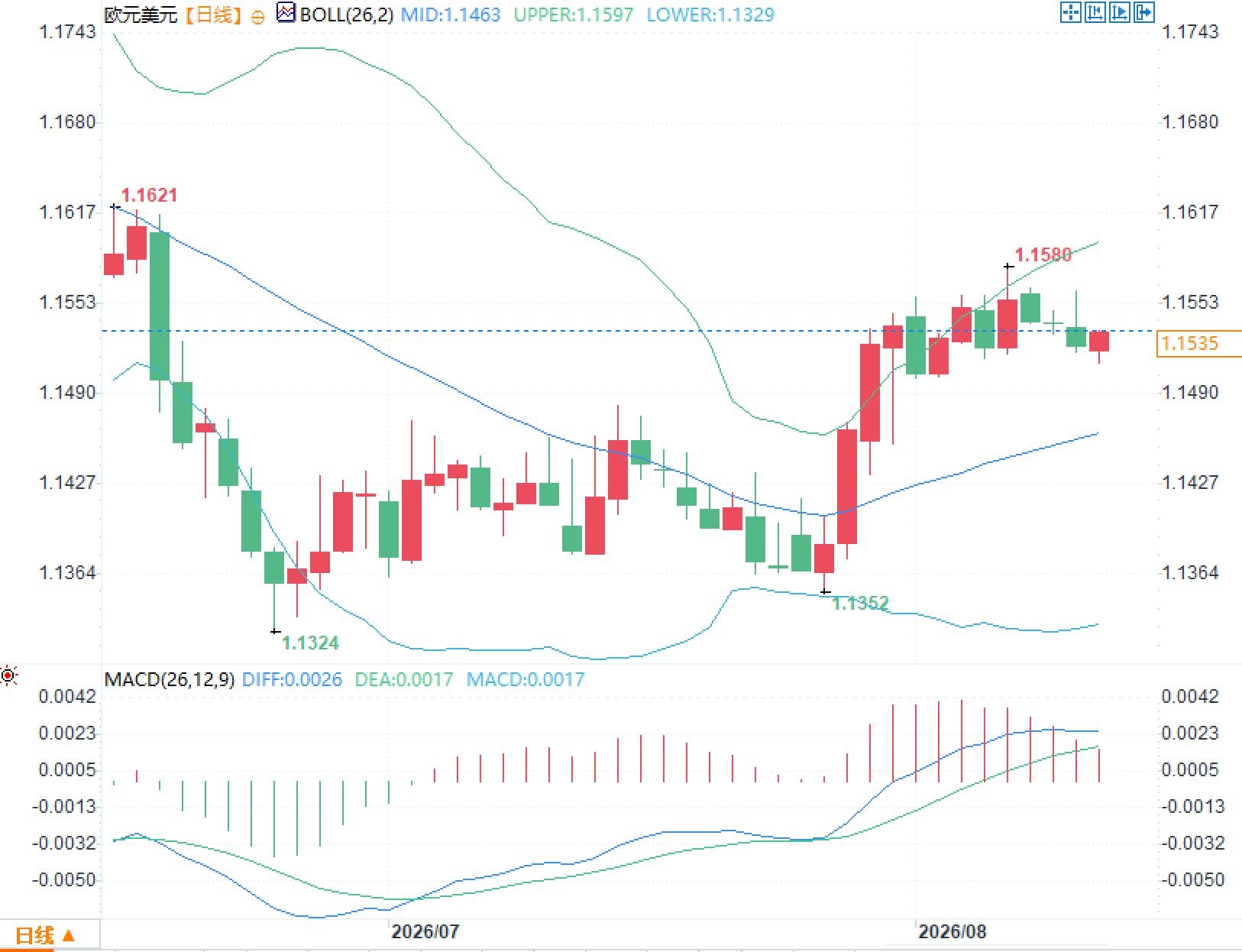 Observing the daily chart of EUR/USD, the exchange rate rebounded rapidly from around 1.1352 and moved back above the Bollinger Band's middle band. The Bollinger Band middle band is approximately 1.1463, the upper band is approximately 1.1597, and the lower band is approximately 1.1329. The current price is between the middle and upper bands, but the recent price action has been noticeably shorter, indicating that after the previous rapid price correction, short-term fluctuations are entering a rebalancing phase. Regarding the MACD, the DIFF is approximately 0.0026 and the DEA is approximately 0.0017, both above the zero line, but the recent rate of expansion of the histogram has slowed.
The European Central Bank (ECB) raised its deposit facility rate from 2.00% to 2.25% in June, then paused adjustments in July. Therefore, if it acts again in September, the policy rate will further deviate from its previous near-neutral range. The question has shifted from whether to tighten further to how long the restrictive environment might last. The preliminary estimate for Eurozone overall inflation in July was 2.9%, up from 2.8% in June, indicating that the previous decline in inflation did not form a stable one-way path. The current macroeconomic environment is unique in that energy factors have risen again. International oil prices have recently remained around $88 per barrel, significantly higher than before the escalation of external conflicts at the beginning of the year. For European economies heavily reliant on energy imports, the impact is not limited to household energy bills but may also be transmitted layer by layer along transportation, manufacturing, food processing, and service costs. Therefore, what the ECB really needs to observe is the second-round effect, not the primary energy price increase itself. If rising business costs further impact end prices, and wage negotiations begin to compensate for previous real income losses, the energy shock could evolve from relative price changes into broader inflation stickiness. Currently, there is insufficient evidence to suggest that this second-round effect has clearly taken shape, but this is precisely the data chain that policymakers most need to confirm before the September meeting. The Federal Reserve maintained its policy rate range of 3.50% to 3.75% in July, and the nominal policy rate differential between Europe and the US remains significant. However, US consumer prices rose 0.1% month-on-month in July, subsequently reducing the market's pricing strength for further rate adjustments by the Fed in September. This creates a noteworthy pricing structure: policy expectations on the European side are shifting back towards a tighter stance, while recent marginal changes on the US side have been relatively mild. If market estimates of the ECB's prolonged maintenance of higher interest rates change, short-term interest rates and forward spreads may reflect this change earlier than spot exchange rates. At the same time, the constraint of economic growth cannot be ignored. The longer the restrictive interest rate is maintained, the more significant the cumulative impact on corporate financing, real estate credit, and household consumption will be. Therefore, the ECB is not facing a single-dimensional inflation problem, but rather a dynamic balance between price stability and financing conditions. This is why the market cannot rely solely on the outcome of a single meeting to complete long-term pricing. Observing the daily chart of EUR/USD, the exchange rate rebounded rapidly from around 1.1352 and moved back above the Bollinger Band's middle band. The Bollinger Band middle band is approximately 1.1463, the upper band is approximately 1.1597, and the lower band is approximately 1.1329. The current price is between the middle and upper bands, but the recent price action has been noticeably shorter, indicating that after the previous rapid price correction, short-term fluctuations are entering a rebalancing phase. Regarding the MACD, the DIFF is approximately 0.0026 and the DEA is approximately 0.0017, both above the zero line, but the recent rate of expansion of the histogram has slowed.
- Risk Warning and Disclaimer
- The market involves risk, and trading may not be suitable for all investors. This article is for reference only and does not constitute personal investment advice, nor does it take into account certain users’ specific investment objectives, financial situation, or other needs. Any investment decisions made based on this information are at your own risk.