Compared to US Treasury yields, are smart money eyeing TIPS?
2026-08-13 21:12:59
TIPS (Treasury Inflation-Protected Securities) are official fixed-income securities issued by the U.S. Treasury Department, designed to help investors hedge against inflation risk. Unlike ordinary nominal Treasuries with fixed principal, TIPS principal is directly linked to the unadjusted CPI index (CPI-U), and the principal moves dynamically in the same direction as inflation. If the CPI increases, the TIPS principal increases proportionally; if deflation occurs, the principal decreases (but if held to maturity, the Treasury promises to return at least the original face value, providing a downside protection). Interest payments: The coupon rate is fixed, but because the interest payment base is the "adjusted new principal," your interest cash flow will increase with rising inflation. While we cannot invest in these bonds, their yields are quite attractive. 
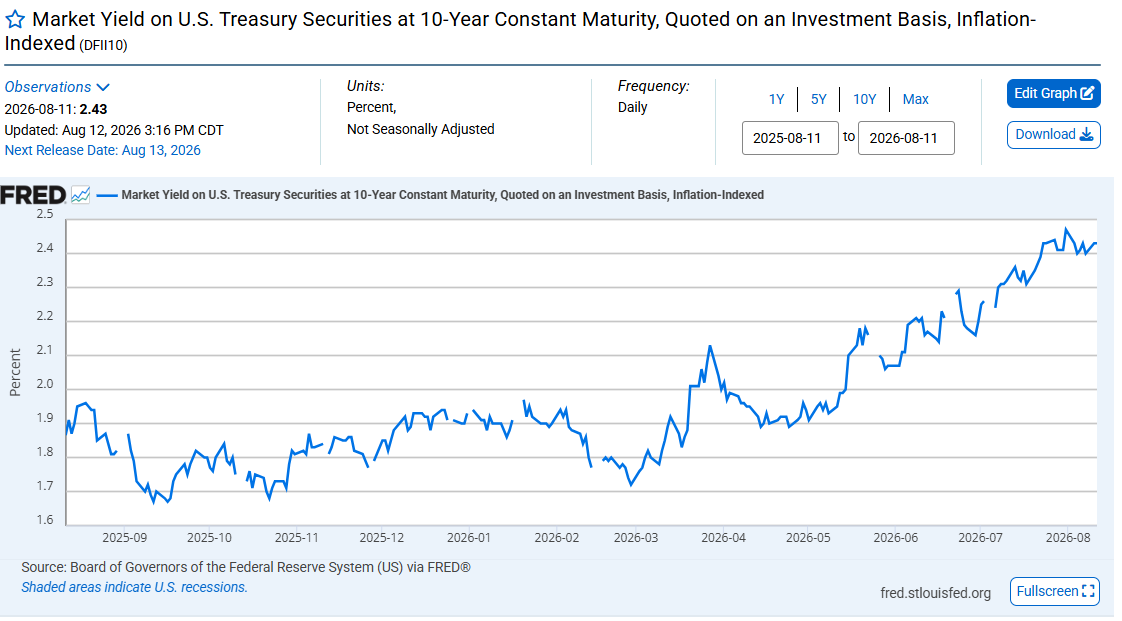 (US 10-year TIPS yield, source: Federal Reserve)
The core formula and the "break-even inflation rate"
When observing TIPS, the most crucial formula is as follows: Nominal US Treasury yield - TIPS yield = Break-even inflation rate. In other words, TIPS yield = Nominal US Treasury yield - Break-even inflation rate. The break-even inflation rate is what is commonly referred to as inflation expectation. Simply put, TIPS yield = Nominal US Treasury yield - Inflation expectation. Even more simply, TIPS yield = Real US Treasury yield. In short, the yield locked in by buying TIPS is essentially the "real yield" of US Treasury bonds.How can TIPS be profitable?
Taking 30-year TIPS as an example, a 30-year TIPS offers a real yield of approximately 3%, meaning investors are locking in a net return of "a 3% increase in pure purchasing power after adjusting for inflation." For such TIPS, if the average real CPI over the next 30 years exceeds the 2.2% break-even inflation rate priced in by the market at the time of purchase, the total return of TIPS will outperform nominal US Treasury bonds; conversely, if real inflation is below 2.2%, nominal US Treasury bonds will perform better. Therefore, the break-even inflation rate reflects the market's expectation of the inflation threshold needed to outperform nominal US Treasury bonds. However, if investors actually buy 30-year TIPS, although the yield is as high as 3%, it is actually a double-edged sword. The real yield of around 3% is a historical high in recent years. For investors who intend to hold to maturity, this means locking in a very attractive real risk-free return. But if investors do not intend to hold to maturity, TIPS is still a bond, and its price is inversely proportional to the market interest rate (real yield). The duration of 30-year bonds is extremely long. For every additional 0.5% increase in the real yield, the bond price will fall sharply, resulting in a significant paper loss. Therefore, with the overall yield of TIPS currently rising, investing in 5-10% year TIPS will result in relatively smaller losses. This article does not recommend that readers try to buy TIPS. We mainly use the yield of TIPS to help observe the real interest rate, because the real interest rate is the pricing anchor for almost all financial assets.The impact of recent data and macroeconomic variables on TIPS
We can examine how recent data and trends affect TIPS from two dimensions: "inflation realization" and "interest rate risk (duration)." According to the latest July CPI data, the overall US CPI rose 3.4% year-on-year, while core CPI rose 2.5%. A high current CPI (3.4%) immediately adjusts the TIPS principal upwards, increasing current interest cash flow, which is directly beneficial to holders. The market is forward-looking; a current CPI of 3.4% does not mean inflation will be 3.4% for the next 30 years. The market will re-induce this high CPI into future expectations, pushing up the "break-even inflation rate" (or prompting a more hawkish stance from the Federal Reserve, leading to higher real interest rates). The current CPI (3.4%) being higher than the break-even inflation rate (2.2%) indicates that the "realized value" of inflation in the short term is stronger than the "long-term expected average," providing solid near-term principal protection for TIPS. • CPI Limitations and Stickiness: Because the CPI does not include growth rates of rigid expenditures such as education and elderly care, and its calculation method has undergone several revisions (as Kevin Warsh emphasized at the hearing, "conventional indicators are difficult to accurately reflect true inflation"), if the prices of crude oil, energy, and essential services remain high, although "core inflation" excluding energy will decline to a growth rate of 2.5%, the overall CPI including energy (3.4%) can still continuously provide TIPS investors with increased returns on their principal. Interest Rates and Supply-Demand Variables: These bring the risk of "long-term price retracement."The main drivers of real interest rates:
Massive financing in the AI industry: The construction of data centers and infrastructure for generative AI consumes extremely high capital costs, pushing up overall social capital lending rates and raising real interest rates from both the supply and demand sides. Excess supply of US Treasury bonds and expanding deficit: The US fiscal deficit continues to expand, leading to a significant increase in the supply of US Treasury bonds, demanding higher term premiums, suppressing bond prices, and raising interest rates. Real interest rates are not only affected by long-term capital supply and demand, but also heavily dependent in the short term on the interplay between the Federal Reserve's policy rate and market expectations of rate cuts/hikes. If the market expects the Federal Reserve to maintain higher interest rates for a longer period to combat supply-side inflation (Higher for Longer), even if inflation expectations remain unchanged, persistently high nominal interest rates will directly push up real interest rates (TIPS yields). (US 10-year TIPS yield, source: Federal Reserve)Summary and Macro Observation Perspective
In summary, TIPS are not merely a safe-haven asset; they are also a barometer for observing the core variable in the macro market—the real interest rate. From a term structure perspective, the real yield of long-term TIPS (20-30 years) is at a historical high of around 3.0%, reflecting the market's pricing of rising long-term capital costs and the supply premium of US Treasury bonds. This has significantly increased the opportunity cost of holding gold and equities, exerting a strong downward pressure on their valuations. Meanwhile, the real yield of medium- and short-term TIPS (5-10 years) remains in the range of 2.0% to 2.4%, with the break-even inflation rate hovering around 2.2% to 2.3%, more closely reflecting the real interplay between the Fed's short- and medium-term policy rates and immediate inflation expectations. In short, understanding TIPS yields essentially means grasping the pricing anchor of global financial assets (the real interest rate). With the current CPI of 3.4% still above the 2.2% break-even point, inflation continues to support real yields. However, on the other hand, the significant financing needs of the AI industry and the oversupply resulting from the expansion of the US fiscal deficit are pushing up long-term real interest rates from both supply and demand perspectives. In macroeconomic research, tracking changes in TIPS yields and their term structure can help us more accurately capture the evolution of capital costs and the boundaries of central bank policy.- Risk Warning and Disclaimer
- The market involves risk, and trading may not be suitable for all investors. This article is for reference only and does not constitute personal investment advice, nor does it take into account certain users’ specific investment objectives, financial situation, or other needs. Any investment decisions made based on this information are at your own risk.