The collapse of interest rate hike expectations led institutions to massively increase their gold holdings, resulting in a strong bullish counterattack.
2026-08-17 17:34:57
On Monday (August 17), spot gold maintained its upward trend during the Asian and European sessions, currently trading up 0.51% around 4398. Recent US economic data has collectively weakened: July non-farm payrolls unexpectedly declined, CPI inflation remained moderate, and the probability of a Fed rate hike in September fell to 30%; Michigan consumer confidence fell sharply for the first time in three months in August, with both short- and long-term inflation expectations remaining high, particularly impacting low-income groups; meanwhile, July retail sales recorded their largest drop in over a year, indicating a cooling in consumer spending. 
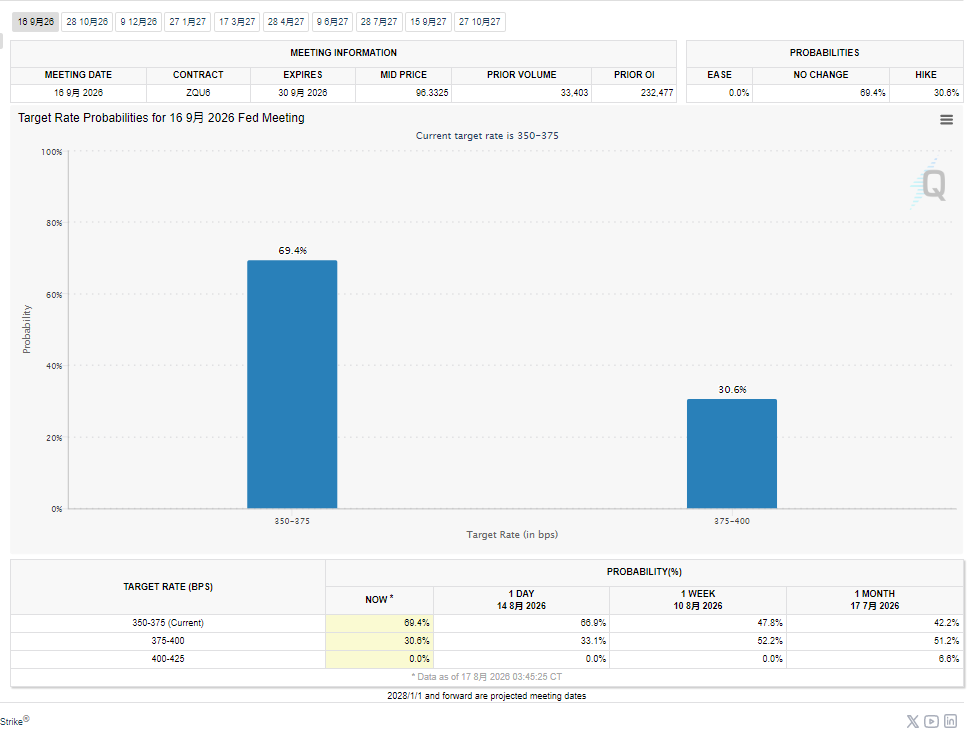 (CME FedWathch interest rate futures, source: CME Group)
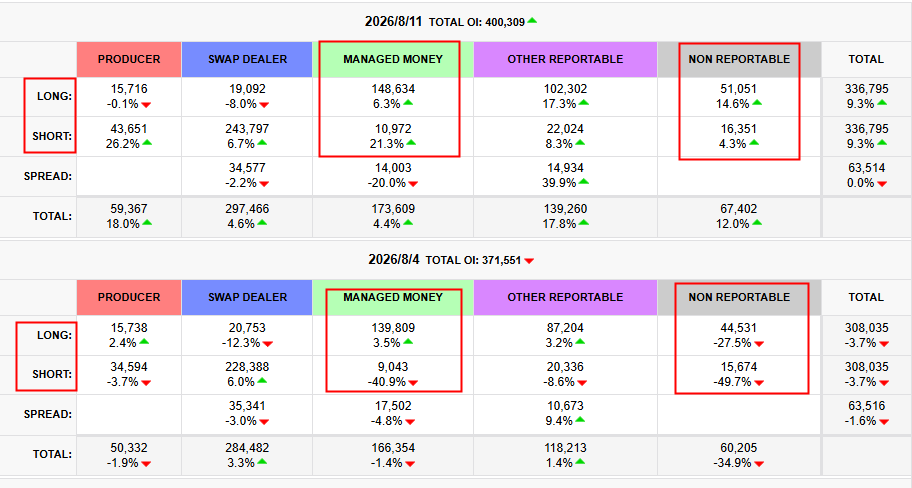 (CFTC's COT gold futures position report, source: CME Group)
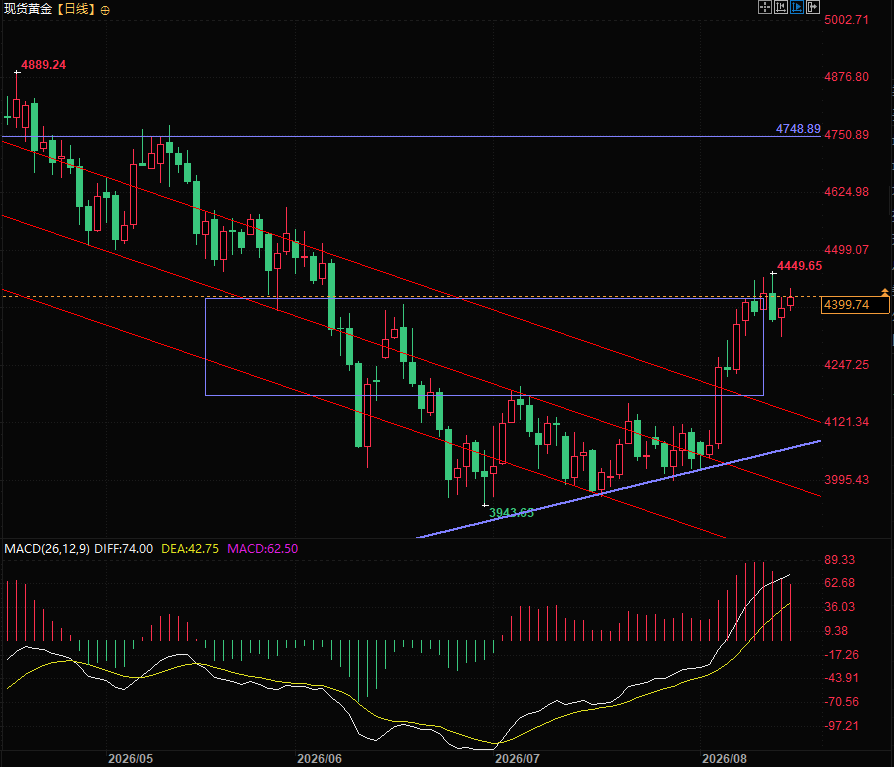 (Spot gold daily chart, source: EasyTrade) At 17:21 Beijing time, spot gold is currently trading at $4398 per ounce.
US K-shaped economic divergence and consumer data
In July, wage and consumption growth among low-income groups in the US rebounded significantly, with year-on-year consumption growth even surpassing that of middle- and high-income groups, seemingly narrowing the consumption gap between the rich and poor. However, from an underlying perspective, the core structure of the US K-shaped economy has not fundamentally changed. This round of consumption recovery among low-income groups relies primarily on short-term increases in take-home pay due to tax withholding adjustments, representing a temporary policy benefit rather than a fundamental optimization of the wealth structure or employment pattern. In stark contrast, the consumption momentum of high-income groups in the US continues to weaken marginally, which is the core reason for the current overall sluggish consumption and continued CPI decline in the US. In the past K-shaped economic model, high-income families accumulated substantial wealth through stock and real estate asset appreciation, serving as the core driving force for high-end services and discretionary consumption in the US. Their strong demand for leisure and high-end consumption has long supported the high stickiness of the US core service CPI. However, in a persistently high-interest-rate environment, high-income groups are highly sensitive to interest rate fluctuations. Asset valuations are under pressure, and credit costs have risen sharply, directly suppressing discretionary consumption expenditures such as luxury goods, high-end services, and leisure and entertainment, completely reversing the previous consumption-driven pattern. Conversely, the recovery in low-income groups is primarily driven by consumption in essential goods and services such as clothing, food, housing, and transportation, with extremely limited ability to drive inflation in core services. The offsetting consumption trends of high- and low-income groups have kept overall US household demand moderate, preventing overheating and providing crucial support for the recent moderate decline in CPI figures.Weaker economic data significantly dampened expectations of a Federal Reserve rate hike.
A divergence in household consumption patterns, continued cooling of inflation, and unexpectedly weak US non-farm payroll data in July, coupled with multiple mild economic signals, have led the market to completely revise its expectations for a tightening of Federal Reserve monetary policy. Market bets on further Fed rate hikes have cooled significantly, while expectations for policy easing have continued to rise. According to data from the CME FedWatch Tool, the market's priced-in probability of a September Fed rate hike has fallen sharply, from 47% a month ago to 29%, significantly reducing the likelihood of another rate hike. The fading expectation of continued high interest rates suggests that the US tightening monetary policy cycle is likely nearing its end, and the overall macroeconomic liquidity environment is expected to improve marginally, providing core positive support for the precious metals market. (CME FedWathch interest rate futures, source: CME Group)A weaker dollar and lower opportunity costs have propelled gold prices to new highs.
The rapid decline in expectations for a Federal Reserve interest rate hike has directly triggered a chain reaction in the foreign exchange and precious metals markets, becoming the core driver of this round of gold price increases. Cooling policy expectations have pushed the US dollar index weaker, which continued to weaken on Monday, hitting a new low for the month. This has increased the cost-effectiveness of dollar-denominated gold for global overseas investors, directly opening up upward potential for gold prices. From an asset perspective, gold is a non-interest-bearing safe-haven asset. The cooling of expectations for a Fed rate hike and the decline in market interest rate expectations have significantly reduced the opportunity cost of holding gold, attracting a large amount of funds to increase their holdings and continuously pushing up gold prices. The latest COT (Commodity Occupations Traded) positions also show that institutions did not significantly reduce their positions during the decline; in fact, they have significantly increased their positions this time. Retail investors, who had 92,529 positions during the decline, have only reduced their positions to 67,402 after the rebound, indicating a significant decrease in long positions. Half of the participants chose to cut their losses near recent lows. Although short positions have also increased, it is far less than the rate of increase in long positions, indicating that while there is some divergence of opinion, the bulls still hold an absolute advantage, which is directly related to the reduced expectations for a Fed rate hike. (CFTC's COT gold futures position report, source: CME Group)Gold prices face upward pressure; a core catalyst is still needed for a short-term push to new highs.
While bullish sentiment towards gold continues to rise in the market, mainstream institutions remain rational, believing that for gold prices to firmly establish themselves above the $4,500/ounce mark and initiate a new round of strong upward movement, the current moderate economic data and cooling interest rate hike expectations are insufficient. Regarding future trends, market institutions generally point out that a breakout in gold prices requires attention to two core catalysts and two external constraints: A clear shift in the Federal Reserve's stance and a deep decline in the US dollar: Institutions such as UBS and Goldman Sachs point out that declining real interest rates and a long-term weakening dollar are the main medium- to long-term drivers supporting gold prices. If the dollar index fails to establish a deep weakening trend, the opportunity cost advantage of gold as a non-interest-bearing asset will be limited. A trend of easing inflationary pressures: A clear decline in energy prices will effectively release the sticky inflationary pressures of the macroeconomy, opening up greater room for monetary policy easing. Although continued purchases by global central banks and geopolitical safe-haven demand (such as the Middle East situation) provide solid bottom support for gold prices, the sharp fluctuations in oil prices and commodities have also exacerbated market concerns about recurring inflation, thus suppressing the unilateral upward momentum of gold prices to some extent. Market attention is focused on the upcoming release of the Federal Reserve's FOMC meeting minutes. Institutions will be digging into the minutes to discern the true attitudes of Fed officials towards the resilience of the job market and the pace of inflation cooling, aiming to capture precise signals regarding the future path of monetary policy and guide the short-term breakout direction of gold prices.Macroeconomic Logic Review and Future Market Outlook
The overall macroeconomic transmission logic is clear: the US K-shaped economic pattern has not ended. The decline in consumption by high-income groups has offset the temporary rebound in consumption by low-income groups, resulting in moderate overall economic demand and continued easing of inflationary pressures. This significantly reduces the probability of a Fed rate hike, leading to a weaker dollar and ultimately providing sustained upward pressure on gold prices. However, market uncertainties remain, and the market is not unilaterally bullish. On one hand, the current rebound in low-income group consumption relies on short-term tax benefits. If this effect fades, low-income consumption momentum will decline, and overall US consumption will further weaken. On the other hand, if subsequent wage growth at the bottom continues to spread and high-income consumption demand restarts, US inflation risks will rise again, and the Fed's monetary policy may shift back to tightening. At that time, gold prices will face significant downward pressure. Overall, the medium-term bullish logic for gold remains intact, but the short-term market is likely to experience repeated fluctuations and await catalysts. Technically , spot gold continues to hold near the upper edge of its trading range (while the price is above the 5-day moving average, which is not superimposed on the chart). For the bulls, gold prices remain in a very strong position. (Spot gold daily chart, source: EasyTrade) At 17:21 Beijing time, spot gold is currently trading at $4398 per ounce.
- Risk Warning and Disclaimer
- The market involves risk, and trading may not be suitable for all investors. This article is for reference only and does not constitute personal investment advice, nor does it take into account certain users’ specific investment objectives, financial situation, or other needs. Any investment decisions made based on this information are at your own risk.