With the probability of a Fed rate hike in September reduced to only 35%, the euro is not happy. Has the US and Iran "hijacked" the deal for safe-haven assets?
2026-08-19 12:07:00
The euro edged higher against the dollar in Asian trading on Wednesday (August 19), currently trading around 1.1580. Weak US inflation, employment, and retail data continued to erode market expectations for a September rate hike by the Federal Reserve, putting downward pressure on the dollar. Meanwhile, European Central Bank Chief Economist Ryan pointed out that the eurozone's 3% inflation rate remains too high, echoing market expectations for further ECB rate hikes—with a 90%-94% probability of a September rate hike. Germany's better-than-expected ZEW economic sentiment index for August provided additional support for the euro. However, the ongoing US-Iran conflict and cautious statements from ECB officials limited the euro's upside potential. The market is now focused on ECB President Lagarde's speech later on Wednesday. 
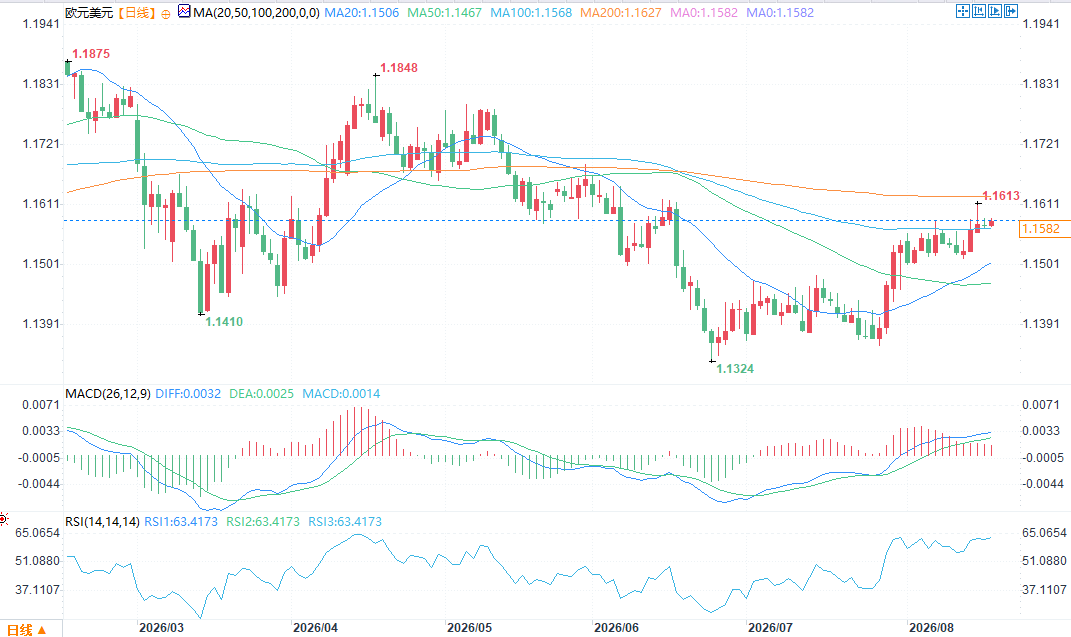 (Euro/USD daily chart, source: FX678) At 12:03 Beijing time on August 19, the euro was trading at 1.1581/82 against the US dollar.
With dollar data weakening across the board, the probability of a September rate hike has fallen to less than 40%.
The continued weakness in US economic data over the past few weeks—an unexpected drop in July's nonfarm payrolls, moderate consumer price inflation, and weak retail sales—has prompted investors to significantly reduce their bets on a September rate hike by the Federal Reserve. A survey by a prominent institution shows that most economists expect the Fed to keep interest rates unchanged at its September meeting and maintain this stance until the end of the year. According to CME's FedWatch Tool, the probability of the Fed keeping rates unchanged by September is 65%, and the probability of a cumulative 25 basis point rate hike is 35%. However, geopolitical factors may provide support for the US dollar. The US-Iran conflict has entered its sixth month, and Trump has stated that he has no intention of extending the expiring peace agreement with Iran. On Tuesday, he further clarified that "there are no negotiations or dialogue arrangements with Iran," and stated that the naval blockade remains fully in effect. With geopolitical risks persisting, the US dollar will have safe-haven buying support, making a sustained rise in the euro difficult.The euro is supported by three factors: high inflation, better-than-expected ZEW rates, and stable expectations of ECB rate hikes.
In the Eurozone, expectations of a European Central Bank (ECB) rate hike continue to support the euro. Financial markets are pricing in the ECB continuing its rate hike cycle—the ECB Watch tool shows a 90%-94% probability of a 25 basis point rate hike to 2.50% at the next meeting on September 9. ECB Chief Economist Ryan stated on Tuesday that the Eurozone's 3% inflation rate remains too high, although it appears moderate compared to previous levels. This statement echoes market expectations that the ECB will maintain its tightening stance. German economic data provided additional fundamental support for the euro. The ZEW Economic Sentiment Index's expectations sub-index rose to 34 in August, higher than the market expectation of 30 and July's 26.3, reflecting an improved outlook for the German economy among analysts. Scotiabank strategists noted that although the recovery remains slow, the improvement in German survey data is helping the euro maintain its resilience. However, Ryan's wording revealed a degree of caution. Given Lane's emphasis on a "meeting-by-meeting, data-dependent" decision-making approach and a "more responsive" policy role, her stance leans towards a moderately dovish position, limiting market expectations for aggressive tightening by the ECB. Overall, the combination of confidence in economic growth and responsive policy guidance supports a narrative of gradual normalization rather than a new round of tightening, keeping euro traders cautious about further bets on a stronger euro.Institutional Views
In its latest research report, Bank of America predicts that the euro will continue to weaken against the dollar until the end of the third quarter, primarily supported by strong US economic data and a more hawkish stance from the Federal Reserve. Short-term oil price increases will also provide additional support for the dollar. The institution believes that the growth divergence between the US and the Eurozone will peak in the coming months, after which the Eurozone is expected to improve due to German fiscal stimulus and falling energy prices, supporting a gradual recovery in the euro. However, before the Fed's rate hike expectations are fully priced in and oil prices fall, the dollar will remain relatively strong, limiting the euro's upside potential. ING's foreign exchange strategist, Francesco Pesole, points out that the euro/dollar exchange rate has begun to appear slightly undervalued around 1.1570. The bank's short-term fair value model shows that the fair value range for EUR/USD is 1.1600-1.1650, approximately 30-80 basis points higher than current levels. The main driver is the change in relative interest rates; the two-year swap spread has narrowed by about 10 basis points, sufficient to support the bank's bullish stance. ING believes that although the euro has rebounded from its July lows and returned above 1.15, it lacks a clear catalyst for a break above 1.1600 in the short term unless the Federal Reserve unexpectedly shifts its dovish stance. Ahead of the Jackson Hole symposium, if more centrist officials soften their hawkish position, it could open up further upside potential for the euro.Summarize
The continued cooling of expectations for a Fed rate hike and the relatively hawkish policy outlook of the ECB are providing support at the interest rate differential level. Better-than-expected German ZEW data injected fundamental confidence into the euro, but the potential for the US-Iran conflict to boost safe-haven demand for the dollar, along with cautious rhetoric from the ECB's chief economist, has limited the euro's upside potential. In the short term, the euro is likely to fluctuate within the 1.1550-1.1620 range, awaiting further clarity on the policy paths of the two major central banks in Europe and the US. (Euro/USD daily chart, source: FX678) At 12:03 Beijing time on August 19, the euro was trading at 1.1581/82 against the US dollar.
- Risk Warning and Disclaimer
- The market involves risk, and trading may not be suitable for all investors. This article is for reference only and does not constitute personal investment advice, nor does it take into account certain users’ specific investment objectives, financial situation, or other needs. Any investment decisions made based on this information are at your own risk.