Why is the Bank of Japan raising interest rates when core CPI has been below 2% for seven consecutive months?
2026-08-21 11:35:02
On Friday (August 21) during the Asian session, the USD/JPY pair traded in a volatile pattern, currently hovering around 159.00, having rebounded by about 4 yen from its August low. At the end of July, joint US-Japan intervention pushed the exchange rate from above 164.00 to around 155.00 within two days, and the market has since recovered nearly half of those losses in the following three weeks. Today's Japanese inflation data provides new directional clues for the yen's movement. The core CPI for July, released on Friday, rose 1.8% year-on-year, in line with market expectations and accelerating from 1.6% in June; the core-core CPI, excluding fresh food and energy, rose from 1.7% to 1.9%, a more noteworthy signal. Energy prices rose for the first time since November 2025, with an even larger increase after deducting subsidies—wholesale inflation reached 7.2%, with electricity prices being the largest contributor, suggesting that upstream cost pressures are being passed on to consumers. The rise in services inflation from 1.1% to 1.2% indicates that businesses are passing on labor costs through price increases, a signal that is more important to policymakers than overall energy-driven inflation. Driven by both a weak yen and Middle Eastern energy prices, the Bank of Japan's expectation of raising interest rates to 1.25% in September is essentially locked in. 
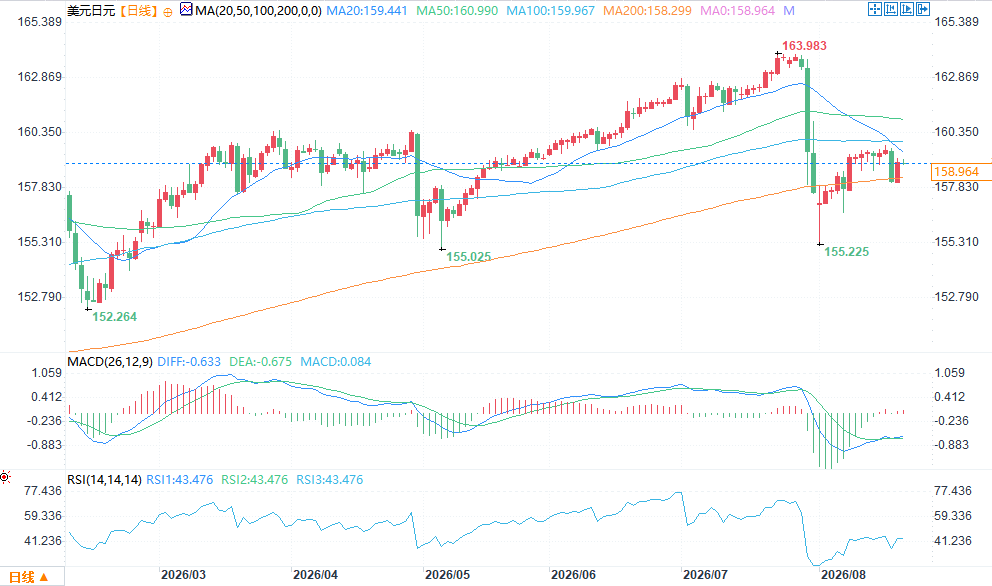 (USD/JPY daily chart, source: EasyForex) At 11:33 Beijing time on August 21, the USD/JPY exchange rate was 159.03/04.
Core inflation accelerated to 1.8%, but remained below the 2% target.
Japan's core CPI (including energy, excluding fresh food) rose 1.8% year-on-year in July, in line with expectations and higher than June's 1.6%. Overall inflation reached 1.9%, the highest level this year. The core-core CPI, excluding fresh food and energy, accelerated to 1.9% from 1.7% in June and is considered a cleaner indicator of underlying price pressures. However, this still marks the seventh consecutive month that core inflation has remained below the Bank of Japan's 2% target. Analysts attribute this to government subsidies implemented to curb fuel costs—the actual increase in energy prices after deducting subsidies far exceeds the level shown in official data.Upstream cost pressures are accumulating: wholesale inflation is at 7.2%, with electricity being the biggest driver.
The real signal of inflationary pressures is coming from upstream. Wholesale inflation soared to 7.2% in July, with electricity prices being the largest single contributor, suggesting that broader cost pressures are being passed on to consumers. Energy prices have risen year-on-year for the first time since November 2025—although government subsidies are still in place, the oil prices driven up by the US-Iran conflict have begun to seep into the consumer market. A senior economist at Sompo Institute Plus noted that given the renewed escalation of tensions in the Middle East—which is expected to push up oil prices and increase pressure from a weaker yen—core consumer inflation may accelerate again, and he anticipates the Bank of Japan will raise interest rates in September.A “real signal” of inflation in the service sector: businesses are passing on labor costs.
Services inflation rose to 1.2% in July from 1.1% in June, a more moderate increase than the 2.7% year-on-year rise in goods prices, but analysts see it as evidence that businesses are gradually passing on higher labor costs amid a tight labor market. For policymakers, the rise in services inflation is more significant than energy-driven overall inflation—because it points to businesses passing on costs through price increases, rather than a one-off oil price transmission. Analysts expect core inflation to further exceed the Bank of Japan's target in the coming months as the transmission of raw material costs—which has already driven wholesale inflation high—spreads throughout the broader economy.Policy Outlook: A September rate hike to 1.25% is essentially locked in.
The Bank of Japan (BOJ) raised interest rates to a 31-year high of 1% in June, kept policy unchanged in July, and issued its strongest warning to date about upside risks to inflation. Major media outlets reported that the BOJ will raise rates as soon as possible in September and is considering a more aggressive tightening pace thereafter than the current pace of about twice a year. The BOJ's outlook report last month stated that core inflation could accelerate significantly above 2% starting in the second half of the current fiscal year (September to March of the following year), due to factors including wage increases passing to prices, rising oil prices, and the recent depreciation of the yen. The report added that inflation should subsequently fall back to 2% as oil prices decline. The market widely expects the BOJ to raise its benchmark interest rate from 1% to 1.25% at its policy meeting on September 17-18.Summarize
Japan's core CPI rose 1.8% year-on-year in July, in line with expectations, while core-core CPI accelerated to 1.9%. Moderate inflation in the services sector indicates that companies are passing on labor costs through price increases. Wholesale inflation, reaching 7.2%, suggests that upstream cost pressures are being transmitted to consumers, although government subsidies continue to suppress overall inflation. Under the dual pressure of a weak yen and rising energy prices in the Middle East, the expectation of a Bank of Japan rate hike to 1.25% in September is essentially locked in, with the market pricing in a near 80% probability of a rate hike. The upward trend in services inflation will be a key variable determining the pace of subsequent tightening. (USD/JPY daily chart, source: EasyForex) At 11:33 Beijing time on August 21, the USD/JPY exchange rate was 159.03/04.
- Risk Warning and Disclaimer
- The market involves risk, and trading may not be suitable for all investors. This article is for reference only and does not constitute personal investment advice, nor does it take into account certain users’ specific investment objectives, financial situation, or other needs. Any investment decisions made based on this information are at your own risk.