Gold prices surged over 13% in March, driven by a loosening of the US dollar's credit rating and a turning point in the interest rate cycle.
2026-08-21 22:00:58
Spot gold continued its strong bullish trend this week, achieving its third consecutive weekly gain. Prices surged to a three-month high since mid-May, briefly breaking through the $4,600/ounce resistance level. Currently trading around $4,580, the month-to-date gain is approaching 13%. This upward breakout is not driven by a single event, but rather by a confluence of three cyclical factors: a long-term easing of dollar credit, a lower-than-current neutral interest rate from the Federal Reserve in the medium term, reduced expectations of rate hikes providing support, and a weakening of short-term US Treasury bonds and the dollar. These factors, coupled with continued intervention in the US Treasury bond market and intensified macroeconomic policy maneuvering, have created a trend that demonstrates remarkable resilience in the bullish market. 
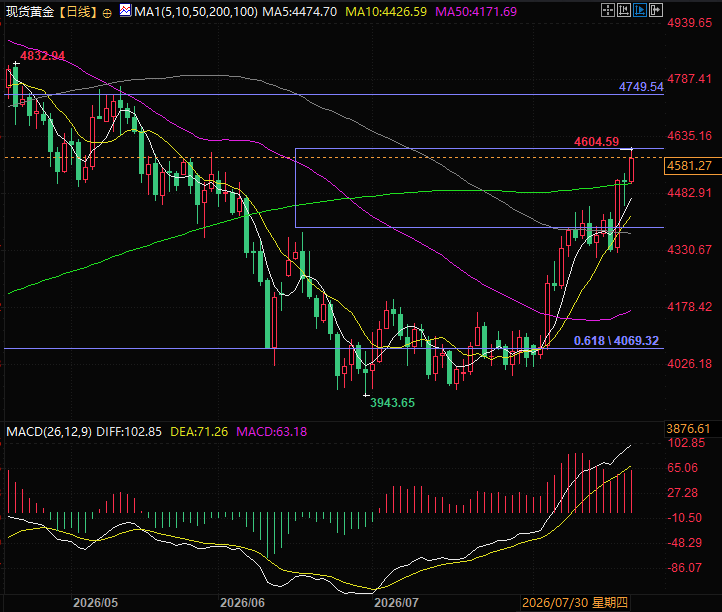 (Spot gold daily chart, source: EasyTrade) At 21:55 Beijing time, spot gold is currently trading at $4,583 per ounce.
Policy game escalates: Fiscal intervention to offset monetary tightening, completely rewriting the gold pricing system.
The core variable driving this market trend was first the turnaround in the US job market, followed by the Treasury intervention triggered by the US debt crisis. Faced with the continued sell-off of long-term US Treasury bonds and soaring yields impacting AI company financing and the fiscal system, the US Treasury proactively intervened, using an implicit yield curve control (YCC) operation of issuing short-term bonds and repurchasing long-term bonds to support long-term debt and offset the effects of the Federal Reserve's market-driven tightening. Meanwhile, the Federal Reserve, constrained by high debt interest rates and the impact of fiscal constraints, has significantly limited the independence of its monetary policy, making it difficult to sustain a hawkish stance on interest rate hikes. Industry institutions generally believe that this round of Treasury intervention is only a short-term "band-aid" fix and cannot fundamentally address the structural problems of high US debt and high deficits; the long-term vulnerability of the bond market remains. This two-way policy tug-of-war further exacerbates the uncertainty of dollar assets, continuously driving funds towards gold.Long-term core logic: As the US debt crisis unfolds, gold's role as an alternative reserve becomes more prominent.
From a long-term perspective, the structural imbalance in the US debt system is the underlying support for the current sustained strength of gold. The US federal government debt has historically surpassed the $40 trillion mark, surging from $30 trillion to $40 trillion in just four and a half years. The rate of debt expansion has continued to spiral out of control, with fiscal interest payments reaching $1.1 trillion this year, doubling in size within five years. The US's long-term debt repayment capacity has been widely questioned by global markets. Against the backdrop of massive US debt and continuously exposed fiscal risks, global markets have initiated a sustained sell-off of US Treasuries and the US dollar, further advancing the global de-dollarization process. The safety and stability of traditional dollar reserve assets have significantly declined, while gold, as an alternative reserve asset without sovereign credit and ultra-hard currency, has seen its core allocation value continuously reassessed by the market. In the long term, the weakening of the dollar's credit, the fading safe-haven aura of US Treasuries, and the rising demand for gold as a reserve alternative have opened up a long-term upward trend for gold prices.The core logic for the medium term: Low neutral interest rates limit the scope for interest rate cuts, and expectations of policy easing support gold prices.
In the medium term, the Federal Reserve's interest rate stance provides solid bullish support for gold. Current market pricing indicates that the Fed's forward neutral rate is significantly lower than the current market interest rate level, meaning that the current high policy rate is not sustainable in the long term. Even if US inflation exhibits structural stickiness at present and the Fed maintains high interest rates, from the perspective of the medium-term monetary policy cycle, the Fed still has clear room for a shift towards rate cuts, and the overall trend of monetary policy will eventually move towards easing. Considering the current Fed policy landscape, new Chairman Warsh's abandonment of traditional forward guidance and allowing long-term interest rates to fluctuate in a market-driven manner, coupled with increasing hawkish divisions within the Fed and fluctuating inflation and employment data, market confidence in the Fed's continued high interest rates continues to weaken. The continued expectation of medium-term rate cuts continues to suppress the upward potential of long-term US Treasury yields, reducing the opportunity cost of holding gold and safeguarding the medium-term bullish trend for gold.Short-term catalysts: Dollar sell-off + interest rate decline + geopolitical easing – multiple positive factors converge.
In the short term, multiple marginal positive factors have converged, propelling gold prices to break through resistance levels. Firstly, the US dollar index experienced sustained selling pressure, falling to a three-month low near 98.65. This weakening dollar directly boosted dollar-denominated commodities and gold assets. Secondly, the US Treasury's continued intervention in the bond market became a key short-term catalyst. Following the increase of the single repurchase program for long-term bonds to $4 billion, Treasury Secretary Bessenter reiterated that there was no upper limit to the repurchase program and that further increases would follow, effectively confirming long-term bond support and suppressing the rebound in US Treasury yields, thus easing the pressure on gold from interest rates. Simultaneously, the short-term geopolitical situation has eased, and market risk aversion has cooled in an orderly manner. Funds have flowed out of safe-haven assets like the dollar and US Treasuries and into the gold market to hedge against dollar credit and debt risks. The combination of these multiple short-term factors has ignited this round of accelerated gold price increases. It is worth noting that although US Treasury yields briefly rebounded on Thursday, approaching their year-to-date highs, gold did not experience a deep correction, fully demonstrating the strong resilience of the bulls in this round of price increases.Funding and Institutional Validation: Significant net inflow of funds indicates institutions are optimistic about the gold repricing trend.
The continued strength of the gold market is validated by strong liquidity. With fiscal intervention taking effect and multiple positive factors converging, demand for gold as a safe-haven asset has surged. Data shows that the daily increase in gold ETF holdings hit a new high since September 2025, with a net inflow of 18 tons. Meanwhile, continued gold purchases by global central banks, coupled with a sustained influx of funds seeking to hedge against inflation and debt risks, have provided strong support for the gold price rally. Commerzbank commented that the current rise in US Treasury yields is essentially a market price adjustment to the massive US debt and long-term inflation risks. The Treasury's emergency intervention in the bond market has thoroughly exposed the fragility of the US financial system, accelerating the repricing of gold globally. Currently, gold has stabilized above all daily moving averages, with $4600/ounce serving as a key short-term resistance level. A successful break above this level would open up further upside potential.Market Outlook: Short-term volatility is expected to increase, but the overall bullish trend remains intact across the long, medium, and short term.
In the short term, gold faces minor fluctuations and balancing factors, with increased volatility at higher levels. US Treasury yields remain at historically high levels, and the lingering threat of energy inflation in the Middle East may constrain expectations of further easing by the Federal Reserve, limiting the short-term upward momentum of gold prices. However, from a core cyclical perspective, the three core logics of long-term dollar debt concerns, medium-term expectations of Fed rate cuts, and short-term dollar weakness supported by interest rates remain intact. With multiple cycles converging, the overall bullish trend for gold is solid, and any subsequent corrections will present buying opportunities. The medium- to long-term strong trend is unlikely to reverse. Technically, spot gold has reached a three-fold increase from the lower consolidation range, with current resistance around 4604 and the 0.786 Fibonacci retracement level of the previous upward move. (Spot gold daily chart, source: EasyTrade) At 21:55 Beijing time, spot gold is currently trading at $4,583 per ounce.
- Risk Warning and Disclaimer
- The market involves risk, and trading may not be suitable for all investors. This article is for reference only and does not constitute personal investment advice, nor does it take into account certain users’ specific investment objectives, financial situation, or other needs. Any investment decisions made based on this information are at your own risk.