A chart shows that the Baltic Dry Index (BDI) rebounded across all ship types but closed lower for the week, with Supramax vessels showing resilience at 1879.
2026-08-22 01:44:58
Latest data shows that the Baltic Dry Index (BDI) reached 2841 points on August 21, 2026, a four-day high, up 1.79% month-on-month (compared to the previous value), marking the largest increase since August 5, 2026, and the second consecutive day of increase (including zero growth). Looking at the short-term charts, the recent 11 BDI data points show: 5 positive increases, 6 negative increases, and 0 zero increases. Specifically, the Panamax Freight Index (BPI) reached 2103 points, up 0.72% from the previous value; the Capesize Freight Index (BCI) reached 4552 points, up 2.78%; and the Supramax Freight Index (BSI) reached 1879 points, up 14.78%. For detailed 720-day and 10-year trend charts of the Baltic Dry Index and its three sub-indices, please refer to the charts specially created by FX678. 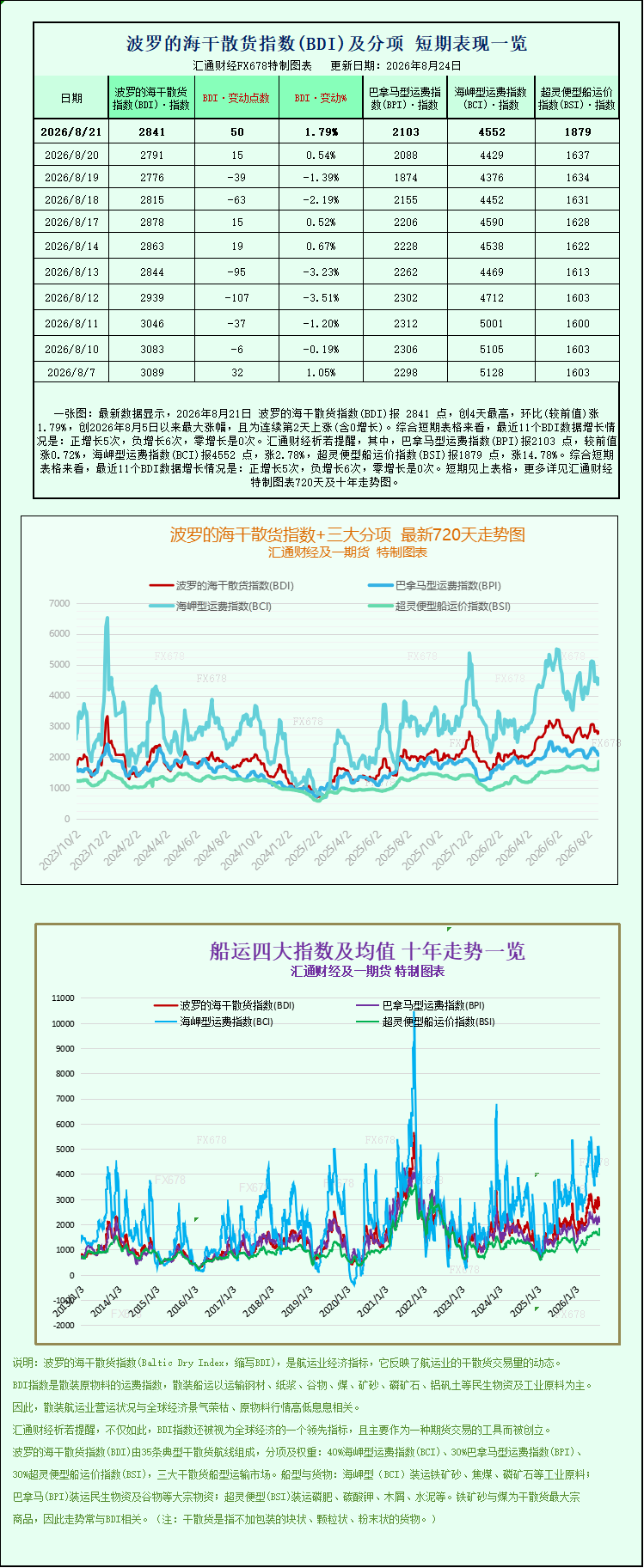 On August 21, 2026, the latest shipping market data showed that the Baltic Dry Index (BDI) rebounded across the board on Friday, with freight rates for all vessel types, including Capesize, Panamax, and Supramax, rising simultaneously, ending the previous period of weakness. However, from a weekly perspective, the market still faces downward pressure from the previous correction, with the core benchmark index still recording a weekly decline, presenting a distinct market pattern of "general intraday gains, weekly declines, and structural differentiation." The Supramax vessel market, representing smaller vessels, performed particularly well, demonstrating strong resilience against the trend. The Supramax freight rate index closed at 1879 points on Friday, becoming a key highlight in this round of market differentiation. Data shows that the Baltic Dry Index (.BADI) rose 50 points on Friday, an increase of 1.8%, ultimately closing at 2841 points, achieving a steady daily recovery. However, looking at the overall trend for the week, dragged down by the continued weakness in freight rates for large vessels for several days during the week, the index fell by 0.8% cumulatively for the week, ending the previous phase of recovery. This round of rebound covered all mainstream dry bulk carrier types, breaking the recent disconnect between large and small vessel trends, and overall market sentiment has improved somewhat. However, the magnitude of price changes and weekly performance of vessels of different tonnages varied significantly, and the structural differentiation of the shipping market remains prominent. As the mainstay of large dry bulk carriers, Capesize vessels saw the most significant rebound in this round. On Friday, the Capesize index surged 123 points, a gain of 2.8%, closing at 4552 points, achieving two consecutive days of gains and a clear trend of stabilization and recovery. For the whole week, the Capesize index rose slightly by 0.3%, making it the only major vessel type to achieve a weekly gain. Correspondingly, vessel profitability data improved simultaneously. Capesize vessels mainly engaged in the transportation of 150,000-ton iron ore and coal bulk raw materials saw their average daily earnings rise by $1,118 to $37,785. The core driver supporting the recovery in Capesize freight rates came from the commodities market. The continued destocking of iron ore at major Chinese ports offset the demand pressure caused by declining steel mill profits. Iron ore futures prices remained largely flat, and the steady release of demand for bulk raw materials via sea freight provided key support for the large mining vessel market. The medium-sized vessel market also recovered, with Panamax vessels ending their weak performance. On Friday, the Panamax index rose 15 points, or 0.7%, to 2103 points, successfully ending a seven-day losing streak and easing short-term market pessimism. However, the weekly recovery for this vessel type was limited, with a cumulative weekly drop of 5.6%, the largest weekly decline among the three major vessel types. Panamax vessels primarily handle 60,000 to 70,000-ton coal and grain shipments. The significant weekly drop in freight rates was mainly due to weak global grain shipping orders, a temporary decline in regional coal transport demand, and relative overcapacity on the Atlantic route, which had previously put pressure on freight rates. With restocking demand kicking in in the Asia-Pacific region on Friday, cargo volumes on shipping routes rebounded, and freight rates finally bottomed out and rebounded, with average daily earnings rising by $138 to $18,928. Amidst the dramatic fluctuations in prices for large and small vessels, Supramax vessels, with their unique market characteristics, maintained a stable operating trend, with the index holding steady above 1879 points on the day, continuing their recent strong resilience. Supramax vessels, with a deadweight tonnage concentrated between 40,000 and 60,000 tons, possess core advantages such as shallow draft, onboard loading and unloading equipment, and strong port adaptability. They can call at numerous small and medium-sized feeder ports without relying on large deep-water terminals, and their routes cover feeder markets in Southeast Asia, the Middle East, and the Mediterranean. Compared to large vessels primarily engaged in bulk raw material transportation, this vessel type transports a more diverse range of cargoes, including steel, cement, fertilizers, minor minerals, and light industrial raw materials, etc., without relying solely on cyclical commodities such as iron ore and coal, thus being minimally affected by fluctuations in demand from a single industry. Looking at recent market trends, Supramax vessels have consistently outperformed the broader market for small and medium-sized vessels. Even during the overall market downturn and significant correction in large vessel segments in early August, they remained resilient, achieving multiple increases against the trend. The current closing price of 1879 points reflects the continuation of the monthly high-level fluctuation pattern, fully demonstrating the stable demand in the feeder shipping market. Currently, the demand for infrastructure materials, agricultural supplies, and chemical raw materials transported between global regions remains rigid, with ample fragmented, small-batch shipping orders. This, coupled with the steady increase in shipping activity at global small and medium-sized ports, provides solid support for Supramax freight rates. Furthermore, the global fleet size of this vessel type is large, the market competition is mature, and freight rate fluctuations are far less than those of Capesize and Panamax vessels, making them more resilient to risks. In summary, the structural market trend of the Baltic Dry Index this week is essentially a mismatch between supply and demand for different cargo types and routes. Large vessel types were affected by fluctuations in steel mill profits and cyclical ups and downs in demand for bulk raw materials, resulting in a weak weekly trend. Meanwhile, steady demand for feeder services supported the continued strength of Supramax vessels. Industry analysts point out that in the short term, with the continued destocking of domestic bulk commodities and increased activity in global regional trade, freight rates for all vessel types are expected to continue their recovery. However, large vessel types still face uncertainties regarding industrial demand fluctuations, while Supramax vessels, with their inelastic demand and diversified routes, are likely to maintain high and stable freight rates, continuing to act as a stabilizer in the dry bulk market.
On August 21, 2026, the latest shipping market data showed that the Baltic Dry Index (BDI) rebounded across the board on Friday, with freight rates for all vessel types, including Capesize, Panamax, and Supramax, rising simultaneously, ending the previous period of weakness. However, from a weekly perspective, the market still faces downward pressure from the previous correction, with the core benchmark index still recording a weekly decline, presenting a distinct market pattern of "general intraday gains, weekly declines, and structural differentiation." The Supramax vessel market, representing smaller vessels, performed particularly well, demonstrating strong resilience against the trend. The Supramax freight rate index closed at 1879 points on Friday, becoming a key highlight in this round of market differentiation. Data shows that the Baltic Dry Index (.BADI) rose 50 points on Friday, an increase of 1.8%, ultimately closing at 2841 points, achieving a steady daily recovery. However, looking at the overall trend for the week, dragged down by the continued weakness in freight rates for large vessels for several days during the week, the index fell by 0.8% cumulatively for the week, ending the previous phase of recovery. This round of rebound covered all mainstream dry bulk carrier types, breaking the recent disconnect between large and small vessel trends, and overall market sentiment has improved somewhat. However, the magnitude of price changes and weekly performance of vessels of different tonnages varied significantly, and the structural differentiation of the shipping market remains prominent. As the mainstay of large dry bulk carriers, Capesize vessels saw the most significant rebound in this round. On Friday, the Capesize index surged 123 points, a gain of 2.8%, closing at 4552 points, achieving two consecutive days of gains and a clear trend of stabilization and recovery. For the whole week, the Capesize index rose slightly by 0.3%, making it the only major vessel type to achieve a weekly gain. Correspondingly, vessel profitability data improved simultaneously. Capesize vessels mainly engaged in the transportation of 150,000-ton iron ore and coal bulk raw materials saw their average daily earnings rise by $1,118 to $37,785. The core driver supporting the recovery in Capesize freight rates came from the commodities market. The continued destocking of iron ore at major Chinese ports offset the demand pressure caused by declining steel mill profits. Iron ore futures prices remained largely flat, and the steady release of demand for bulk raw materials via sea freight provided key support for the large mining vessel market. The medium-sized vessel market also recovered, with Panamax vessels ending their weak performance. On Friday, the Panamax index rose 15 points, or 0.7%, to 2103 points, successfully ending a seven-day losing streak and easing short-term market pessimism. However, the weekly recovery for this vessel type was limited, with a cumulative weekly drop of 5.6%, the largest weekly decline among the three major vessel types. Panamax vessels primarily handle 60,000 to 70,000-ton coal and grain shipments. The significant weekly drop in freight rates was mainly due to weak global grain shipping orders, a temporary decline in regional coal transport demand, and relative overcapacity on the Atlantic route, which had previously put pressure on freight rates. With restocking demand kicking in in the Asia-Pacific region on Friday, cargo volumes on shipping routes rebounded, and freight rates finally bottomed out and rebounded, with average daily earnings rising by $138 to $18,928. Amidst the dramatic fluctuations in prices for large and small vessels, Supramax vessels, with their unique market characteristics, maintained a stable operating trend, with the index holding steady above 1879 points on the day, continuing their recent strong resilience. Supramax vessels, with a deadweight tonnage concentrated between 40,000 and 60,000 tons, possess core advantages such as shallow draft, onboard loading and unloading equipment, and strong port adaptability. They can call at numerous small and medium-sized feeder ports without relying on large deep-water terminals, and their routes cover feeder markets in Southeast Asia, the Middle East, and the Mediterranean. Compared to large vessels primarily engaged in bulk raw material transportation, this vessel type transports a more diverse range of cargoes, including steel, cement, fertilizers, minor minerals, and light industrial raw materials, etc., without relying solely on cyclical commodities such as iron ore and coal, thus being minimally affected by fluctuations in demand from a single industry. Looking at recent market trends, Supramax vessels have consistently outperformed the broader market for small and medium-sized vessels. Even during the overall market downturn and significant correction in large vessel segments in early August, they remained resilient, achieving multiple increases against the trend. The current closing price of 1879 points reflects the continuation of the monthly high-level fluctuation pattern, fully demonstrating the stable demand in the feeder shipping market. Currently, the demand for infrastructure materials, agricultural supplies, and chemical raw materials transported between global regions remains rigid, with ample fragmented, small-batch shipping orders. This, coupled with the steady increase in shipping activity at global small and medium-sized ports, provides solid support for Supramax freight rates. Furthermore, the global fleet size of this vessel type is large, the market competition is mature, and freight rate fluctuations are far less than those of Capesize and Panamax vessels, making them more resilient to risks. In summary, the structural market trend of the Baltic Dry Index this week is essentially a mismatch between supply and demand for different cargo types and routes. Large vessel types were affected by fluctuations in steel mill profits and cyclical ups and downs in demand for bulk raw materials, resulting in a weak weekly trend. Meanwhile, steady demand for feeder services supported the continued strength of Supramax vessels. Industry analysts point out that in the short term, with the continued destocking of domestic bulk commodities and increased activity in global regional trade, freight rates for all vessel types are expected to continue their recovery. However, large vessel types still face uncertainties regarding industrial demand fluctuations, while Supramax vessels, with their inelastic demand and diversified routes, are likely to maintain high and stable freight rates, continuing to act as a stabilizer in the dry bulk market.- Risk Warning and Disclaimer
- The market involves risk, and trading may not be suitable for all investors. This article is for reference only and does not constitute personal investment advice, nor does it take into account certain users’ specific investment objectives, financial situation, or other needs. Any investment decisions made based on this information are at your own risk.