Jackson Hole becomes a key juncture for the US dollar: If its credibility as an anti-inflationary force is lost, will the pressure on the dollar intensify further?
2026-08-22 15:06:58
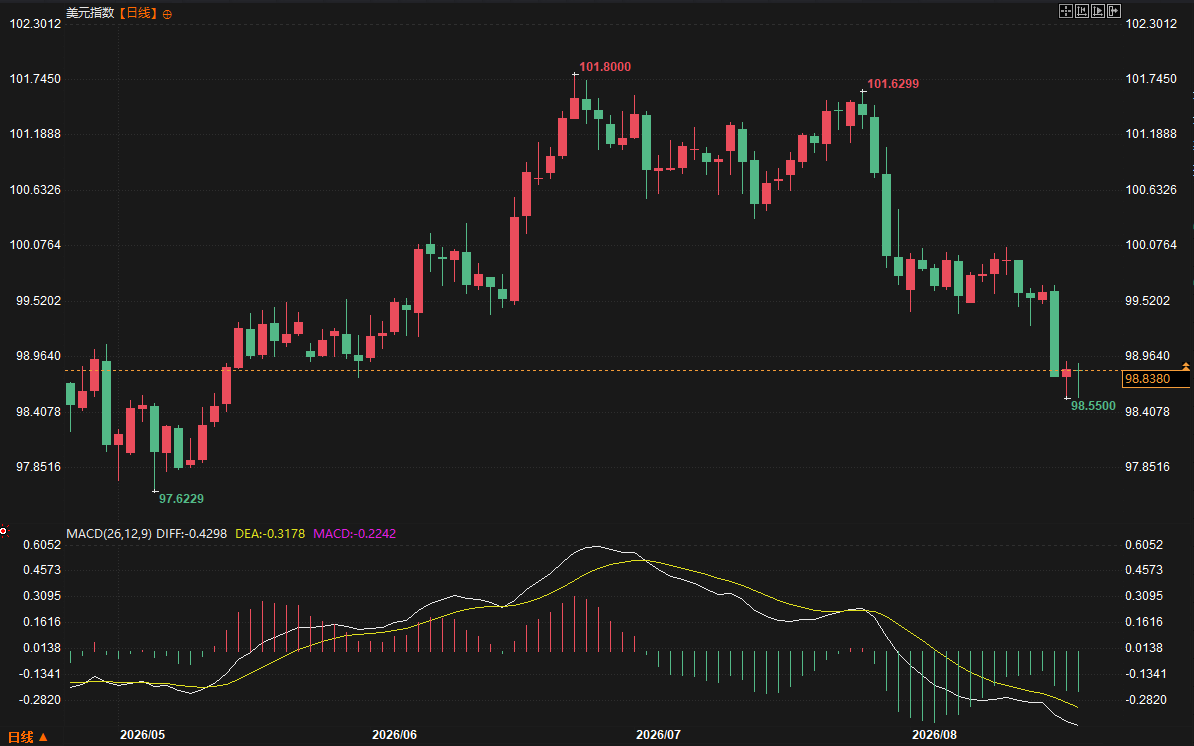
Over the past week, the foreign exchange market has seen a broad weakening of the US dollar and a general strengthening of non-US currencies. The US dollar index recorded declines on both the weekly and monthly charts, and on the daily chart, it has continued to fall from its July high, breaking below the 99 level. The euro, pound sterling, and Australian dollar all rose on both the weekly and monthly charts, with the Australian dollar leading the monthly gains, demonstrating the resilience of commodity currencies. The core driver was the US Treasury Secretary's statement regarding expanding the scale of longer-term Treasury bond repurchase agreements. Market concerns arose that fiscal pressure was being transmitted to the exchange rate, and the repurchase program, instead of stabilizing long-term yields, became a new reason to sell the dollar. Meanwhile, accelerating inflation in Japan provided short-term support for the yen, but the strength of the yen's rebound after the joint US-Japan intervention remained constrained by expectations of the Bank of Japan's policy. Overall, the weakness of the US dollar reflects more a wavering of market confidence in US fiscal and policy developments than solely due to changes in interest rates. 
 The pound rose to its highest level against the dollar this week since mid-February, gaining approximately 0.8% for the week and about 1.3% for the month. On the daily chart, it has been trending upwards from a low near 1.3139, repeatedly making new highs. The MACD indicator shows strong bullish momentum, and the current price is approaching the previous high of 1.3657. The pound itself lacks new catalysts; the upward movement is mainly driven by a weaker dollar and improved risk sentiment, rather than a significant change in expectations regarding UK policy.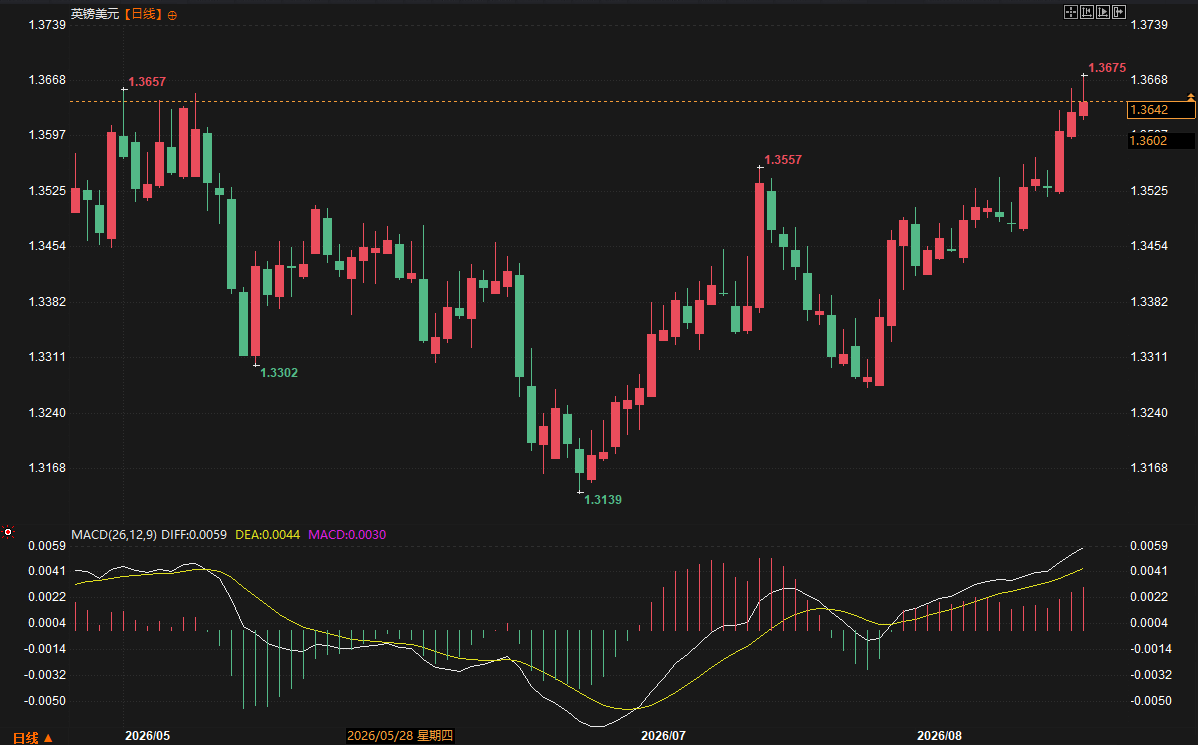
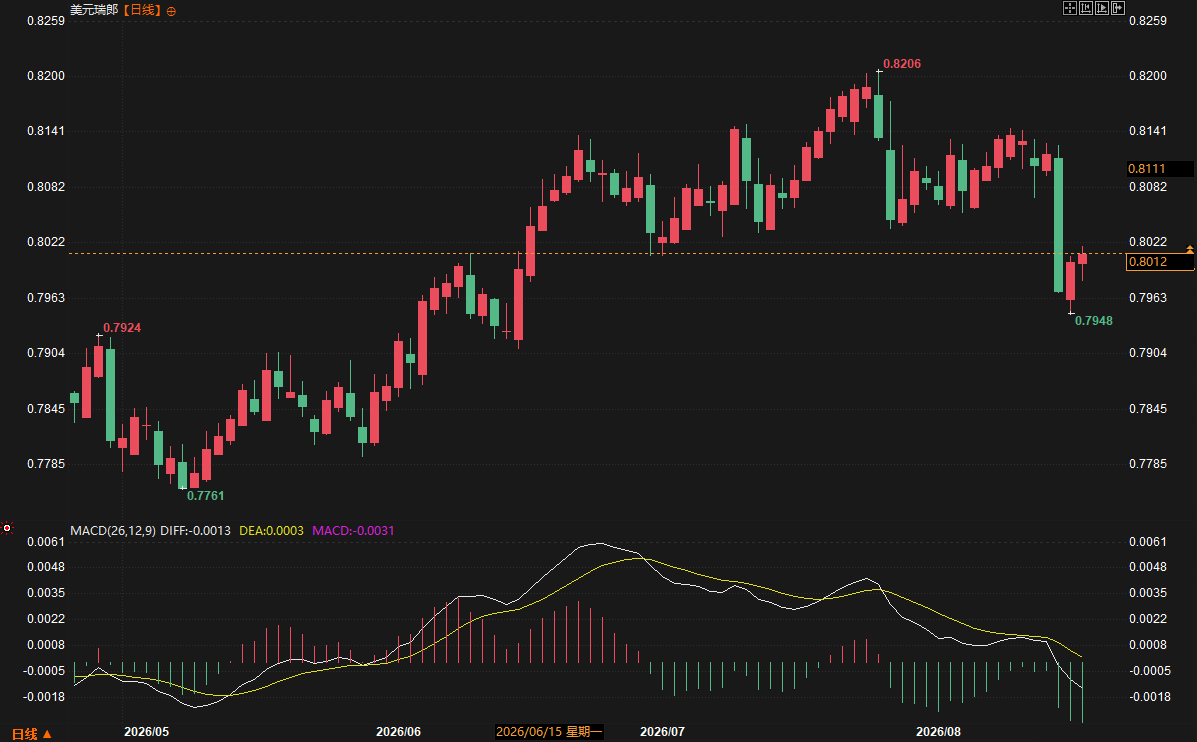
 Among commodity currencies, the Australian dollar rose approximately 1.3% against the US dollar on a weekly basis and approximately 2.1% on a monthly basis, making it the strongest performer among major non-US dollar currencies. The US dollar/Canadian dollar pair fell approximately 0.8% on a weekly basis and approximately 1.9% on a monthly basis; the US dollar/Swiss franc pair fell approximately 1.3% on a weekly basis and approximately 0.9% on a monthly basis. The overall strength of commodity prices, improved risk appetite, and a weaker US dollar jointly boosted commodity currencies such as the Australian dollar and the Canadian dollar. The Swiss franc, on the other hand, benefited more from the weaker US dollar and the rebalancing of safe-haven flows. From a technical perspective, the Australian dollar, British pound, and euro are all in an upward trend, while the US dollar/Canadian dollar and the US dollar/Swiss franc are in a downward trend, consistent with the weakening US dollar index.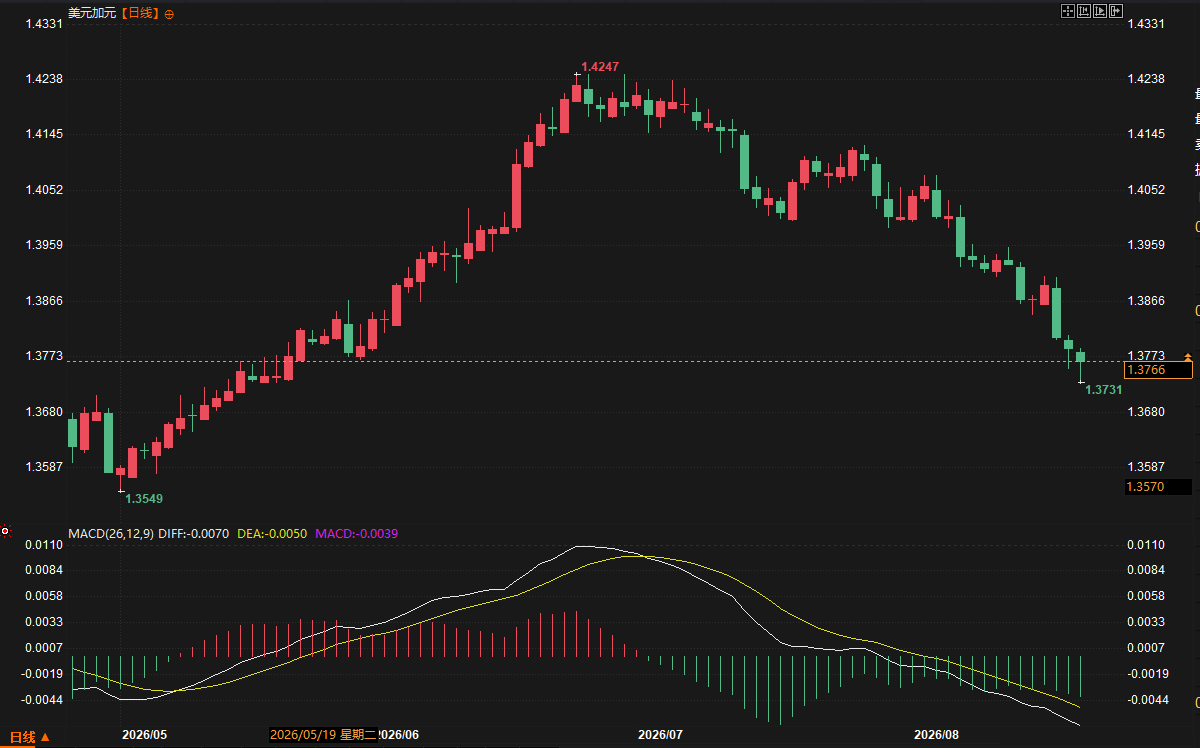
 The core issue in the foreign exchange market this week was not the level of interest rates themselves, but the transmission path of US fiscal policy. The repurchase program, attempting to suppress long-term yields, has shaken market confidence in the coordination between US fiscal and policy measures, making the dollar a source of pressure. The Fed Chair's remarks at the Jackson Hole meeting will be a key short-term variable, but whether the dollar can stabilize may depend more on the market's reassessment of the fiscal outlook. Among non-US currencies, the euro, pound sterling, and Australian dollar all show strong technical patterns, but volatility may increase after approaching previous highs. The relative resilience of commodity currencies remains worth noting.
US Dollar Index: Buyback program triggers fiscal confidence gap, index falls below key psychological level
The US dollar index continued its weakness this week. The daily chart shows that the dollar index has been declining since reaching a high of around 101.80 in July, recently weakening further and breaking below the 99 level. The MACD remains bearish. The weekly chart shows a decline of approximately 0.8%, and the monthly chart shows a decline of approximately 1.2%, indicating a weak technical pattern. Regarding events, the US Treasury Secretary indicated mid-week that the program for repurchasing longer-term Treasury bonds might be further expanded. Previously, the Treasury had pledged to at least double the size of its repurchase operations to curb rising yields. However, long-term Treasury yields still rose sharply this week, with the 30-year yield briefly reaching its highest level since 2007. Traders cited concerns including a deteriorating fiscal outlook, large-scale debt issuance, geopolitical risks, and uncertainty surrounding the Federal Reserve's policy path. In conclusion, the repurchase program neither effectively lowered yields nor mitigated fiscal pressure, instead shifting it to the exchange rate. In terms of institutional views, some foreign exchange strategists stated that efforts to lower US yields have had little effect on Treasury yields, instead weakening the dollar, and the market is now retaliating. Another institution noted in a report that the risks to the US dollar are slightly skewed to the downside, and any hawkish clarification regarding the credibility of inflation protection may only provide limited support for the dollar; if the issue of inflation protection credibility is not addressed, the dollar may face more significant pressure. Federal funds rate futures show that the market expects a rate hike in September at around 40%, and a rate hike in December has risen to 72%, but the dollar has not received support as a result, reflecting that the market focus has shifted from simply the interest rate path to fiscal and credit dimensions.Euro and Pound Sterling: Non-US core currencies rise on the back of the trend, approaching their recent highs.
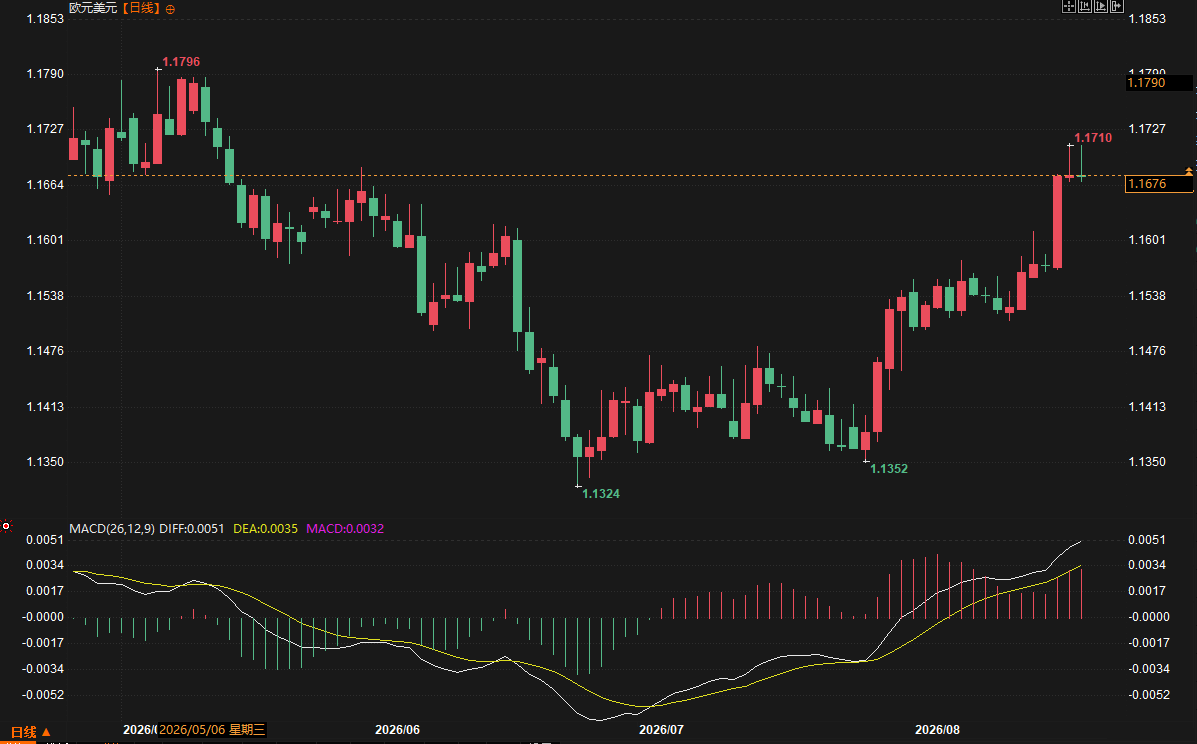
The euro rose above 1.16 against the dollar this week, earlier touching its highest level since mid-May, with a weekly gain of about 1.0% and a monthly gain of about 1.4%. The daily chart shows a reversal from the early July lows, with a recent rapid rise and strengthening MACD bullish momentum. The current price is near the previous high of around 1.1796. The euro's strength is mainly driven by a weaker dollar. The Eurozone's August manufacturing PMI rose to a 54-month high, and improved external demand expectations also provided some fundamental support for the euro. The pound rose to its highest level against the dollar this week since mid-February, gaining approximately 0.8% for the week and about 1.3% for the month. On the daily chart, it has been trending upwards from a low near 1.3139, repeatedly making new highs. The MACD indicator shows strong bullish momentum, and the current price is approaching the previous high of 1.3657. The pound itself lacks new catalysts; the upward movement is mainly driven by a weaker dollar and improved risk sentiment, rather than a significant change in expectations regarding UK policy. Japanese Yen and Commodity Currencies: Accelerating inflation boosts the yen, while commodity currencies are more resilient.
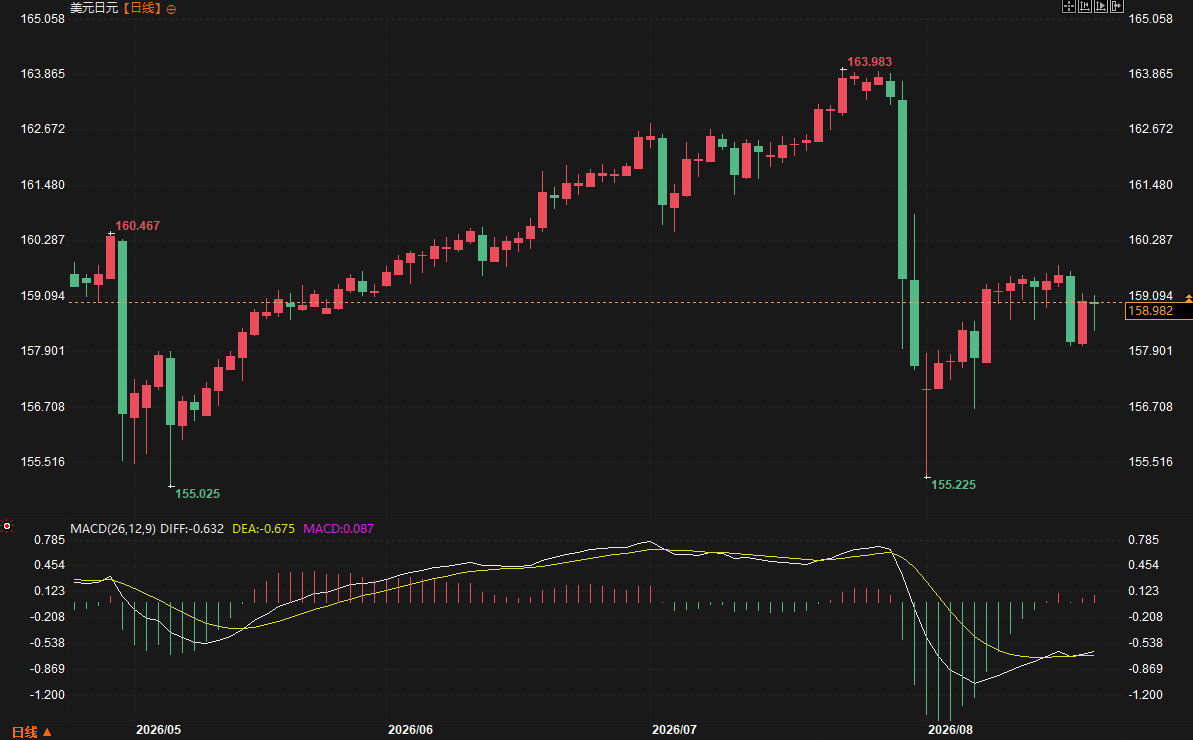
The USD/JPY pair edged lower this week, fluctuating around 159. Japan's core consumer inflation accelerated in July, providing justification for a Bank of Japan (BOJ) rate hike, which boosted short-term buying of the yen. However, the effects of the joint US-Japan intervention are waning, and investors generally believe that the yen may resume its weakness unless the BOJ explicitly tightens policy. A private bank strategist stated that the yen still has room for recovery, but the trend will not be one-way; if the market perceives a more symmetrical policy stance from the BOJ, i.e., measures to curb inflationary pressures, it will help support the yen. The BOJ's next policy meeting will be held in mid-September. Among commodity currencies, the Australian dollar rose approximately 1.3% against the US dollar on a weekly basis and approximately 2.1% on a monthly basis, making it the strongest performer among major non-US dollar currencies. The US dollar/Canadian dollar pair fell approximately 0.8% on a weekly basis and approximately 1.9% on a monthly basis; the US dollar/Swiss franc pair fell approximately 1.3% on a weekly basis and approximately 0.9% on a monthly basis. The overall strength of commodity prices, improved risk appetite, and a weaker US dollar jointly boosted commodity currencies such as the Australian dollar and the Canadian dollar. The Swiss franc, on the other hand, benefited more from the weaker US dollar and the rebalancing of safe-haven flows. From a technical perspective, the Australian dollar, British pound, and euro are all in an upward trend, while the US dollar/Canadian dollar and the US dollar/Swiss franc are in a downward trend, consistent with the weakening US dollar index. The core issue in the foreign exchange market this week was not the level of interest rates themselves, but the transmission path of US fiscal policy. The repurchase program, attempting to suppress long-term yields, has shaken market confidence in the coordination between US fiscal and policy measures, making the dollar a source of pressure. The Fed Chair's remarks at the Jackson Hole meeting will be a key short-term variable, but whether the dollar can stabilize may depend more on the market's reassessment of the fiscal outlook. Among non-US currencies, the euro, pound sterling, and Australian dollar all show strong technical patterns, but volatility may increase after approaching previous highs. The relative resilience of commodity currencies remains worth noting.Market Q&A
Question 1: What is the core reason for the weakening dollar? Why did the Treasury repurchase program become a negative factor for the dollar? The core reason for the weakening dollar is not the decline in yields, but the policy signal revealed by the repurchase program. The US Treasury Secretary attempted to lower yields by expanding the repurchase of longer-term Treasury bonds, but the market interpreted this as a passive response from the fiscal side to rising interest rates, rather than an improvement in credit. As a result, long-term yields rose instead of falling, with the 30-year yield hitting its highest level since 2007, indicating that market concerns about the sustainability of US fiscal policy have not eased. In this situation, the repurchase program did not solve the fundamental problem, but instead shifted some of the pressure originally focused on the bond market to the exchange rate. Some strategists bluntly stated that the effort to lower yields had little effect on Treasury yields, but weakened the dollar. The market is no longer focused on the interest rate path, but on the coordination of US fiscal and monetary policies, and whether overseas investors are willing to continue to fund the US deficit. Therefore, after the repurchase program was announced, the dollar actually fell below a key psychological level, and non-US currencies rose accordingly. Question 2: How much upside potential does the euro have? What are the resistance levels near the previous high? The euro is currently in a strong upward trend against the dollar, approaching its previous high of around 1.1796 on the daily chart. The key to its short-term movement lies in whether the dollar can stabilize and whether Eurozone data can continue to improve. The Eurozone's August manufacturing PMI rose to a 54-month high, providing fundamental support for the euro, but the ECB's policy path remains uncertain. If the dollar experiences a technical correction around the Jackson Hole meeting, the euro may face profit-taking pressure near its previous high; if the Fed chairman fails to effectively address the issue of credibility in combating inflation, the dollar's weakness will continue, and the euro may continue to test higher levels. From a cross-market perspective, the euro's rise is not only a passive reaction to the dollar's weakness but also includes pricing in the recovery of the Eurozone's manufacturing sector. Therefore, its sustainability depends on the relative strength of the US and European economies, rather than the weakness of the dollar alone. Question 3: Why is the yen still weak after the joint US-Japan intervention? What is the Bank of Japan's policy path? The joint US-Japan intervention briefly supported the yen, but the effect of the intervention diminished marginally because the market is focused on the Bank of Japan's interest rate path. Japan's core inflation accelerated in July, providing justification for the central bank to raise interest rates, but the Bank of Japan has not yet released a clear tightening signal. Investors generally believe that intervention alone cannot reverse the yen's weakness unless the Bank of Japan responds symmetrically in its policy. Some strategists suggest that if the market believes the Bank of Japan will take measures to curb inflationary pressures, it will help support the yen. The Bank of Japan's next meeting is in mid-September. If it releases a clearer signal of a policy shift at that time, the yen may receive more sustained buying; if it continues to hold steady, the yen may return to its weak trend. Therefore, the yen's short-term rebound is more of a sentiment correction catalyzed by inflation data than a trend reversal. Question 4: Can the strength of commodity currencies (Australian dollar, Canadian dollar) be sustained? The strength of the Australian dollar and Canadian dollar stems primarily from the mirror effect of the weakening US dollar, and secondarily from support from commodity prices. The Australian dollar's monthly gains have outpaced major non-US dollar currencies, and the Canadian dollar has also strengthened significantly. Commodity prices are generally in a strong range, and the vulnerability of crude oil supply has not yet been resolved, providing indirect support for the Canadian dollar; the Australian dollar benefits from improved risk appetite and expectations of Asian demand. However, the sustainability of commodity currencies depends on two variables: first, whether the US dollar can experience a phased recovery; and second, whether the commodity market faces a cooling demand. If the US dollar stabilizes around Jackson Hole, commodity currencies may experience a pullback; if commodity prices continue to rise and the US dollar remains weak, the Australian dollar and Canadian dollar may continue to show their elasticity. From a technical perspective, both are in an upward trend, but volatility may increase after approaching key resistance areas, and linear extrapolation is not advisable. Question 5: What does the Fed Chairman's statement at the Jackson Hole meeting mean for the US dollar? The Jackson Hole meeting is a key juncture for the short-term dollar trend. Some institutional reports indicate that the risk to the dollar is slightly skewed to the downside. If the Fed Chairman makes a hawkish clarification on the credibility of combating inflation in his speech, it may provide limited support for the dollar, but the market may perceive this as a passive response to fiscal pressure, resulting in a limited rebound; if he fails to effectively address the issue of combating inflation, or continues to obscure the policy path, the dollar may face more significant pressure. Currently, the market expects about 40% for a rate hike in September and about 72% for a rate hike in December, but the dollar has not strengthened as a result, indicating that the market focus has shifted from interest rate levels to policy credibility. Therefore, the impact of the meeting's outcome on the US dollar may be asymmetrical: a moderate hawkish stance is unlikely to reverse the dollar's weakness, while a dovish or ambiguous stance may exacerbate selling pressure on the dollar and push non-US currencies such as the euro and the Australian dollar to rise further.- Risk Warning and Disclaimer
- The market involves risk, and trading may not be suitable for all investors. This article is for reference only and does not constitute personal investment advice, nor does it take into account certain users’ specific investment objectives, financial situation, or other needs. Any investment decisions made based on this information are at your own risk.