Bessant's "toughest sanctions in history" are about to be revealed! Iran threatens to cut off all supplies; oil prices await the next move.
2026-08-24 08:23:01
Brent crude futures opened lower in Asian trading on Monday (August 24) and are currently trading around $93.40 per barrel. On Friday, it briefly rose to $94.81 per barrel, a new high since the end of July. US Treasury Secretary Bessenter will announce the toughest sanctions against Iran in history on Monday, marking the official start of Trump's "economic Normandy landings" announced last week. Bessenter stated that this is the largest coordinated economic isolation operation in history, aimed directly at the collapse of the Iranian regime. Washington will demand that allies sever economic ties with Tehran and will use all its resources to deal with countries that do not comply. Iran's Supreme National Security Council Secretary Rezaei responded that any country participating in US sanctions will be considered to have declared war on Iran, and threatened to halt all oil exports from the Strait of Hormuz and the entire Persian Gulf if the economic war continues. Furthermore, Tehran may target the US bond market in retaliation, suggesting it is seeking to "weaponize" financial volatility as a means of retaliation. 
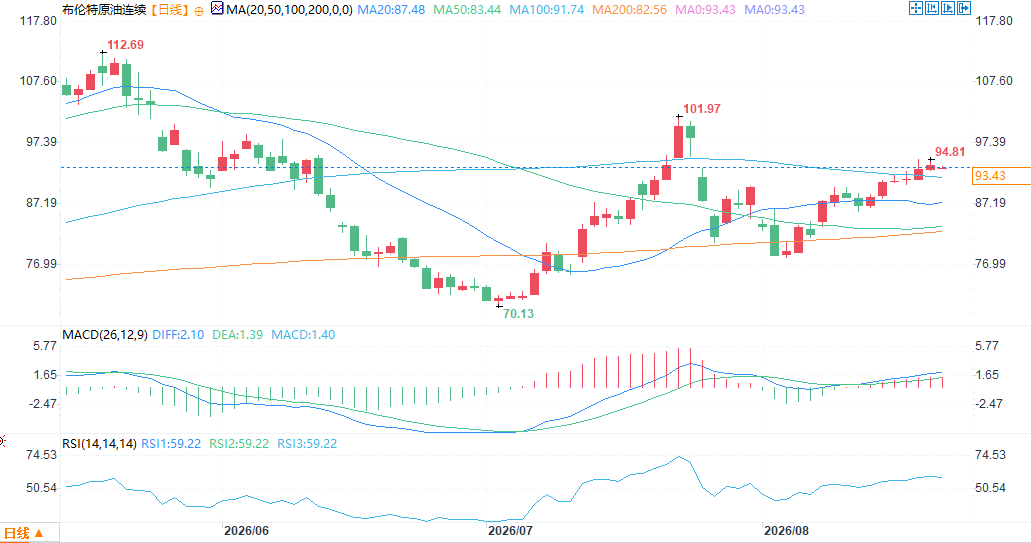 (Brent crude oil futures daily chart, source: FX678) At 8:16 AM Beijing time on August 24, Brent crude oil futures were trading at $93.42 per barrel.
Bessant: The harshest sanctions in history, aimed at "bringing down the Iranian regime"
U.S. Treasury Secretary Matt Bessen will unveil what the Trump administration calls the “toughest sanctions ever” against Iran at a press conference on Monday, marking the official start of Trump’s much-anticipated “economic Normandy.” Bessen writes that countries that believe compromise with Iran is a safer path should reconsider—he positions these sanctions as a “turning point” rather than a gradual escalation. In an interview, Bessen stated that these measures represent the largest coordinated economic isolation operation in history, a tactic previously used to blockade Venezuela and still in effect in Cuba, now applicable to Iran. He said the U.S. goal is to bring down the Iranian regime, and Washington will urge allies and the world to sever economic ties with Tehran, using “the full power of the nation” against any country that refuses to comply. Trump has reinforced this message on social media, calling the campaign “an unprecedented economic war and isolation,” and warning of severe economic consequences for any country that helps Iran circumvent sanctions.Iran's response: Threats of war and warnings of a complete disruption to oil exports
Tehran's response was swift and sharp. Rezaei, secretary of Iran's Supreme National Security Council, warned that Iran would consider any country's participation in US sanctions as an "act of war against Iran," and stated that if economic pressure continued, not a single drop of oil would be exported through the Strait of Hormuz or anywhere in the Persian Gulf. Furthermore, Iran warned that this would be a "panic shock" to US financial markets—suggesting that Tehran might target the US bond market as a retaliatory measure, intending to use financial volatility as a means of retaliation. The Iranian Islamic Revolutionary Guard Corps adopted a more dismissive and public stance. State media quoted a spokesperson as saying that the threat of sanctions was merely a "subtle admission of a humiliating defeat suffered by the enemy in the military field," and that Iran had ways to cope with the adverse effects of so-called "enemy economic warfare," and could establish economic relations with other countries regardless of US pressure.Market Impact: Dual Risks of Energy and Finance
The sanctions announced on Monday, combined with Iran's explicit threat to completely halt Gulf oil exports, position this event as a true "trigger point" rather than a routine policy update. Rezaei's high position on Iran's Security Council lends institutional weight to his warnings, and Washington's characterization of this action as a design forcing a binary choice globally means that the risk of rapid escalation on both the energy and financial fronts is higher than in the early stages of the standoff. On the energy front, the Strait of Hormuz, a crucial chokepoint for global oil transport, will directly impact crude oil supply expectations should exports be completely disrupted. Markets are recalibrating the magnitude of the global supply gap, and international oil prices face further upward pressure in the short term. Tanker freight rates will also rise sharply due to route avoidance and soaring insurance costs. On the financial front, if sanctions extend further to interbank clearing, insurance, and shipping financing channels, it could trigger a tightening of cross-border capital flows, push up the dollar liquidity premium, and exacerbate safe-haven selling of emerging market assets. With these dual risks combined, investors will be forced to reprice risk premiums between energy security and financial stability, and global risk assets may face simultaneous pressure in the short term.Summarize
U.S. Treasury Secretary Bessenter will announce the toughest sanctions in history against Iran on Monday, aimed at crippling the Iranian regime and demanding that global allies sever economic ties with Tehran. Iran's Supreme National Security Council Secretary Rezaei responded that any country participating in the sanctions would be considered to have declared war on Iran, and threatened to halt all oil exports from the Strait of Hormuz and the entire Persian Gulf. Furthermore, Tehran may target the U.S. bond market in retaliation. This combination positions Monday's announcement as a true "trigger point," with the possibility of a rapid escalation of both energy and financial risks higher than in the early stages of the standoff. Crude oil, freight rates, and related assets are expected to experience significant volatility ahead of the announcement. (Brent crude oil futures daily chart, source: FX678) At 8:16 AM Beijing time on August 24, Brent crude oil futures were trading at $93.42 per barrel.
- Risk Warning and Disclaimer
- The market involves risk, and trading may not be suitable for all investors. This article is for reference only and does not constitute personal investment advice, nor does it take into account certain users’ specific investment objectives, financial situation, or other needs. Any investment decisions made based on this information are at your own risk.