Gold Trading Alert: Gold surges over 5% in a single week, breaking through $4600; over 70% of analysts are bullish on the market outlook; focus this week on the Jackson Hole Economic Symposium.
2026-08-24 07:40:59
The past week witnessed a truly astonishing surge in the global gold market. Spot gold jumped over 5% in just five trading days, breaking through the key psychological levels of $4,400, $4,500, and $4,600, ultimately closing at $4,604.53 per ounce, having touched $4,632.10 intraday—its highest level since May 15th. US gold futures also rose 2.4%, closing at $4,680.60. This powerful rally marked the third consecutive week of gains for gold, and virtually no Wall Street analysts remained bearish. The forces driving gold prices above $4,600 were not singular, but rather a convergence of three factors: a key technical breakthrough, a systemic erosion of the US dollar's credibility, and renewed geopolitical risks. Behind all this lies a core issue—US Treasury Secretary Bessant's "self-rescue" measures are pushing global capital into the embrace of gold. On Monday (August 24) in early Asian trading, spot gold fluctuated at high levels and is currently trading around $4,617.50 per ounce. 
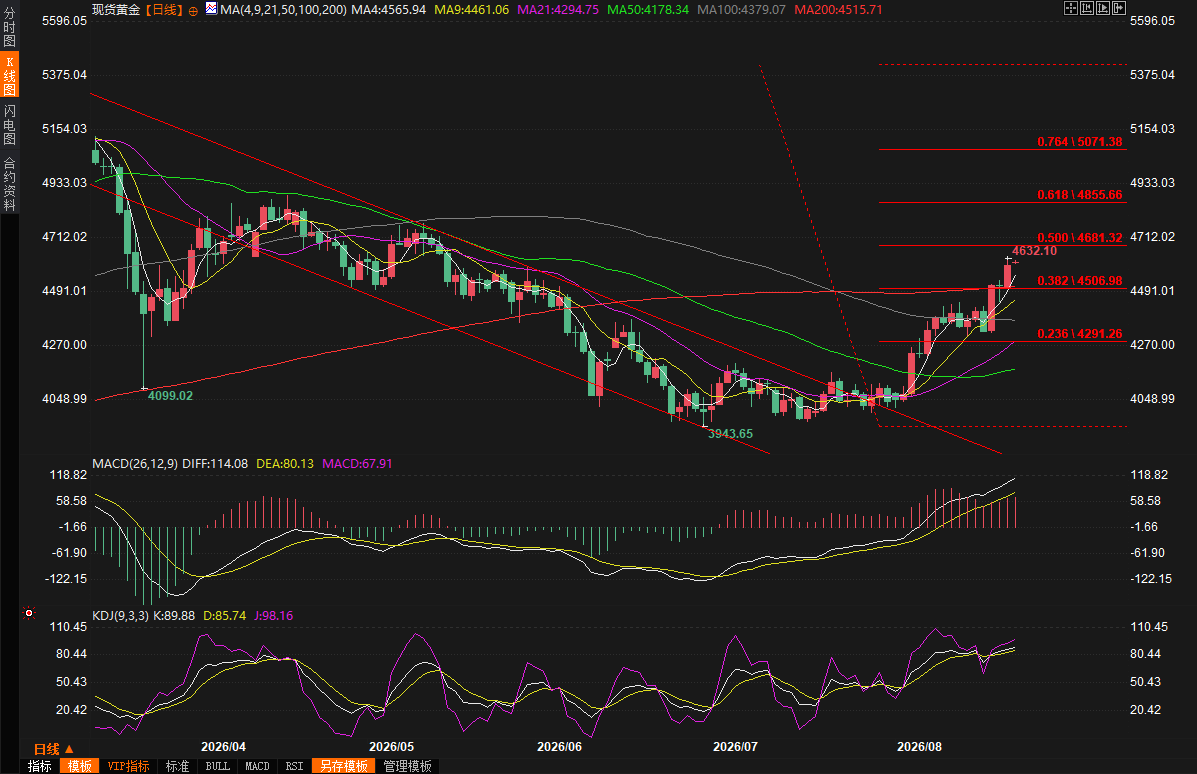 (Spot gold daily chart, source: EasyTrade) At 07:36 Beijing time, spot gold is currently trading at $4618.24 per ounce.
I. Technical Breakthrough: The price has risen above the 100-day moving average and touched the 200-day moving average, fully activating bullish signals.
The most direct catalyst for this round of gold price increases comes from technical factors. Last Wednesday, gold prices surged 4.35% in a single day, marking the largest single-day gain since early February. This rally propelled gold above the highly anticipated 100-day moving average around $4380 and even rose above the 200-day moving average—currently around $4515. For technical traders, the 200-day moving average is a key watershed for judging long-term trends. A valid breakout often signifies a shift in market sentiment from hesitation to confidence, triggering a concentrated influx of algorithmic trading and trend-following funds. Currently, gold has risen above all key moving averages—from short-term to long-term moving averages, all showing a bullish alignment. Bart Melek, Global Head of Commodities Strategy at TD Securities, stated bluntly, "Technical factors are a significant reason... If this momentum continues, the next target will be $4,700." Goldman Sachs also noted in a report that demand for gold call options has surged as market demand for global macroeconomic policy hedging tools has reignited, "creating a mechanical price amplification effect on both the upside and downside." However, the technical breakout is merely a superficial phenomenon. What truly supports the continued rise in gold prices is a deeper shift in macroeconomic logic.II. The Dollar's Tragedy: How Bessant's "Repurchase Dilemma" Is Damaging the Dollar's Credit
The biggest driver behind the recent surge in gold prices is a decision made by US Treasury Secretary Bessant. Last Wednesday, the US Treasury announced it would at least double the size of its repurchase program for 10- to 30-year Treasury bonds—from $2 billion per operation to at least $4 billion. This move aimed to suppress the soaring yields on long-term Treasury bonds—at the time, the 30-year Treasury yield had reached its highest level since 2007. However, the market's reaction was completely unexpected. After the repurchase program was announced, long-term Treasury yields briefly fell, but then quickly rebounded. More seriously, the dollar index fell sharply, dropping to its lowest level since mid-May, eventually closing near 98.84. The dollar also fell to a three-month low against the euro. What went wrong? Marc Chandler, chief market strategist at Bannockburn Global Forex, succinctly put it: "Bessant's efforts to lower US yields have had little effect on Treasury yields; instead, they have weakened the dollar. The market is fighting back." Citigroup quickly lowered its three-month dollar index forecast from 102.12 to 98.34. Strategists warn that the Treasury's buyback program adds new negative factors to the dollar through two paths: first, it lowers US Treasury yields; second, it triggers deep market concerns about "financial repression" policies. Ole Hansen, head of commodities strategy at Saxo Bank, commented more bluntly: "Attempting to suppress borrowing costs without addressing the underlying fiscal imbalances could exacerbate market concerns about financial repression and currency devaluation." He pointed out that even with long-term yields at historical highs, gold has still risen, "which shows that investors are moving away from traditional opportunity cost logic and focusing on the sustainability of government borrowing." Adding to market unease is Bessant's further indication on Thursday that the government may continue to expand the buyback program. Rich Checkan, president of Asset Strategies International, bluntly stated: "He plans to buy old debt with new debt at least twice the current rate. This is highly inflationary because he plans to expand the money supply faster than it is now. More dollars chasing limited gold means only one thing—higher prices." In fact, the US Treasury buyback program was launched just as the US government debt had historically surpassed $40 trillion. Kevin Grady, president of Phoenix Futures and Options, succinctly put it: "They're going to double down... When people say 'we're going to add to our positions again,' it only tells me there's a systemic problem. When you have to intervene like that, the market eventually has to face it."III. Geopolitics and Inflation: The Undercurrents of the Hormuz and the Blazing Oil Prices
If a weakening dollar is the "booster" for rising gold prices, then Middle East geopolitical risks are the "trigger" igniting the market. Tensions remain high in the Strait of Hormuz. An Iranian parliamentary committee has approved a proposed law allowing Iran to charge vessels granted passage through the strait fees covering maritime services, environmental services, fuel supply, insurance, and security. Commercial shipping on this vital global energy route has plummeted—before the war, over 130 cargo ships passed daily; now, only single digits do. US Treasury Secretary Bessenter announced a new round of "the toughest in history" economic sanctions against Iran. Iranian Foreign Minister Araghchi responded strongly, stating that the US move revealed "despair" and that the new round of sanctions was also "doomed to failure." Pakistan's Army Chief of Staff has traveled to Tehran to mediate, while Trump is observing the situation. This stalemate of "neither war nor peace" is pushing up global energy prices. Brent crude is nearing $94 a barrel. Rising energy prices not only exacerbate inflationary pressures but also directly strengthen gold's appeal as an inflation hedge. When oil and gold prices rise in tandem, a key signal is emerging—the market is simultaneously pricing in geopolitical risk premiums and expectations of currency devaluation.IV. A Complete Shift in Market Sentiment: There Are No Short Sellers on Wall Street
After gold broke through $4,600, market sentiment underwent a qualitative shift. The latest Kitco News gold survey shows that of the 11 Wall Street analysts surveyed, 8 (73%) expect gold prices to continue rising, while the remaining 3 believe the gains will consolidate – none predict a price decline. Main Street retail investors are equally enthusiastic, with 164 (78%) of the 211 voters expecting further price increases. This overwhelmingly bullish sentiment contrasts sharply with the hesitation during gold's consolidation period this summer. Kevin Grady frankly stated, "I wasn't bullish all summer… but now we're starting to see an increase in open interest, and new longs are entering the market." Adrian Day, president of Adrian Day Asset Management, offered the most representative commentary: "The short-term impact of Treasury Secretary Bessant's decision to increase long-term bond buybacks will fade, but the fundamental problems exposed by this 'Operation Twist' will not disappear. Bessant's decision to try to save the bond market at the expense of the dollar is good for gold."V. The Challenges Ahead: Jackson Hole Annual Meeting, PCE, and Nvidia's Financial Report
Gold stands above $4,600, but the road ahead is not smooth. This week, the market will face a double test. Federal Reserve Chairman Warsh will speak at the Jackson Hole Economic Symposium —his first appearance since taking office in May. TD Securities warned in a report: "The risks to the dollar are slightly skewed to the downside. Any hawkish clarification regarding the credibility of inflation protection may only provide limited support for the dollar. Conversely, failure to address the issue of inflation protection credibility could put more significant pressure on the dollar." Federal funds rate futures show that the market expects a 40% rate hike in September, rising to 73% by December. Warsh's speech could be a key variable determining the short-term direction of gold prices. Wednesday (August 26) is the day with the most concentrated economic data this week, with the US core PCE price index, the second estimate of Q2 GDP, and durable goods orders all released at 8:30 AM ET. Meanwhile, Nvidia will release its Q2 earnings report on August 26. As a bellwether for the AI boom, its performance will directly affect market confidence in technology stocks and risk assets. If AI trading falters, capital may flow further into safe-haven assets such as gold.Conclusion: The long-term logic for gold is being rewritten.
Looking back at the recent sharp rebound in gold prices from below $4,100 to above $4,600, we see not just a technical breakthrough, but a profound shift in macroeconomic logic. The erosion of the dollar's credibility, questions about the sustainability of US fiscal policy, escalating geopolitical risks, and the continued gold-buying trend by global central banks—all these factors point to one conclusion: gold is evolving from a traditional "anti-inflation tool" to a "strategic asset against dollar credit risk." Saxo Bank points out that gold's ability to continue rising while nominal yields are increasing "indicates that fiscal and debt concerns are becoming a significant driver of demand for physical assets." UBS is even more optimistic, predicting that gold prices could rise to $5,400 in the next 12 months. Of course, short-term overbought signals have emerged, and a technical correction is possible after the rapid rise. Analysts caution that even if gold prices fall back to $4,400, holding this support level would still be a positive signal for bulls. But regardless of short-term fluctuations, the long-term narrative for gold has fundamentally changed—as the world's largest economy begins to address its debt crisis through "balance sheet expansion and bond buying," gold's brilliance will only grow stronger. (Spot gold daily chart, source: EasyTrade) At 07:36 Beijing time, spot gold is currently trading at $4618.24 per ounce.
- Risk Warning and Disclaimer
- The market involves risk, and trading may not be suitable for all investors. This article is for reference only and does not constitute personal investment advice, nor does it take into account certain users’ specific investment objectives, financial situation, or other needs. Any investment decisions made based on this information are at your own risk.