Crude oil trading alert: Oil prices retreated slightly following the US plan to escalate economic sanctions against Iran, but remain range-bound.
2026-08-24 09:42:59
WTI crude oil fell back to around $85.30 in Asian trading on Monday, experiencing some profit-taking after two consecutive days of gains. The market hasn't completely turned bearish; rather, investors are proactively reducing some short-term long positions ahead of the announcement of new US sanctions against Iran. Oil prices have rebounded significantly from previous lows recently, and profit-taking at higher levels is a major reason for the price pullback, barring any new substantial escalation in geopolitical risks.  U.S. Treasury Secretary Scott Bessant stated that the U.S. government plans to introduce the “toughest” sanctions against Iran, describing the policy as an unprecedented act of economic isolation. The U.S. hopes to weaken Iran’s crude oil export capacity by further restricting its economic activities and the participation of its trading partners. For the global energy market, if the sanctions truly impact the scale of Iranian crude oil exports, the market supply side may tighten again, especially given that shipping through the Strait of Hormuz has not yet returned to normal; the potential impact is even more noteworthy. Iran, on the other hand, continues to send strong signals, believing that the new economic restrictions are unlikely to achieve the desired effect and emphasizing its years of experience in dealing with external restrictions. More importantly, Iran has stated that if economic pressure escalates further, oil exports from the Strait of Hormuz and even the Persian Gulf region could be affected. This statement has prompted the market to reassess energy transportation risks, as the Strait of Hormuz is a crucial global energy transport route, and any sustained disruption to shipping could rapidly increase crude oil risk premiums. The announcement of specific U.S. measures is imminent, and the market is awaiting policy details. Compared to the mere wording of sanctions, investors are more concerned about three issues: First, whether the sanctions will directly affect Iranian crude oil exports; second, whether major buyers' import channels will be further restricted; and third, whether ship traffic in the Strait of Hormuz can return to normal levels. If the US measures mainly remain at the level of financial and trade restrictions, the geopolitical risk premium previously priced into oil prices may continue to decline; however, if the sanctions further impact Iran's actual exports, or lead to a significant increase in marine insurance, shipping costs, and transit time, oil prices may regain upward momentum. From the supply side, the market is currently most sensitive not to changes in the daily production of a single oil-producing country, but to whether the transportation sector can remain stable. The continued low traffic volume in the Strait of Hormuz indicates that there are still potential supply bottlenecks in the global oil market. Even if the impact on Iran's own exports is limited, as long as major shipping routes remain blocked, the market may reflect potential supply losses by increasing the risk premium. Therefore, although the geopolitical risk premium has declined from its previous peak, it has not completely disappeared. At the same time, inventory factors are beginning to re-enter investors' view. Commerzbank's commodities strategy team points out that the situation in the Strait of Hormuz remains a key focus for the energy market, and in the absence of other major market reports, inventory changes may become a significant driver of short-term oil prices. Tight diesel inventories are particularly noteworthy. Insufficient refined product inventories mean that refineries and end-user markets are more sensitive to supply disruptions. If crude oil transportation is disrupted again, the diesel market may be the first to amplify energy price volatility, which in turn could increase the risk premium for crude oil. From a demand perspective, current oil price increases still face certain limitations. The global economic growth outlook lacks a strong catalyst sufficient to support a sustained rapid rise in oil prices, and high oil prices themselves may suppress some energy demand by increasing transportation and industrial costs. Therefore, even with geopolitical risks on the supply side, oil prices are more likely to exhibit a short-term pattern of "risk events driving rapid increases, while fundamental factors limit sustained upside." Currently, the WTI market structure is still closer to a slightly bullish state after a period of range-bound trading, rather than a confirmed entry into a one-sided bull market. The previous rebound was mainly driven by geopolitical risks and supply concerns, but as the market gradually digests related news, oil prices need new fundamental catalysts to break through to the upside. The upcoming US measures against Iran are one of the most important short-term variables. If the final sanctions are less severe than market expectations, investors may continue to realize previously accumulated profits; conversely, if the measures significantly impact Iranian exports or shipping through the Strait of Hormuz, WTI may quickly retest previous highs. From a daily technical perspective, WTI is currently maintaining a range-bound trading pattern. Prices have corrected after a continuous rise, but the overall trend remains intact. The area around $83 is a crucial support level within the current range. As long as prices can stabilize above this area, the bulls retain the potential to retest higher levels. The first resistance level to watch is around $88. A successful break above this level and confirmation on the daily chart would indicate a potential upward breakout from the range, potentially opening up further upside potential. Conversely, if oil prices fall below $83 and continue trading below this level, the short-term structure will weaken significantly, with the next target potentially around $79. From a 4-hour perspective, WTI is still in a correction phase, but the short-term trend has not yet shown clear reversal signals. Prices are currently trading above the 9-period and 50-period exponential moving averages, indicating that the previously accumulated buying pressure has not completely disappeared. The 9-period EMA is around $83.91, the 50-period EMA is around $81.62, and the 14-period RSI is around 56, still in the neutral-to-strong zone, indicating that market momentum has cooled somewhat, but has not yet entered a clearly oversold state. If the price retraces to the $83-$84 area and regains buying support, and rises back above $85, it may retest $88; if $83 is breached, the short-term correction may extend to around $81.60, and a further break below that level should raise concerns about a potential pullback to the lower edge of the $79 trading range.
 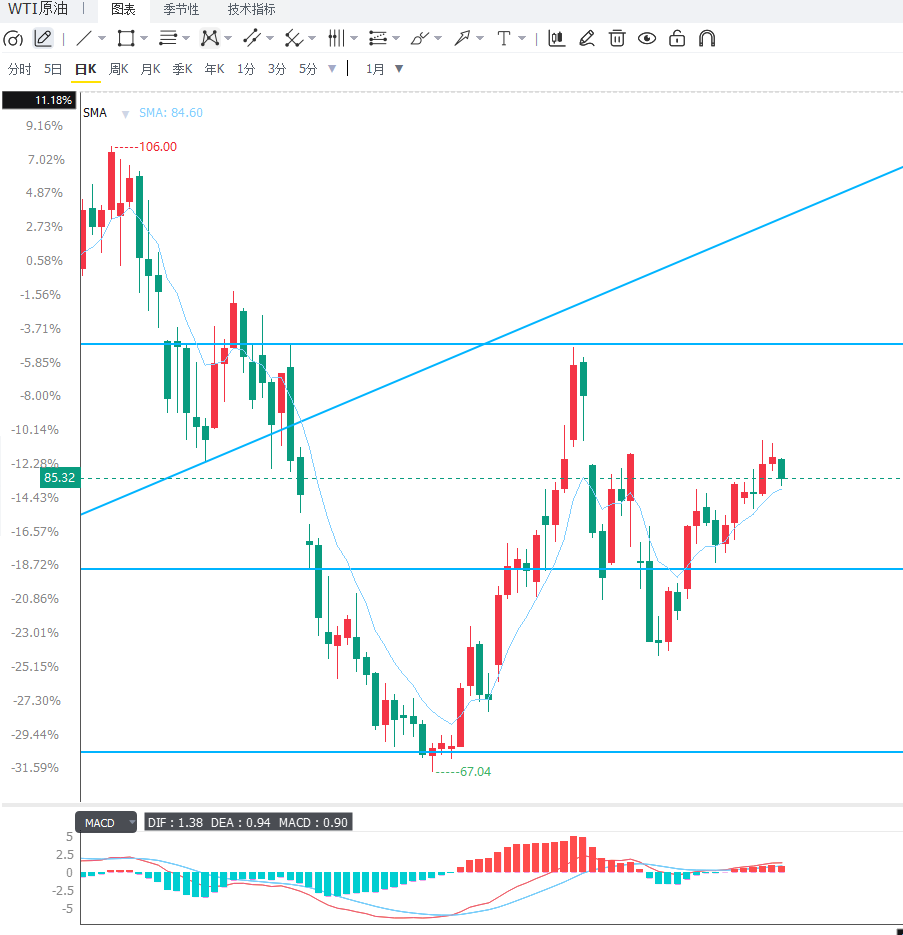 Editor's Summary : Overall, the current pullback in WTI is more likely a profit-taking after a continuous rise and a cautious wait-and-see approach before policy implementation, rather than indicating the end of the bullish trend. The upcoming new round of US measures against Iran will determine the direction of short-term geopolitical risk premiums, while shipping conditions in the Strait of Hormuz and diesel inventories are key variables affecting the medium-term oil price trend. Technically, $83 is the core level of the current battle between bulls and bears. Holding this area, WTI still has a chance to break through to $88; if it falls below $83, the range-bound trading pattern may seek support again around $79. The biggest opportunity for future oil prices comes from further tightening of the supply side, but the biggest risk also comes from a rapid deterioration of geopolitical risks and the concentrated release of risk premiums previously priced in by the market.
U.S. Treasury Secretary Scott Bessant stated that the U.S. government plans to introduce the “toughest” sanctions against Iran, describing the policy as an unprecedented act of economic isolation. The U.S. hopes to weaken Iran’s crude oil export capacity by further restricting its economic activities and the participation of its trading partners. For the global energy market, if the sanctions truly impact the scale of Iranian crude oil exports, the market supply side may tighten again, especially given that shipping through the Strait of Hormuz has not yet returned to normal; the potential impact is even more noteworthy. Iran, on the other hand, continues to send strong signals, believing that the new economic restrictions are unlikely to achieve the desired effect and emphasizing its years of experience in dealing with external restrictions. More importantly, Iran has stated that if economic pressure escalates further, oil exports from the Strait of Hormuz and even the Persian Gulf region could be affected. This statement has prompted the market to reassess energy transportation risks, as the Strait of Hormuz is a crucial global energy transport route, and any sustained disruption to shipping could rapidly increase crude oil risk premiums. The announcement of specific U.S. measures is imminent, and the market is awaiting policy details. Compared to the mere wording of sanctions, investors are more concerned about three issues: First, whether the sanctions will directly affect Iranian crude oil exports; second, whether major buyers' import channels will be further restricted; and third, whether ship traffic in the Strait of Hormuz can return to normal levels. If the US measures mainly remain at the level of financial and trade restrictions, the geopolitical risk premium previously priced into oil prices may continue to decline; however, if the sanctions further impact Iran's actual exports, or lead to a significant increase in marine insurance, shipping costs, and transit time, oil prices may regain upward momentum. From the supply side, the market is currently most sensitive not to changes in the daily production of a single oil-producing country, but to whether the transportation sector can remain stable. The continued low traffic volume in the Strait of Hormuz indicates that there are still potential supply bottlenecks in the global oil market. Even if the impact on Iran's own exports is limited, as long as major shipping routes remain blocked, the market may reflect potential supply losses by increasing the risk premium. Therefore, although the geopolitical risk premium has declined from its previous peak, it has not completely disappeared. At the same time, inventory factors are beginning to re-enter investors' view. Commerzbank's commodities strategy team points out that the situation in the Strait of Hormuz remains a key focus for the energy market, and in the absence of other major market reports, inventory changes may become a significant driver of short-term oil prices. Tight diesel inventories are particularly noteworthy. Insufficient refined product inventories mean that refineries and end-user markets are more sensitive to supply disruptions. If crude oil transportation is disrupted again, the diesel market may be the first to amplify energy price volatility, which in turn could increase the risk premium for crude oil. From a demand perspective, current oil price increases still face certain limitations. The global economic growth outlook lacks a strong catalyst sufficient to support a sustained rapid rise in oil prices, and high oil prices themselves may suppress some energy demand by increasing transportation and industrial costs. Therefore, even with geopolitical risks on the supply side, oil prices are more likely to exhibit a short-term pattern of "risk events driving rapid increases, while fundamental factors limit sustained upside." Currently, the WTI market structure is still closer to a slightly bullish state after a period of range-bound trading, rather than a confirmed entry into a one-sided bull market. The previous rebound was mainly driven by geopolitical risks and supply concerns, but as the market gradually digests related news, oil prices need new fundamental catalysts to break through to the upside. The upcoming US measures against Iran are one of the most important short-term variables. If the final sanctions are less severe than market expectations, investors may continue to realize previously accumulated profits; conversely, if the measures significantly impact Iranian exports or shipping through the Strait of Hormuz, WTI may quickly retest previous highs. From a daily technical perspective, WTI is currently maintaining a range-bound trading pattern. Prices have corrected after a continuous rise, but the overall trend remains intact. The area around $83 is a crucial support level within the current range. As long as prices can stabilize above this area, the bulls retain the potential to retest higher levels. The first resistance level to watch is around $88. A successful break above this level and confirmation on the daily chart would indicate a potential upward breakout from the range, potentially opening up further upside potential. Conversely, if oil prices fall below $83 and continue trading below this level, the short-term structure will weaken significantly, with the next target potentially around $79. From a 4-hour perspective, WTI is still in a correction phase, but the short-term trend has not yet shown clear reversal signals. Prices are currently trading above the 9-period and 50-period exponential moving averages, indicating that the previously accumulated buying pressure has not completely disappeared. The 9-period EMA is around $83.91, the 50-period EMA is around $81.62, and the 14-period RSI is around 56, still in the neutral-to-strong zone, indicating that market momentum has cooled somewhat, but has not yet entered a clearly oversold state. If the price retraces to the $83-$84 area and regains buying support, and rises back above $85, it may retest $88; if $83 is breached, the short-term correction may extend to around $81.60, and a further break below that level should raise concerns about a potential pullback to the lower edge of the $79 trading range. Editor's Summary : Overall, the current pullback in WTI is more likely a profit-taking after a continuous rise and a cautious wait-and-see approach before policy implementation, rather than indicating the end of the bullish trend. The upcoming new round of US measures against Iran will determine the direction of short-term geopolitical risk premiums, while shipping conditions in the Strait of Hormuz and diesel inventories are key variables affecting the medium-term oil price trend. Technically, $83 is the core level of the current battle between bulls and bears. Holding this area, WTI still has a chance to break through to $88; if it falls below $83, the range-bound trading pattern may seek support again around $79. The biggest opportunity for future oil prices comes from further tightening of the supply side, but the biggest risk also comes from a rapid deterioration of geopolitical risks and the concentrated release of risk premiums previously priced in by the market.
- Risk Warning and Disclaimer
- The market involves risk, and trading may not be suitable for all investors. This article is for reference only and does not constitute personal investment advice, nor does it take into account certain users’ specific investment objectives, financial situation, or other needs. Any investment decisions made based on this information are at your own risk.