The real energy crisis has only just begun: scarce production capacity has led to a surge in diesel prices, and inflation is already quietly emerging.
2026-08-24 10:48:59
With the Middle East conflict showing no signs of abating, Washington has just issued a stern warning against Tehran regarding the "toughest sanctions in history," while global fuel stocks are nearing depletion. Even more pressing is the significant reduction in global refining capacity. Even if a sudden ceasefire occurs in the Middle East tomorrow and the US and Iran reach a truce, this fuel shortage and its impact on the global economy will continue for months.
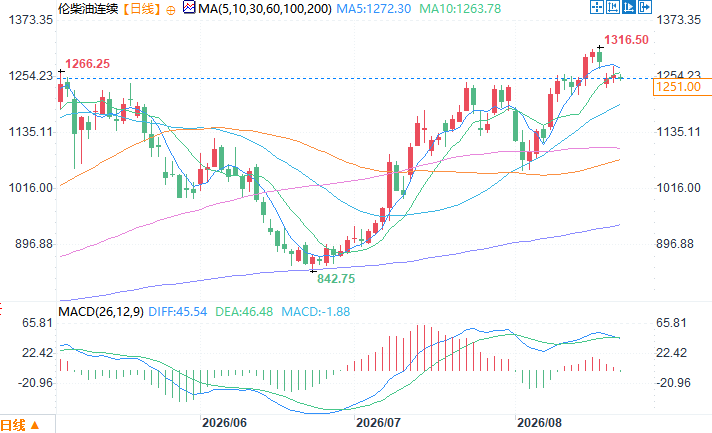 LME diesel futures daily chart source: EasyTrade. At 10:46 AM Beijing time on August 24th, LME diesel futures were trading at $1251/ton.
The illusion of "calm" in crude oil prices
Looking at crude oil prices alone, you might think everything is under control. Brent crude and West Texas Intermediate (WTI) crude are both hovering below $100 a barrel. Although they have risen by about $20 since pre-war levels, this increase pales in comparison to the surge in end-fuel prices. Take European diesel, for example. According to a report last week by journalist Ron Bousso, its price has skyrocketed by 70% since pre-war levels. Other foreign media reports indicate that European diesel prices have now surpassed jet fuel prices, marking the first time in over a year that the price spread has shifted in favor of diesel, data from the London Stock Exchange Group (LSEG). The US market is even more dramatic: earlier last week, the US diesel crack spread broke into triple digits for the first time in history, surging to $102 a barrel on Monday before slightly retreating to around $100 on Tuesday.Oil refineries have become the scarcest resource.
As the energy crisis continues to escalate, global refining profits are hitting record highs. The first layer of the crisis is obvious: tightening crude oil supplies from the Middle East, a topic almost daily in the media over the past six months. However, what has been overlooked is the damage to local refining facilities in the Middle East caused by conflict. According to the International Energy Agency (IEA), up to one-fifth of the region's refining capacity, equivalent to approximately 9.6 million barrels per day, has been brought to a standstill due to hostilities. Beyond the Middle East, the ongoing drone attacks by Ukrainian forces on Russian refineries during the Russia-Ukraine conflict have led to fuel shortages in Russia, prompting an export ban to ensure domestic demand. Consequently, the world's second-largest diesel exporter has closed its doors, further straining the market for this economic "mainstay fuel." And outside the Middle East and Russia, there is simply not enough global refining capacity to fill the gap.The US became "the only gas station that was open."
Demand remains strong, and the US, far removed from the direct impact of the two hot wars, is ramping up fuel exports, with weekly exports reaching a record high of 1.9 million barrels per day. However, this figure is not only supported by higher-than-usual refinery operating rates but is also consuming large amounts of inventory, potentially creating new risks. Bank of America analysts warned in a report earlier last week: "These export flows are draining already tight US inventories, and the US is currently the only major fuel hub still functioning normally. This will trigger a global fuel scramble, pushing diesel crack spreads back to seasonal record highs." The Wall Street Journal cited this view. The diesel situation is particularly dire; Goldman Sachs analysts also warned this month that global diesel inventories were already strained before the outbreak of the Middle East conflict.Inflation risks are only just beginning to emerge.
This means that inflation risks have risen sharply and are likely to remain high for years to come. According to IEA data cited by foreign media, global refining operations in the second quarter of this year decreased by 5.1 million barrels per day compared to the same period last year, while fuel demand fell by about 4 million barrels per day, leaving a deficit of more than 1 million barrels per day. Don't forget, this "demand destruction" was not voluntary, but rather forced by soaring prices. In other words, relying on a collapse in demand to combat inflation has very limited effectiveness. Bussau points out that the real energy crunch has only just begun. Some say the crisis started in March, but it is a slowly spreading "chronic disease," not a sudden "acute attack," so it took longer to surface. Eugene Lindell, head of refined products at consulting firm FGE NexantECA, said earlier this month: "Europe is facing an extremely serious diesel problem, and things are going to get very bad; you're likely to see extremely high absolute prices."Winter is coming, and the world is footing the bill.
Europe isn't the only one suffering. The entire world is using diesel in large quantities, and as the Northern Hemisphere cools, demand will surge further for both transportation and heating. Inflation is already on the rise: the US Consumer Price Index jumped 3.4%, and prices in the Eurozone rose 2.9%, both driven by rising energy costs. These few figures tell a compelling story of urgent energy security. The "moderate" crude oil prices are merely a facade; the real storm is brewing in the refining and diesel markets. With nearly a fifth of the world's Middle Eastern refining capacity shut down, Russian exports closed, and US inventories depleted, diesel is becoming the new "liquid gold." Winter hasn't even arrived in the Northern Hemisphere, but a price winter has already begun, and this time, no one can escape unscathed. LME diesel futures daily chart source: EasyTrade. At 10:46 AM Beijing time on August 24th, LME diesel futures were trading at $1251/ton.
- Risk Warning and Disclaimer
- The market involves risk, and trading may not be suitable for all investors. This article is for reference only and does not constitute personal investment advice, nor does it take into account certain users’ specific investment objectives, financial situation, or other needs. Any investment decisions made based on this information are at your own risk.