The US Treasury's expansion of Treasury bond buybacks has weakened the dollar, causing gold to rise sharply and potentially accelerate its upward trend.
2026-08-24 09:55:02
Spot gold continued its strong performance in Asian trading on Monday, with XAU/USD rising to around $4,625, a new high since mid-May. The pace of gold's rise has accelerated significantly over the past few trading days, with a weakening dollar being a key factor driving the precious metal's breakthrough. At the same time, the US Treasury's more aggressive liquidity support measures in the long-term Treasury market have led the market to reassess US long-term interest rates, fiscal policy, and the relative attractiveness of dollar assets, further strengthening demand for gold.  U.S. Treasury Secretary Scott Bessant previously stated that the U.S. government would expand its long-term Treasury bond repurchase program, increasing the size of each operation from at least $2 billion to $4 billion, with the possibility of further increases. The program, primarily covering 10- to 30-year Treasury bonds, will begin implementation in September. Following the policy announcement, long-term Treasury yields fell significantly, the dollar weakened, and gold quickly received a boost. The World Gold Council pointed out that after the U.S. Treasury announced the expansion of long-term Treasury bond repurchases, yields and the dollar fell in tandem, while gold rose by about 3% in a single day, indicating that this policy signal had a direct impact on the precious metals market. From a market perspective, Treasury bond repurchases do not directly change the overall size of U.S. debt, but they can influence the yield curve by improving the liquidity of long-term bonds and reducing some of the supply pressure on long-term bonds. The U.S. Treasury previously announced that it would increase the scale of related operations to at least $4 billion, one of its goals being to alleviate liquidity pressure in the long-term bond market. If long-term yields subsequently decline, the dollar's interest rate advantage will be suppressed, and the opportunity cost of gold as a non-interest-bearing asset will also decrease accordingly. More importantly, the market's understanding of this policy is no longer limited to short-term liquidity management. US long-term Treasury yields had previously risen to multi-year highs, with the 30-year yield reaching approximately 5.31%, before quickly falling back after the Treasury announced its repurchase program. However, this decline was not sustained, and long-term yields subsequently rebounded, indicating that investor concerns about the US fiscal situation, debt supply, and inflation prospects persist. This forms a key logic behind the recent rise in gold prices. If the US Treasury continues to take measures to lower long-term financing costs, while the market simultaneously worries about the US fiscal deficit and debt size, the long-term valuation logic of dollar assets may change, further strengthening gold's safe-haven and store-of-value attributes. Recently, concerns about the long-term purchasing power of the dollar have even resurfaced in the market, allowing gold to benefit not only from short-term interest rate changes but also from asset allocation support. However, the rise in gold prices is not without risk. Continued tensions in the Middle East and the impact of supply risks on oil prices may transmit back to global inflation. If energy prices continue to rise, the Federal Reserve may need to maintain a more cautious policy balance between inflation and economic growth. For gold, while inflation itself typically increases safe-haven demand, if inflation again pushes up real interest rates, gold's non-interest-bearing asset attributes will be suppressed. Therefore, the current gold market faces a complex policy mix: on the one hand, the fiscal authorities hope to stabilize the long-term bond market and alleviate yield pressures, which directly benefits gold; on the other hand, rising energy prices may push up inflation expectations, limiting the speed of monetary policy shifts. The interaction of these two forces makes gold more likely to exhibit high-level fluctuations and upward movement, rather than a simple one-sided rise. The US dollar's performance remains one of the most important external variables for gold in the short term. Recently, the US dollar index has fallen to a low level, providing significant exchange rate support for gold. Since international gold is priced in US dollars, a weaker dollar means lower costs for non-dollar investors to buy gold, thereby expanding international demand for gold. Currently, the US dollar has not shown a clear trend rebound signal; therefore, as long as the dollar continues to weaken, gold still has the potential to further test upper resistance levels. From a fund flow perspective, the recent rise in gold also exhibits clear trend trading characteristics. After the price breaks through the previous consolidation area, trend-following funds may further increase long positions, thus forming a positive feedback loop of "price increase—trend funds follow—price further increase." TD Securities' commodity strategy team previously believed that the US Treasury's supportive signals to the long-term bond market could provide support for gold and other precious metals. If the Federal Reserve adopts a relatively tolerant attitude towards rising energy prices, gold's high trading range may continue. From a daily technical perspective, XAU/USD maintains a clear bullish trend, with the price consistently trading above the 100-day simple moving average and the Bollinger Band's middle line, indicating that the medium-term upward structure remains intact. Gold is currently advancing towards the upper Bollinger Band, which is around $4680. Therefore, the $4680-$4700 area is a key resistance zone that bulls must face in the next phase. If it can effectively break through $4700 and establish stable trading above that level, gold is expected to open up further upside potential. On the downside, the first support level to watch is around $4600, followed by the 100-day moving average around $4380, and further down is the Bollinger Band's middle line around $4300. From a 4-hour chart perspective, gold remains in a short-term upward channel, with both highs and lows rising steadily. Short-term moving averages maintain a bullish alignment, indicating that buying pressure still dominates the market. However, the 14-period RSI on the daily chart has risen to approximately 70.8, entering a significantly overbought zone, suggesting that while short-term momentum is strong, it has already shown overbought characteristics. If gold can hold above the $4600-$4620 range and break through $4650, the bulls may further test the $4680-$4700 range. If it breaks below $4600 after a surge, short-term profit-taking pressure may increase, and the price may first retrace to around $4550 or even $4500. The current technical structure remains bullish, but the closer it gets to $4700, the higher the market's expectations for the validity of the breakout will be.
 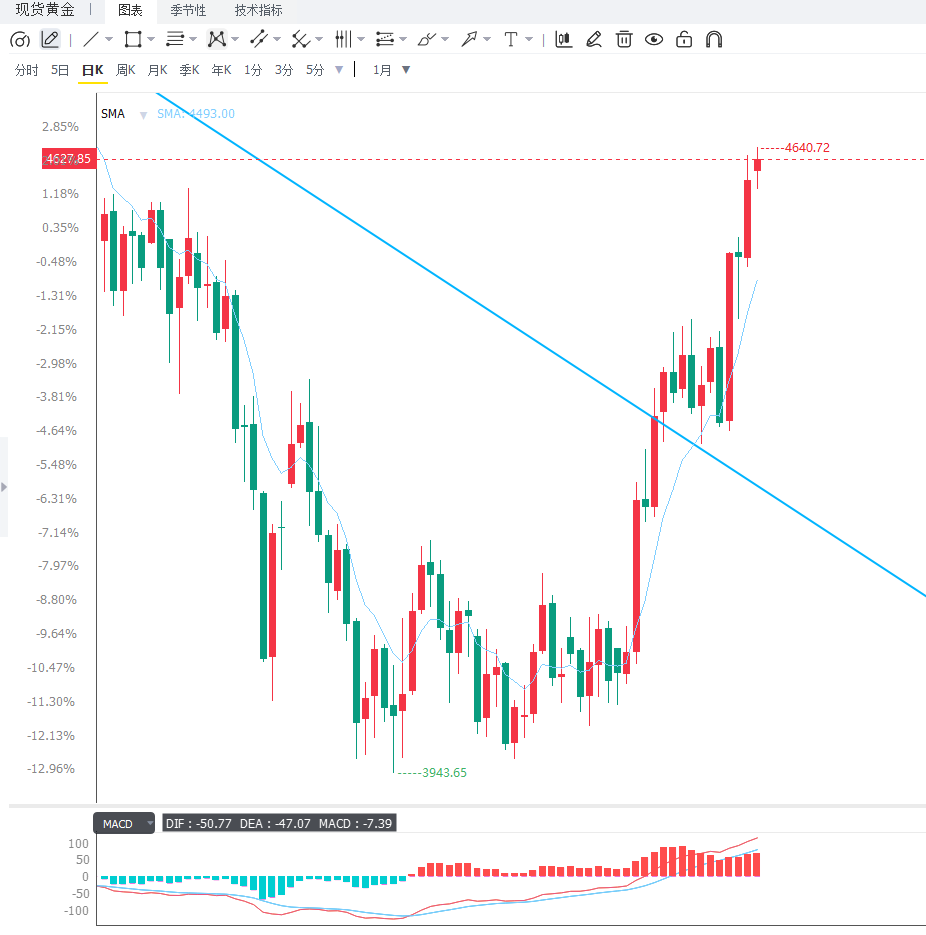 Editor's Summary : Overall, the core driving factors for gold's breakthrough of $4,600 and its new three-month high are the US Treasury's expansion of long-term Treasury repurchase programs, a weakening dollar, and a temporary decline in long-term interest rates. Meanwhile, while fiscal policy intervention in the bond market can improve short-term liquidity, it has failed to completely eliminate long-term US debt and inflationary pressures, which has instead strengthened some funds' long-term demand for gold. In the short term, $4,675-$4,700 is a key area for further bullish breakthroughs. If it successfully holds above this level, gold may open up new upside potential; however, the RSI has entered overbought territory, and any dollar rebound or a renewed rise in US Treasury yields could trigger a technical correction. Going forward, the gold market will continue to focus on US long-term interest rates, the dollar's performance, energy prices, and Federal Reserve policy signals. The overall outlook remains bullish, but volatility may increase significantly.
U.S. Treasury Secretary Scott Bessant previously stated that the U.S. government would expand its long-term Treasury bond repurchase program, increasing the size of each operation from at least $2 billion to $4 billion, with the possibility of further increases. The program, primarily covering 10- to 30-year Treasury bonds, will begin implementation in September. Following the policy announcement, long-term Treasury yields fell significantly, the dollar weakened, and gold quickly received a boost. The World Gold Council pointed out that after the U.S. Treasury announced the expansion of long-term Treasury bond repurchases, yields and the dollar fell in tandem, while gold rose by about 3% in a single day, indicating that this policy signal had a direct impact on the precious metals market. From a market perspective, Treasury bond repurchases do not directly change the overall size of U.S. debt, but they can influence the yield curve by improving the liquidity of long-term bonds and reducing some of the supply pressure on long-term bonds. The U.S. Treasury previously announced that it would increase the scale of related operations to at least $4 billion, one of its goals being to alleviate liquidity pressure in the long-term bond market. If long-term yields subsequently decline, the dollar's interest rate advantage will be suppressed, and the opportunity cost of gold as a non-interest-bearing asset will also decrease accordingly. More importantly, the market's understanding of this policy is no longer limited to short-term liquidity management. US long-term Treasury yields had previously risen to multi-year highs, with the 30-year yield reaching approximately 5.31%, before quickly falling back after the Treasury announced its repurchase program. However, this decline was not sustained, and long-term yields subsequently rebounded, indicating that investor concerns about the US fiscal situation, debt supply, and inflation prospects persist. This forms a key logic behind the recent rise in gold prices. If the US Treasury continues to take measures to lower long-term financing costs, while the market simultaneously worries about the US fiscal deficit and debt size, the long-term valuation logic of dollar assets may change, further strengthening gold's safe-haven and store-of-value attributes. Recently, concerns about the long-term purchasing power of the dollar have even resurfaced in the market, allowing gold to benefit not only from short-term interest rate changes but also from asset allocation support. However, the rise in gold prices is not without risk. Continued tensions in the Middle East and the impact of supply risks on oil prices may transmit back to global inflation. If energy prices continue to rise, the Federal Reserve may need to maintain a more cautious policy balance between inflation and economic growth. For gold, while inflation itself typically increases safe-haven demand, if inflation again pushes up real interest rates, gold's non-interest-bearing asset attributes will be suppressed. Therefore, the current gold market faces a complex policy mix: on the one hand, the fiscal authorities hope to stabilize the long-term bond market and alleviate yield pressures, which directly benefits gold; on the other hand, rising energy prices may push up inflation expectations, limiting the speed of monetary policy shifts. The interaction of these two forces makes gold more likely to exhibit high-level fluctuations and upward movement, rather than a simple one-sided rise. The US dollar's performance remains one of the most important external variables for gold in the short term. Recently, the US dollar index has fallen to a low level, providing significant exchange rate support for gold. Since international gold is priced in US dollars, a weaker dollar means lower costs for non-dollar investors to buy gold, thereby expanding international demand for gold. Currently, the US dollar has not shown a clear trend rebound signal; therefore, as long as the dollar continues to weaken, gold still has the potential to further test upper resistance levels. From a fund flow perspective, the recent rise in gold also exhibits clear trend trading characteristics. After the price breaks through the previous consolidation area, trend-following funds may further increase long positions, thus forming a positive feedback loop of "price increase—trend funds follow—price further increase." TD Securities' commodity strategy team previously believed that the US Treasury's supportive signals to the long-term bond market could provide support for gold and other precious metals. If the Federal Reserve adopts a relatively tolerant attitude towards rising energy prices, gold's high trading range may continue. From a daily technical perspective, XAU/USD maintains a clear bullish trend, with the price consistently trading above the 100-day simple moving average and the Bollinger Band's middle line, indicating that the medium-term upward structure remains intact. Gold is currently advancing towards the upper Bollinger Band, which is around $4680. Therefore, the $4680-$4700 area is a key resistance zone that bulls must face in the next phase. If it can effectively break through $4700 and establish stable trading above that level, gold is expected to open up further upside potential. On the downside, the first support level to watch is around $4600, followed by the 100-day moving average around $4380, and further down is the Bollinger Band's middle line around $4300. From a 4-hour chart perspective, gold remains in a short-term upward channel, with both highs and lows rising steadily. Short-term moving averages maintain a bullish alignment, indicating that buying pressure still dominates the market. However, the 14-period RSI on the daily chart has risen to approximately 70.8, entering a significantly overbought zone, suggesting that while short-term momentum is strong, it has already shown overbought characteristics. If gold can hold above the $4600-$4620 range and break through $4650, the bulls may further test the $4680-$4700 range. If it breaks below $4600 after a surge, short-term profit-taking pressure may increase, and the price may first retrace to around $4550 or even $4500. The current technical structure remains bullish, but the closer it gets to $4700, the higher the market's expectations for the validity of the breakout will be. Editor's Summary : Overall, the core driving factors for gold's breakthrough of $4,600 and its new three-month high are the US Treasury's expansion of long-term Treasury repurchase programs, a weakening dollar, and a temporary decline in long-term interest rates. Meanwhile, while fiscal policy intervention in the bond market can improve short-term liquidity, it has failed to completely eliminate long-term US debt and inflationary pressures, which has instead strengthened some funds' long-term demand for gold. In the short term, $4,675-$4,700 is a key area for further bullish breakthroughs. If it successfully holds above this level, gold may open up new upside potential; however, the RSI has entered overbought territory, and any dollar rebound or a renewed rise in US Treasury yields could trigger a technical correction. Going forward, the gold market will continue to focus on US long-term interest rates, the dollar's performance, energy prices, and Federal Reserve policy signals. The overall outlook remains bullish, but volatility may increase significantly.
- Risk Warning and Disclaimer
- The market involves risk, and trading may not be suitable for all investors. This article is for reference only and does not constitute personal investment advice, nor does it take into account certain users’ specific investment objectives, financial situation, or other needs. Any investment decisions made based on this information are at your own risk.