Japan's Finance Minister has announced a major move! He plans to introduce tax incentives to attract retail investors to buy government bonds. Will this give the yen a chance to rebound?
2026-08-25 12:13:00
Japanese Finance Minister Satsuki Katayama said on Tuesday (August 25) that the government will carefully study tax incentives for retail investors to purchase Japanese government bonds in order to broaden the domestic investor base. She emphasized balancing fiscal sustainability and economic growth in the fiscal year 2027 budget and clearly communicating this stance to the market. Encouraging retail investor participation in Japanese government bonds could provide an additional source of demand for government bonds given the continued upward pressure on long-term and ultra-long-term yields, but any tax reforms must first be discussed within the ruling party. Katayama also reiterated Japan's unchanged position of hoping for the early reopening of the Strait of Hormuz and stated that it will respond appropriately based on the progress of the US-Iran peace negotiations. 
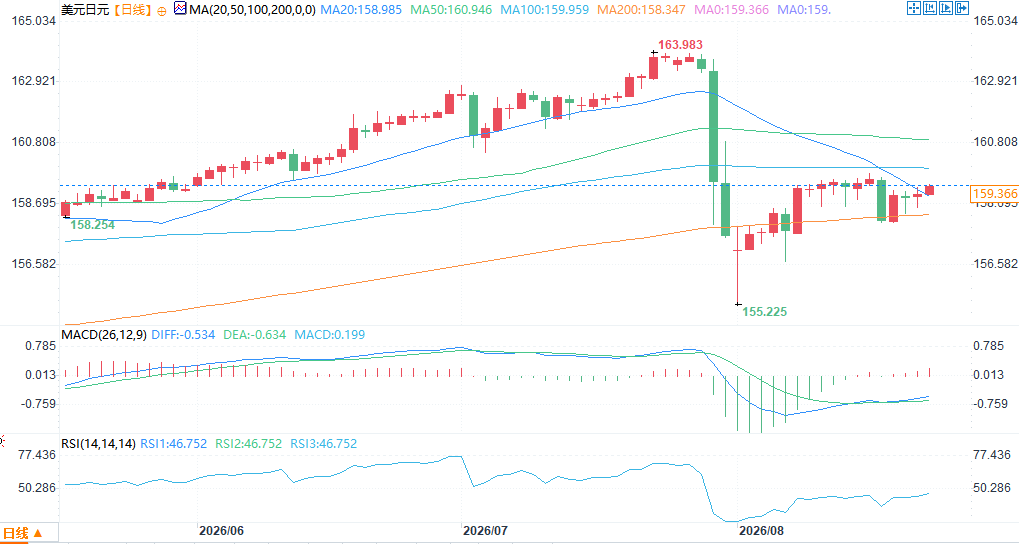 (USD/JPY daily chart, source: FX678) At 12:11 Beijing time on August 25, the USD/JPY exchange rate was 159.35/36.
Tax incentives: Expanding the retail investor base
Japanese Finance Minister Satsuki Katayama said on Tuesday that the government will carefully study potential tax incentives for retail investors to purchase Japanese government bonds as part of a broader effort to expand the domestic investor base for these bonds. Speaking at a regular press briefing, she said that increasing the attractiveness of retail government bonds is important, but many issues remain to be resolved, and the Ministry of Finance intends to hold careful discussions with relevant parties, particularly the ruling Liberal Democratic Party. Katayama stated that the Ministry of Finance has received various comments on the retail Japanese government bond plan and expects further requests for tax reforms to follow. She declined to comment directly on the budget request for fiscal year 2027, only stating that the government will focus on key policies within that budget aimed at promoting economic growth. She added that Japan plans to balance fiscal sustainability with economic growth and will clearly communicate this balance to the market during the budget formulation process.Background: Upward pressure on long-term yields and fiscal sustainability
Katayama Satsuki's remarks come as Japan continues to grapple with upward pressure on long- and ultra-long-term government bond yields—a development partly linked to market speculation about the government's expansionary fiscal stance and reports on next year's budget outlook. Encouraging more retail investors to participate in Japanese government bonds could, in the long run, provide an additional source of demand beyond the traditional base of domestic institutions and the Bank of Japan. However, any tax reform must first be discussed within the ruling party.Diplomatic Stance: Strait of Hormuz and US-Iran Negotiations
On foreign policy, Satsuki Katayama reiterated Japan's unchanged position of hoping for the early reopening of the Strait of Hormuz, and stated that Tokyo would respond appropriately based on the progress of the US-Iran peace negotiations, taking into account the impact on the international community. These remarks did not add anything new to Japan's existing diplomatic posture, but highlighted the government's continued close monitoring of the situation, as the strait is crucial to global energy shipping routes on which Japan relies heavily.USD/JPY: Tax incentives fail to resolve fundamental contradictions; interest rate differentials remain the dominant force.
Satsuki Katayama's statement regarding tax incentives for retail investors to purchase Japanese government bonds has a limited direct impact on the USD/JPY exchange rate. Encouraging retail investor participation in the Japanese government bond market could, in the long run, provide additional demand for Japanese government bonds, helping to alleviate upward pressure on long-term yields and thus marginally narrowing the USD/JPY interest rate differential—theoretically contributing to a stronger yen. However, this policy signal faces three constraints. First, tax reform requires internal discussion within the ruling party, and the implementation timeline is unclear, making it impossible to change the structural pattern of the USD/JPY interest rate differential in the short term. Second, even if retail demand increases, its size is limited in the over 1 trillion yen Japanese government bond market, making it difficult to substantially reverse the upward trend in yields. Third, the core driver of the current USD/JPY exchange rate remains the divergence in monetary policy between the US and Japan—the Federal Reserve's policy rate remains high at 3.5%-3.75%, while even with the Bank of Japan raising rates to 1.25% in September, the interest rate differential will still exceed 200 basis points, with carry trades continuing to suppress the yen. Katayama Satsuki's reiterated stance on the Strait of Hormuz failed to provide new risk premium support for the yen—a consistent diplomatic statement from the Japanese government that offered no new trading clues to the market. In the short term, USD/JPY is expected to continue fluctuating within the 158-160 range, awaiting directional guidance from Fed Chairman Warsh's speech at Friday's Jackson Hole conference. Domestic tax policy discussions in Japan have had limited impact on the yen, and a stronger catalyst is needed for a directional breakout. (USD/JPY daily chart, source: FX678) At 12:11 Beijing time on August 25, the USD/JPY exchange rate was 159.35/36.
- Risk Warning and Disclaimer
- The market involves risk, and trading may not be suitable for all investors. This article is for reference only and does not constitute personal investment advice, nor does it take into account certain users’ specific investment objectives, financial situation, or other needs. Any investment decisions made based on this information are at your own risk.