Gold prices continued their upward trend after US debt surpassed $40 trillion and the dollar weakened.
2026-08-25 11:22:59
International gold prices continued their strong performance in Asian trading on Tuesday, with spot gold briefly touching around $4,680, its highest level since mid-May. It subsequently encountered resistance at the $4,700 mark, while US gold futures approached $4,725, indicating that bullish funds are still actively pushing up precious metal prices. The core driver of this round of gold price increases is changing. Previously, the market focused more on the Federal Reserve's interest rate path and the dollar's trajectory, but recent changes in the US fiscal situation and the long-term Treasury market are beginning to take on greater importance. Data from the US Treasury shows that the total US public debt has surpassed $40 trillion, reaching approximately $40.05 trillion on August 18. This historic milestone has intensified market discussions about fiscal deficits, debt financing costs, and the long-term purchasing power of the dollar. While the debt exceeding $40 trillion does not inherently imply an immediate systemic risk for dollar assets, it alters the market's assessment of the US's long-term fiscal path. As government debt continues to expand while long-term interest rates remain high, the Treasury Department will need to bear increasingly higher interest payments. This has led the market to reconsider whether long-term US bonds can maintain their previous safe-haven asset premium if future fiscal needs require continued debt issuance. This concern is fueling a renewed interest in so-called "devaluation trades." These trades don't necessarily imply an immediate and sharp depreciation of the dollar, but rather that some investors are allocating to physical assets like gold to hedge against the risks of declining currency purchasing power, fiscal expansion, and renewed inflation. Gold carries no issuer credit risk and is not dependent on the fiscal solvency of a single government; therefore, its asset allocation value is often reassessed during periods of increased fiscal uncertainty.  The U.S. Treasury's recent expansion of its long-term Treasury repurchase operations initially eased pressure on the bond market. The Treasury announced a planned increase in long-term Treasury repurchase operations starting in September, which the market initially interpreted as a measure to improve liquidity in long-term bonds and reduce term premiums. Long-term yields subsequently declined briefly, but this easing quickly faded, with 10-year and 30-year Treasury yields returning to or even exceeding pre-announcement levels. This change has a dual impact on gold. On the one hand, higher long-term yields typically increase the opportunity cost of holding gold, a non-interest-bearing asset, theoretically putting downward pressure on gold prices. On the other hand, if the rise in yields primarily stems from fiscal risks and bond supply pressures, and the dollar does not strengthen accordingly, then gold may actually benefit from investors' reassessment of the long-term value of dollar assets. A key reason for gold's current outperformance compared to traditional interest rate logic is that the dollar has not strengthened in tandem with the rebound in U.S. Treasury yields. While U.S. long-term yields have recently risen again, the dollar remains affected by the market's reduced expectations of short-term interest rate hikes. Relatively mild U.S. inflation data in July lowered market expectations for an immediate tightening of policy at the September Fed meeting, thus easing the dollar's downward pressure on gold. However, the rise in gold prices is not without policy risks. The market still believes there is a possibility of further interest rate hikes in the US before the end of the year, especially as rising energy prices could reignite inflation expectations. If crude oil prices continue to strengthen and are transmitted to other goods and services prices through energy, transportation, and production costs, the Federal Reserve's future policy space may be limited again. This is why the US Personal Consumption Expenditures Price Index (PCE) is receiving high attention this week. The PCE will help the market determine whether recent inflationary pressures are easing further or becoming sticky again due to rising energy prices. If the core PCE is lower than expected, the dollar and real yields on US Treasury bonds may come under pressure, and gold will gain further upward momentum; if the data is significantly higher than expected, the market may raise its pricing of a tightening policy by the Federal Reserve, and gold may face profit-taking in the short term. Meanwhile, geopolitical risks continue to provide additional safe-haven demand for gold. The US recently expanded sanctions against Iran's economic network and warned institutions doing business with Iran that they may face sanctions risks. At the same time, regional energy supply risks persist. For the precious metals market, the combination of rising energy prices and geopolitical risks is particularly significant, as it can both fuel inflation expectations and increase uncertainty in global economic growth. Gold is currently benefiting from three main factors simultaneously: a relatively weak US dollar, escalating US fiscal risks, and rising geopolitical and inflationary uncertainties. These three factors work together to maintain strong upward momentum in gold prices despite high US Treasury yields. From a global asset allocation perspective, gold's recent strength also reflects investors' search for risk hedging tools beyond traditional financial assets. When long-term US Treasury yields continue to rise while bond prices are under pressure, the traditional "bond + stock" portfolio faces rebalancing pressure. If fiscal deficits, inflation, and geopolitical risks coexist, the demand for gold as a low-correlation asset may further increase. However, gold has already risen continuously, and short-term technical indicators are beginning to show signs of being overbought. The daily Relative Strength Index (RSI) is approaching 71, entering relatively high territory, indicating that while bullish momentum remains strong, the risk of chasing the rally is increasing. Meanwhile, the MACD remains above the zero line and positive, indicating that the medium-term upward momentum has not been significantly damaged. After gold prices broke through the important technical resistance near $4500, the bullish structure has been further confirmed. From the daily chart, gold currently maintains a clear bullish trend. The area around $4680 is the first major resistance level, while $4700 is a key psychological level. If gold prices can effectively hold above $4700 and further break through the $4680-$4700 area to form a new daily closing confirmation, the upside potential may gradually open up, with the next target around $4850, and further down to the $5100 area. On the downside, the area around $4500 needs to be closely watched, as this area previously formed important support by the 200-day moving average and the 38.2% Fibonacci retracement level. If a significant pullback occurs, the 23.6% Fibonacci retracement level around $4295 provides deeper support. From the 4-hour chart, gold is still in a high-level consolidation with a slightly bullish structure, but there is a clear divergence between bulls and bears around $4700. If the price retraces and holds above the $4600-$4580 range, then a break above $4680 could see a second push towards $4700. A successful break above $4700 could further unleash upward momentum; conversely, repeated failures to break through and a drop below $4580 could lead to a deeper technical correction. The MACD needs close monitoring to see if the high-level momentum continues to expand, and if the RSI enters extreme overbought territory, it indicates a significant increase in short-term price volatility. Therefore, the 4-hour chart is more suitable for focusing on breakout confirmation rather than simply chasing intraday highs.
 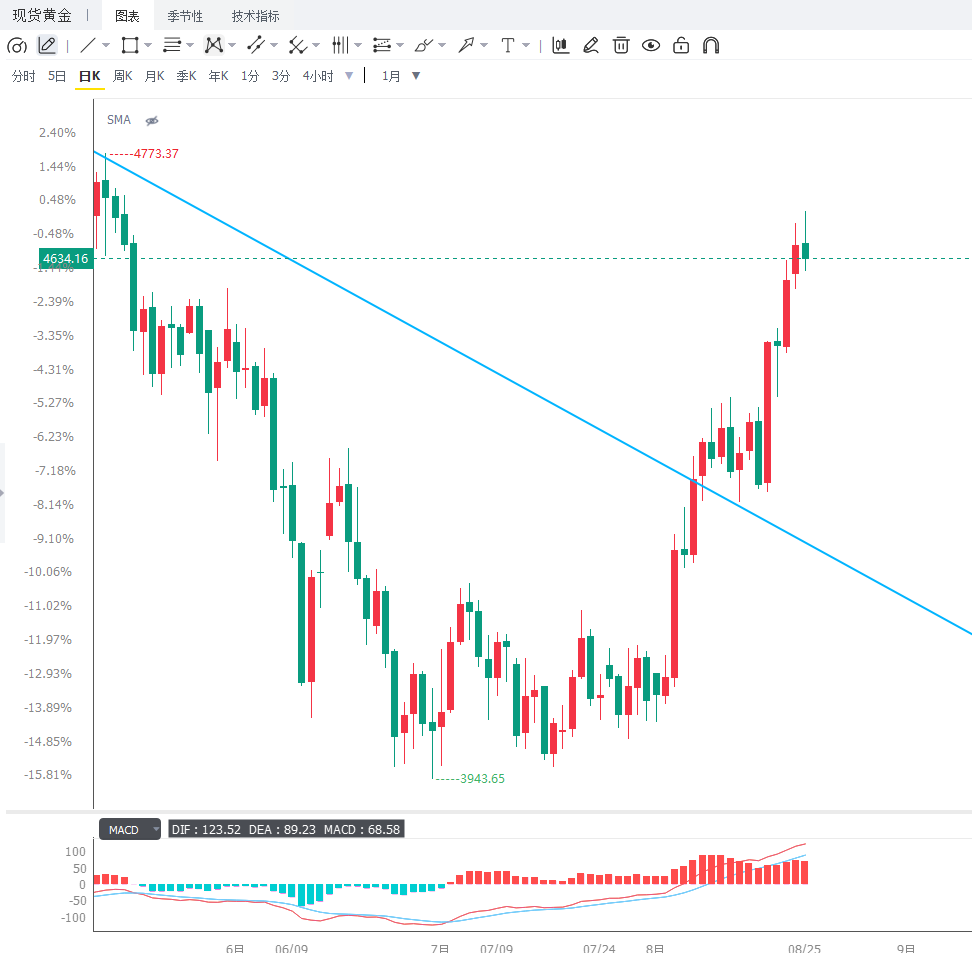 Editor's Summary: The current rise in gold prices has expanded from a simple "Fed rate cut trade" to an asset revaluation driven by a combination of factors including the dollar, fiscal policy, bonds, and geopolitical risks. The US debt exceeding $40 trillion, the renewed rise in long-term US Treasury yields, and concerns about the dollar's purchasing power stemming from fiscal policy are all strengthening market demand for gold as a store of value. In the short term, $4700 is a key psychological level for further upward movement in gold, while $4500 is an important support level for determining the integrity of the medium-term bullish structure. If PCE is lower than expected, the dollar continues to weaken, and geopolitical risks and fiscal concerns persist, gold could potentially advance towards $4850 or even higher. Conversely, if PCE exceeds expectations and US real yields rise significantly, gold prices may undergo a technical correction first. It's important to note that gold is currently at a relatively high level, and a high RSI indicates increasing short-term volatility. Therefore, the key to future price movements is not whether gold can continue to rise, but whether the rise can effectively break through $4700, and whether $4500 can continue to provide support during pullbacks. With the US fiscal risks yet to be fundamentally alleviated, the medium- to long-term investment logic for gold remains intact. However, in the short term, caution is advised against chasing high prices and rapid reversals caused by macroeconomic data.
The U.S. Treasury's recent expansion of its long-term Treasury repurchase operations initially eased pressure on the bond market. The Treasury announced a planned increase in long-term Treasury repurchase operations starting in September, which the market initially interpreted as a measure to improve liquidity in long-term bonds and reduce term premiums. Long-term yields subsequently declined briefly, but this easing quickly faded, with 10-year and 30-year Treasury yields returning to or even exceeding pre-announcement levels. This change has a dual impact on gold. On the one hand, higher long-term yields typically increase the opportunity cost of holding gold, a non-interest-bearing asset, theoretically putting downward pressure on gold prices. On the other hand, if the rise in yields primarily stems from fiscal risks and bond supply pressures, and the dollar does not strengthen accordingly, then gold may actually benefit from investors' reassessment of the long-term value of dollar assets. A key reason for gold's current outperformance compared to traditional interest rate logic is that the dollar has not strengthened in tandem with the rebound in U.S. Treasury yields. While U.S. long-term yields have recently risen again, the dollar remains affected by the market's reduced expectations of short-term interest rate hikes. Relatively mild U.S. inflation data in July lowered market expectations for an immediate tightening of policy at the September Fed meeting, thus easing the dollar's downward pressure on gold. However, the rise in gold prices is not without policy risks. The market still believes there is a possibility of further interest rate hikes in the US before the end of the year, especially as rising energy prices could reignite inflation expectations. If crude oil prices continue to strengthen and are transmitted to other goods and services prices through energy, transportation, and production costs, the Federal Reserve's future policy space may be limited again. This is why the US Personal Consumption Expenditures Price Index (PCE) is receiving high attention this week. The PCE will help the market determine whether recent inflationary pressures are easing further or becoming sticky again due to rising energy prices. If the core PCE is lower than expected, the dollar and real yields on US Treasury bonds may come under pressure, and gold will gain further upward momentum; if the data is significantly higher than expected, the market may raise its pricing of a tightening policy by the Federal Reserve, and gold may face profit-taking in the short term. Meanwhile, geopolitical risks continue to provide additional safe-haven demand for gold. The US recently expanded sanctions against Iran's economic network and warned institutions doing business with Iran that they may face sanctions risks. At the same time, regional energy supply risks persist. For the precious metals market, the combination of rising energy prices and geopolitical risks is particularly significant, as it can both fuel inflation expectations and increase uncertainty in global economic growth. Gold is currently benefiting from three main factors simultaneously: a relatively weak US dollar, escalating US fiscal risks, and rising geopolitical and inflationary uncertainties. These three factors work together to maintain strong upward momentum in gold prices despite high US Treasury yields. From a global asset allocation perspective, gold's recent strength also reflects investors' search for risk hedging tools beyond traditional financial assets. When long-term US Treasury yields continue to rise while bond prices are under pressure, the traditional "bond + stock" portfolio faces rebalancing pressure. If fiscal deficits, inflation, and geopolitical risks coexist, the demand for gold as a low-correlation asset may further increase. However, gold has already risen continuously, and short-term technical indicators are beginning to show signs of being overbought. The daily Relative Strength Index (RSI) is approaching 71, entering relatively high territory, indicating that while bullish momentum remains strong, the risk of chasing the rally is increasing. Meanwhile, the MACD remains above the zero line and positive, indicating that the medium-term upward momentum has not been significantly damaged. After gold prices broke through the important technical resistance near $4500, the bullish structure has been further confirmed. From the daily chart, gold currently maintains a clear bullish trend. The area around $4680 is the first major resistance level, while $4700 is a key psychological level. If gold prices can effectively hold above $4700 and further break through the $4680-$4700 area to form a new daily closing confirmation, the upside potential may gradually open up, with the next target around $4850, and further down to the $5100 area. On the downside, the area around $4500 needs to be closely watched, as this area previously formed important support by the 200-day moving average and the 38.2% Fibonacci retracement level. If a significant pullback occurs, the 23.6% Fibonacci retracement level around $4295 provides deeper support. From the 4-hour chart, gold is still in a high-level consolidation with a slightly bullish structure, but there is a clear divergence between bulls and bears around $4700. If the price retraces and holds above the $4600-$4580 range, then a break above $4680 could see a second push towards $4700. A successful break above $4700 could further unleash upward momentum; conversely, repeated failures to break through and a drop below $4580 could lead to a deeper technical correction. The MACD needs close monitoring to see if the high-level momentum continues to expand, and if the RSI enters extreme overbought territory, it indicates a significant increase in short-term price volatility. Therefore, the 4-hour chart is more suitable for focusing on breakout confirmation rather than simply chasing intraday highs. Editor's Summary: The current rise in gold prices has expanded from a simple "Fed rate cut trade" to an asset revaluation driven by a combination of factors including the dollar, fiscal policy, bonds, and geopolitical risks. The US debt exceeding $40 trillion, the renewed rise in long-term US Treasury yields, and concerns about the dollar's purchasing power stemming from fiscal policy are all strengthening market demand for gold as a store of value. In the short term, $4700 is a key psychological level for further upward movement in gold, while $4500 is an important support level for determining the integrity of the medium-term bullish structure. If PCE is lower than expected, the dollar continues to weaken, and geopolitical risks and fiscal concerns persist, gold could potentially advance towards $4850 or even higher. Conversely, if PCE exceeds expectations and US real yields rise significantly, gold prices may undergo a technical correction first. It's important to note that gold is currently at a relatively high level, and a high RSI indicates increasing short-term volatility. Therefore, the key to future price movements is not whether gold can continue to rise, but whether the rise can effectively break through $4700, and whether $4500 can continue to provide support during pullbacks. With the US fiscal risks yet to be fundamentally alleviated, the medium- to long-term investment logic for gold remains intact. However, in the short term, caution is advised against chasing high prices and rapid reversals caused by macroeconomic data.
- Risk Warning and Disclaimer
- The market involves risk, and trading may not be suitable for all investors. This article is for reference only and does not constitute personal investment advice, nor does it take into account certain users’ specific investment objectives, financial situation, or other needs. Any investment decisions made based on this information are at your own risk.