Why is the pound still holding near a six-month high despite a sudden cooling in UK retail sales?
2026-08-26 19:01:00
On Wednesday, August 26th, UK macroeconomic data presented a crucial combination for foreign exchange pricing: the economy remained expanding and inflation rebounded, but consumption and employment did not strengthen in tandem. The pound was currently trading around 1.36 against the dollar, having previously touched a six-month high. Meanwhile, the UK's August retail survey showed a significant weakening, forcing the market to reassess the interest rate expectations behind the recent pound performance and the extent of the gap between these expectations and the fundamentals of real consumption. The latest Distribution Trade Survey by the Confederation of British Industry showed that the retail sales balance in August fell sharply to -48% from -26% in July, one of the most significant contractions in over a year. Businesses expect sales to continue to decline in September, but the expected balance has improved to -22%. At the same time, retailers believe sales are significantly below normal seasonal levels, with the corresponding balance worsening from -18% in July to -26%. This data should not be simply interpreted as a complete slowdown in UK consumption. Official statistics show that retail sales fell 0.5% month-on-month in July, but retail sales in the three months to July still increased by 1.1% compared to the previous three months, indicating a clear divergence between the monthly decline and the medium-term trend. In other words, the survey data reflects a rapid deterioration in orders, customer traffic, confidence, and operational pressure on the business side, while official sales data still retains the cumulative growth brought about by previous consumption activities.  More importantly, while retailers reported weak demand, they also indicated that sales prices were rising at a faster pace and anticipated further price pressures in the coming months. This suggests a typical profit margin squeeze environment is forming on the consumer side: end-user demand is under pressure, but wages, energy, financing, and other operating costs have not declined in tandem. For macro pricing, this is more complex than a simple decline in sales, because weak demand typically lowers interest rate expectations, while price stickiness limits the scope for monetary policy shifts. The current macroeconomic environment does not support judging a significant overall economic downturn based solely on retail surveys. The UK's real GDP grew by 0.4% quarter-on-quarter in the second quarter, compared to 0.6% in the first quarter; the services sector grew by 0.5% and construction by 0.3% in the second quarter, while the production sector remained largely flat. June's single-month economic output also grew by 0.3%. The problem is that aggregate growth does not entirely align with the economic environment felt by residents. The Consumer Price Index (CPI) rose to 2.9% year-on-year in July, up from 2.6% in June; the index including housing costs rose to 3.1%. The year-on-year increase in commodity prices rose from 1.7% to 2.2%, indicating a resurgence of previously relatively mild commodity inflation. The labor market, however, is sending the opposite signal. The unemployment rate was 4.9% from April to June, up 0.2 percentage points year-on-year; job vacancies fell to 707,000 from May to July, a low level since 2014. The preliminary July payroll figure showed a decrease of 94,000 jobs year-on-year. General wages rose 3.5% year-on-year during the same period, while private sector wages grew by only 2.8%. Therefore, the UK market is not currently facing the traditional scenario of strong growth and high inflation, but rather an expanding economy, gradually cooling employment, pressure on consumer businesses, and persistent price stickiness. For the market, this combination is most likely to cause a temporary misalignment between the yield curve and the spot exchange rate. The Bank of England is currently maintaining its policy rate at 3.75%, having decided against it by a 6-3 vote at its July meeting, with 3 members supporting a 0.25 percentage point increase. The Bank of England also noted that changes in energy prices have tilted inflation risks to the upside, but a loose labor market and higher financing costs will continue to restrain inflation. The next policy decision will be announced on September 17th. This explains why the significantly deteriorating retail environment has not immediately changed the recent market structure of the pound. The foreign exchange market prices relative interest rate paths, not single economic indicators. Recent higher-than-expected UK inflation, continued economic growth in the second quarter, and a vote within the Bank of England on tightening policy have supported the pound's short-term interest rate expectations. Meanwhile, US consumer confidence fell to 89.4 in August, and new home sales declined significantly in July, reducing the relative advantage of some macroeconomic data for the dollar. However, the retail survey provides an important constraint. If business sales, hiring, and capital expenditure continue to contract, monetary policy will no longer face just inflation, but rather the simultaneous existence of inflationary resilience and cooling real demand. This means the market is more likely to focus on whether inflation, wages, employment, and consumption data show a consistent direction, rather than reassessing the policy path based on any single indicator. Looking at the GBP/USD daily chart, the price has been steadily rising from the July lows, reaching near the upper Bollinger Band. The middle Bollinger Band is also moving upwards, while the upper band is expanding, indicating a significant increase in the recent center of gravity for volatility. In the MACD indicator, both DIFF and DEA are above the zero axis, reflecting that the previous momentum was still in the positive range. However, the latest histogram has converged from the previous high, indicating that the short-term momentum is becoming more sensitive to changes.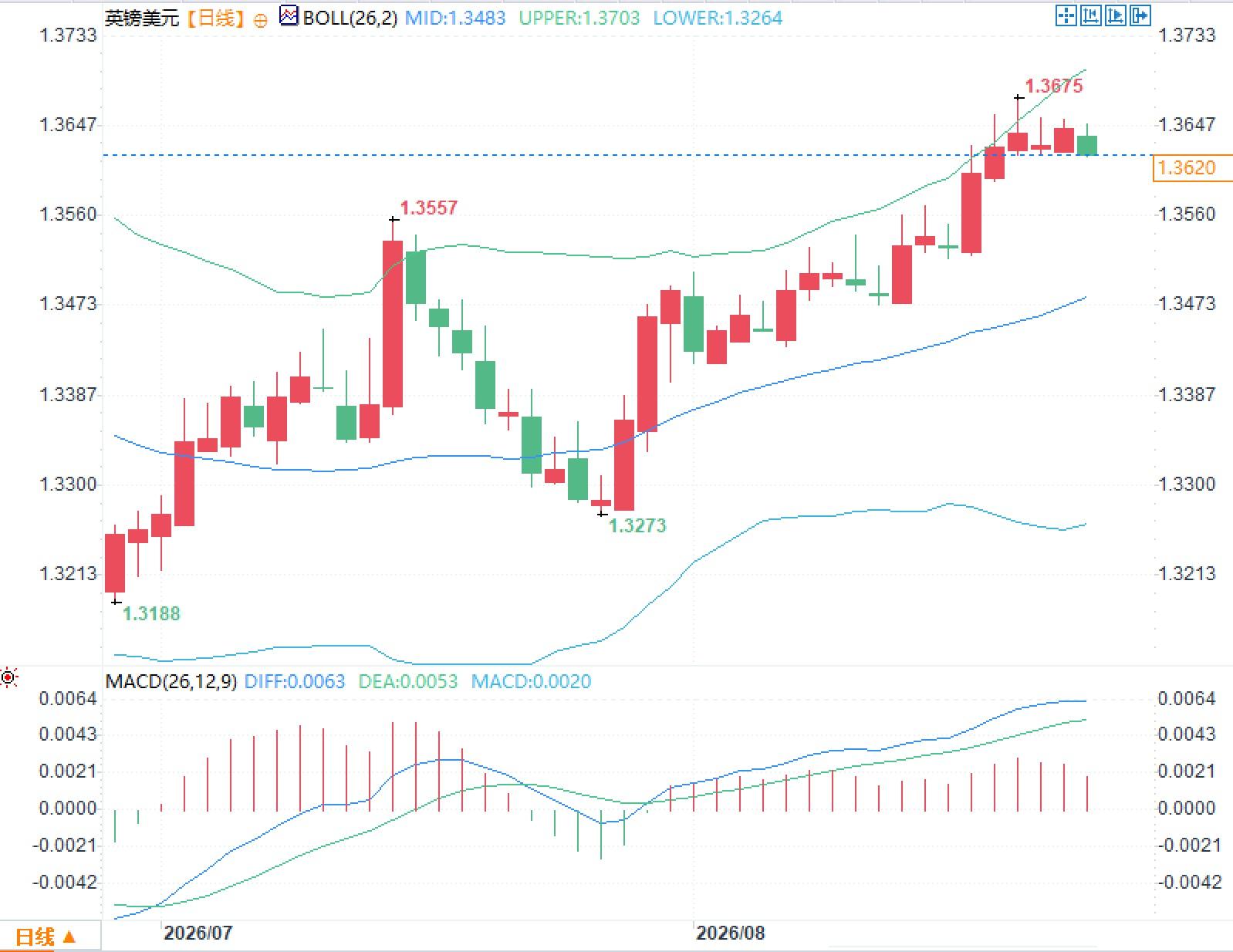
More importantly, while retailers reported weak demand, they also indicated that sales prices were rising at a faster pace and anticipated further price pressures in the coming months. This suggests a typical profit margin squeeze environment is forming on the consumer side: end-user demand is under pressure, but wages, energy, financing, and other operating costs have not declined in tandem. For macro pricing, this is more complex than a simple decline in sales, because weak demand typically lowers interest rate expectations, while price stickiness limits the scope for monetary policy shifts. The current macroeconomic environment does not support judging a significant overall economic downturn based solely on retail surveys. The UK's real GDP grew by 0.4% quarter-on-quarter in the second quarter, compared to 0.6% in the first quarter; the services sector grew by 0.5% and construction by 0.3% in the second quarter, while the production sector remained largely flat. June's single-month economic output also grew by 0.3%. The problem is that aggregate growth does not entirely align with the economic environment felt by residents. The Consumer Price Index (CPI) rose to 2.9% year-on-year in July, up from 2.6% in June; the index including housing costs rose to 3.1%. The year-on-year increase in commodity prices rose from 1.7% to 2.2%, indicating a resurgence of previously relatively mild commodity inflation. The labor market, however, is sending the opposite signal. The unemployment rate was 4.9% from April to June, up 0.2 percentage points year-on-year; job vacancies fell to 707,000 from May to July, a low level since 2014. The preliminary July payroll figure showed a decrease of 94,000 jobs year-on-year. General wages rose 3.5% year-on-year during the same period, while private sector wages grew by only 2.8%. Therefore, the UK market is not currently facing the traditional scenario of strong growth and high inflation, but rather an expanding economy, gradually cooling employment, pressure on consumer businesses, and persistent price stickiness. For the market, this combination is most likely to cause a temporary misalignment between the yield curve and the spot exchange rate. The Bank of England is currently maintaining its policy rate at 3.75%, having decided against it by a 6-3 vote at its July meeting, with 3 members supporting a 0.25 percentage point increase. The Bank of England also noted that changes in energy prices have tilted inflation risks to the upside, but a loose labor market and higher financing costs will continue to restrain inflation. The next policy decision will be announced on September 17th. This explains why the significantly deteriorating retail environment has not immediately changed the recent market structure of the pound. The foreign exchange market prices relative interest rate paths, not single economic indicators. Recent higher-than-expected UK inflation, continued economic growth in the second quarter, and a vote within the Bank of England on tightening policy have supported the pound's short-term interest rate expectations. Meanwhile, US consumer confidence fell to 89.4 in August, and new home sales declined significantly in July, reducing the relative advantage of some macroeconomic data for the dollar. However, the retail survey provides an important constraint. If business sales, hiring, and capital expenditure continue to contract, monetary policy will no longer face just inflation, but rather the simultaneous existence of inflationary resilience and cooling real demand. This means the market is more likely to focus on whether inflation, wages, employment, and consumption data show a consistent direction, rather than reassessing the policy path based on any single indicator. Looking at the GBP/USD daily chart, the price has been steadily rising from the July lows, reaching near the upper Bollinger Band. The middle Bollinger Band is also moving upwards, while the upper band is expanding, indicating a significant increase in the recent center of gravity for volatility. In the MACD indicator, both DIFF and DEA are above the zero axis, reflecting that the previous momentum was still in the positive range. However, the latest histogram has converged from the previous high, indicating that the short-term momentum is becoming more sensitive to changes.
- Risk Warning and Disclaimer
- The market involves risk, and trading may not be suitable for all investors. This article is for reference only and does not constitute personal investment advice, nor does it take into account certain users’ specific investment objectives, financial situation, or other needs. Any investment decisions made based on this information are at your own risk.