The USD/JPY pair consolidated above 159 as US inflation remained sticky and expectations of a Japanese interest rate hike clashed.
2026-08-27 10:05:00
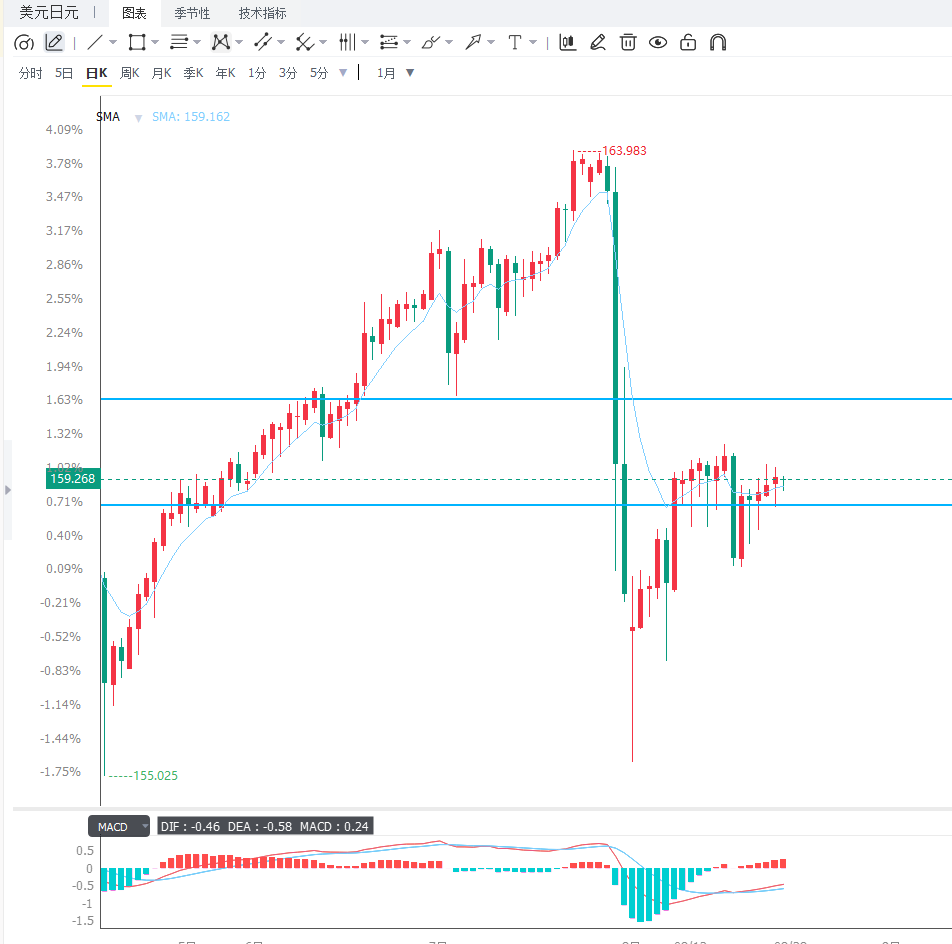
The USD/JPY pair saw profit-taking during Asian trading on Thursday, ending a three-day winning streak and returning above 159 yen. The market is not currently exhibiting a clear bearish trend for USD/JPY, due to the significant interest rate differential between the US and Japan, and the stickiness of US inflation data limiting the dollar's downside. Meanwhile, investors are adjusting their positions in anticipation of new policy signals from the Tokyo Consumer Price Data and the Jackson Hole Economic Symposium.  Recent signs of easing tensions in the Middle East have had different impacts on the safe-haven appeal of the US dollar and the Japanese yen. Market expectations for a ceasefire agreement between the US and Iran have increased, while news of the gradual resumption of commercial shipping in the Strait of Hormuz has reduced the risk of energy supply disruptions. As safe-haven demand has decreased, some of the risk premium previously enjoyed by the US dollar has begun to recede, while the yen has received some support. However, this impact is more reflected in short-term capital flows and is not enough to completely change the fundamental pattern of the USD/JPY pair being driven by interest rate differentials in the long term. US inflation data continues to provide fundamental support for the US dollar. The US personal consumption expenditure price index rose 3.7% year-on-year in July, the same as the growth rate in June, and higher than the market's previous expectation of about 3.6%; core PCE rose 3.3% year-on-year and about 0.2% month-on-month. This means that the inflation indicator preferred by the Federal Reserve is still significantly higher than the long-term target of 2%, and price pressures have not shown a sufficiently significant further cooling. More noteworthy is the significant slowdown in actual consumption growth in July. The combination of "high-level stickiness" in inflation and "cooling demand" in actual consumption presents the Federal Reserve with a more complex policy environment. If inflation continues to exceed the target, the Federal Reserve will find it difficult to quickly shift to an easing stance; however, if consumption and economic activity slow further, continued tightening could increase downward pressure on the economy. Therefore, market assessments of the Fed's next policy path are shifting from solely focusing on inflation data to simultaneously assessing employment, consumption, and financial conditions. The market has already begun to increase its expectations for another Fed rate hike this year. Some market pricing indicates that the probability of a rate hike at the September meeting has risen from about one-third before the PCE data release to about 40%, but there are some discrepancies between different market data sources, suggesting that investors have not yet formed a highly consistent policy expectation. This is why Friday's Jackson Hole meeting is attracting significant attention. Fed Chairman Kevin Warsh will deliver an important speech, and the market hopes to glean clues about the future interest rate path, inflation target, and long-term Treasury yields. Especially given the recent high levels of long-term US Treasury yields, how the Fed assesses inflation stickiness and financial conditions will directly impact the dollar and USD/JPY exchange rates. If Warsh releases stronger hawkish signals, such as emphasizing that inflation remains too high and policy must remain restrictive, or clearly stating that the Fed is prepared to raise rates further if necessary, short-term US yields may continue to rise, and USD/JPY could retest the 160 level. Conversely, if he emphasizes slowing consumption, economic growth risks, and the need for future policy flexibility, the dollar may be suppressed, while the yen could rebound further due to narrowing interest rate differential expectations. For Japan, the core contradiction remains the coexistence of "strengthened interest rate hike expectations" and "fiscal and interest rate differential pressures." Market expectations for further interest rate hikes by the Bank of Japan have intensified, with some institutions even bringing forward their expectations for the next rate hike to September. If the Bank of Japan continues to signal normalization, it will increase the attractiveness of yen-denominated assets and reduce the basis for the USD/JPY to remain high in the long term. However, even if Japanese interest rates are further raised, it may not be enough to completely reverse the USD/JPY interest rate differential structure in the short term. A significant gap remains between US policy rates and Japanese interest rates, and Japan's fiscal situation, government financing needs, and changes in domestic long-term yields will also affect yen valuation. Therefore, the yen has room to rebound, but whether this rebound can translate into a sustained appreciation trend depends on whether the actual pace of the Bank of Japan's interest rate hikes resonates with the magnitude of the decline in US interest rates. From a daily chart perspective, after its previous continuous rise, the USD/JPY encountered significant resistance around 160, and the current pullback is a normal correction after the rise. The area around 159 is the first important area to watch. If the exchange rate can stabilize above 159, the daily bullish structure remains intact. A break above 159.63 would target 160.66 and 162.13. If strong dollar buying re-emerges, the previous high around 163.99 will become a longer-term resistance level. Conversely, if USD/JPY breaks below 159 and further falls below the 158.88-158.60 area, it indicates a significant weakening of short-term upward momentum, and the market may test support around 157.33. Further downside is seen at 155.27. Overall, the daily trend has not yet clearly reversed; it is currently more in a high-level consolidation phase, choosing a direction. Whether USD/JPY can hold 159 will be a crucial indicator of the strength of the short-term trend. On the 4-hour chart, the exchange rate is still trading above the 100-period simple moving average, currently around 158.88, indicating that the medium-to-short-term bullish structure has not been completely broken. The Fibonacci retracement structure shows that the 38.2% level is around 158.60, and the 50% level is around 159.63. Therefore, 159.63 is both a short-term resistance level and an important position to determine whether the bulls have regained the initiative.
  Editor's Summary: USD/JPY is currently in a crucial phase of policy expectation dynamics. The US July PCE year-on-year growth remained at 3.7%, and core PCE remained at 3.3%, indicating that inflation is still well above the Fed's 2% target, providing fundamental support for the dollar. At the same time, rising expectations of a Bank of Japan rate hike and easing Middle East risks have limited further upside potential for USD/JPY. The biggest short-term variable will be the Jackson Hole symposium. If Warsh leans hawkish, USD/JPY may retest 160 or even higher; if it releases dovish signals, a break below 159 could open up further downside potential.
Recent signs of easing tensions in the Middle East have had different impacts on the safe-haven appeal of the US dollar and the Japanese yen. Market expectations for a ceasefire agreement between the US and Iran have increased, while news of the gradual resumption of commercial shipping in the Strait of Hormuz has reduced the risk of energy supply disruptions. As safe-haven demand has decreased, some of the risk premium previously enjoyed by the US dollar has begun to recede, while the yen has received some support. However, this impact is more reflected in short-term capital flows and is not enough to completely change the fundamental pattern of the USD/JPY pair being driven by interest rate differentials in the long term. US inflation data continues to provide fundamental support for the US dollar. The US personal consumption expenditure price index rose 3.7% year-on-year in July, the same as the growth rate in June, and higher than the market's previous expectation of about 3.6%; core PCE rose 3.3% year-on-year and about 0.2% month-on-month. This means that the inflation indicator preferred by the Federal Reserve is still significantly higher than the long-term target of 2%, and price pressures have not shown a sufficiently significant further cooling. More noteworthy is the significant slowdown in actual consumption growth in July. The combination of "high-level stickiness" in inflation and "cooling demand" in actual consumption presents the Federal Reserve with a more complex policy environment. If inflation continues to exceed the target, the Federal Reserve will find it difficult to quickly shift to an easing stance; however, if consumption and economic activity slow further, continued tightening could increase downward pressure on the economy. Therefore, market assessments of the Fed's next policy path are shifting from solely focusing on inflation data to simultaneously assessing employment, consumption, and financial conditions. The market has already begun to increase its expectations for another Fed rate hike this year. Some market pricing indicates that the probability of a rate hike at the September meeting has risen from about one-third before the PCE data release to about 40%, but there are some discrepancies between different market data sources, suggesting that investors have not yet formed a highly consistent policy expectation. This is why Friday's Jackson Hole meeting is attracting significant attention. Fed Chairman Kevin Warsh will deliver an important speech, and the market hopes to glean clues about the future interest rate path, inflation target, and long-term Treasury yields. Especially given the recent high levels of long-term US Treasury yields, how the Fed assesses inflation stickiness and financial conditions will directly impact the dollar and USD/JPY exchange rates. If Warsh releases stronger hawkish signals, such as emphasizing that inflation remains too high and policy must remain restrictive, or clearly stating that the Fed is prepared to raise rates further if necessary, short-term US yields may continue to rise, and USD/JPY could retest the 160 level. Conversely, if he emphasizes slowing consumption, economic growth risks, and the need for future policy flexibility, the dollar may be suppressed, while the yen could rebound further due to narrowing interest rate differential expectations. For Japan, the core contradiction remains the coexistence of "strengthened interest rate hike expectations" and "fiscal and interest rate differential pressures." Market expectations for further interest rate hikes by the Bank of Japan have intensified, with some institutions even bringing forward their expectations for the next rate hike to September. If the Bank of Japan continues to signal normalization, it will increase the attractiveness of yen-denominated assets and reduce the basis for the USD/JPY to remain high in the long term. However, even if Japanese interest rates are further raised, it may not be enough to completely reverse the USD/JPY interest rate differential structure in the short term. A significant gap remains between US policy rates and Japanese interest rates, and Japan's fiscal situation, government financing needs, and changes in domestic long-term yields will also affect yen valuation. Therefore, the yen has room to rebound, but whether this rebound can translate into a sustained appreciation trend depends on whether the actual pace of the Bank of Japan's interest rate hikes resonates with the magnitude of the decline in US interest rates. From a daily chart perspective, after its previous continuous rise, the USD/JPY encountered significant resistance around 160, and the current pullback is a normal correction after the rise. The area around 159 is the first important area to watch. If the exchange rate can stabilize above 159, the daily bullish structure remains intact. A break above 159.63 would target 160.66 and 162.13. If strong dollar buying re-emerges, the previous high around 163.99 will become a longer-term resistance level. Conversely, if USD/JPY breaks below 159 and further falls below the 158.88-158.60 area, it indicates a significant weakening of short-term upward momentum, and the market may test support around 157.33. Further downside is seen at 155.27. Overall, the daily trend has not yet clearly reversed; it is currently more in a high-level consolidation phase, choosing a direction. Whether USD/JPY can hold 159 will be a crucial indicator of the strength of the short-term trend. On the 4-hour chart, the exchange rate is still trading above the 100-period simple moving average, currently around 158.88, indicating that the medium-to-short-term bullish structure has not been completely broken. The Fibonacci retracement structure shows that the 38.2% level is around 158.60, and the 50% level is around 159.63. Therefore, 159.63 is both a short-term resistance level and an important position to determine whether the bulls have regained the initiative. Editor's Summary: USD/JPY is currently in a crucial phase of policy expectation dynamics. The US July PCE year-on-year growth remained at 3.7%, and core PCE remained at 3.3%, indicating that inflation is still well above the Fed's 2% target, providing fundamental support for the dollar. At the same time, rising expectations of a Bank of Japan rate hike and easing Middle East risks have limited further upside potential for USD/JPY. The biggest short-term variable will be the Jackson Hole symposium. If Warsh leans hawkish, USD/JPY may retest 160 or even higher; if it releases dovish signals, a break below 159 could open up further downside potential.
- Risk Warning and Disclaimer
- The market involves risk, and trading may not be suitable for all investors. This article is for reference only and does not constitute personal investment advice, nor does it take into account certain users’ specific investment objectives, financial situation, or other needs. Any investment decisions made based on this information are at your own risk.